
The last chapter on beetle collecting deals with special cases of collecting. The word "special" here indicates either a special collection site or a special method used for collection.
Among the special methods of collecting beetles, I have included collecting beetles in anthills, nests and burrows, collecting in the uppermost levels of trees, the peculiarities of collecting on the banks of bodies of water, and collecting beetles in caves and sinkholes, collection of beetles living underground, mass collection of flying beetles using auto-netting, collection of crawling beetles using a vacuum cleaner, collection on carcasses and in vertebrate droppings, and collection in floodplains. Of course, I have not exhausted all existing collection methods. In the pages of the "Lexicon" I try to present mainly the most used collection methods, applied in our latitudes, which do not require expensive instrumentation.
Collection of beetles living underground
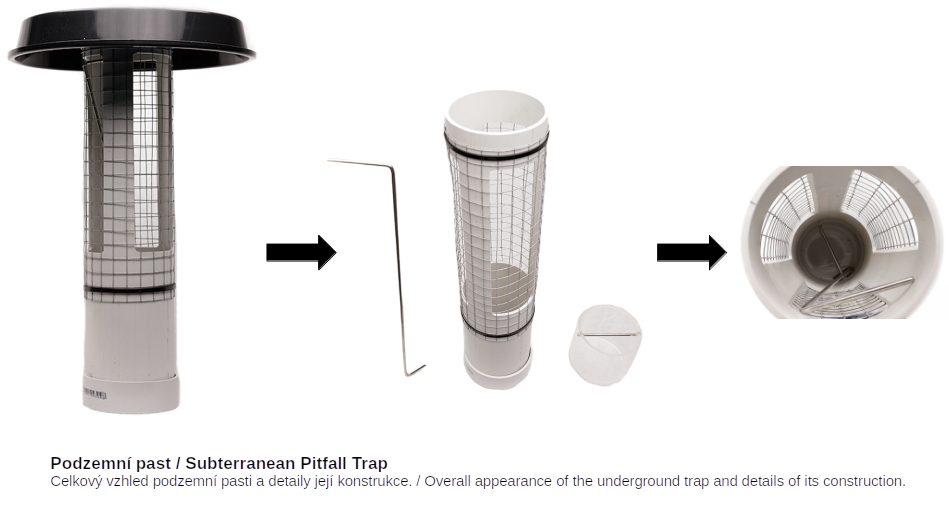 There are many species of beetles that spend most of their lives buried underground. These are mainly representatives of the families Colydiidae, Bothrideridae, Staphyliniae, Histeridae and Carabidae. These "underground" representatives can only rarely be caught, for example, with a sowing machine. When trapping them, it is therefore preferable to use underground traps.
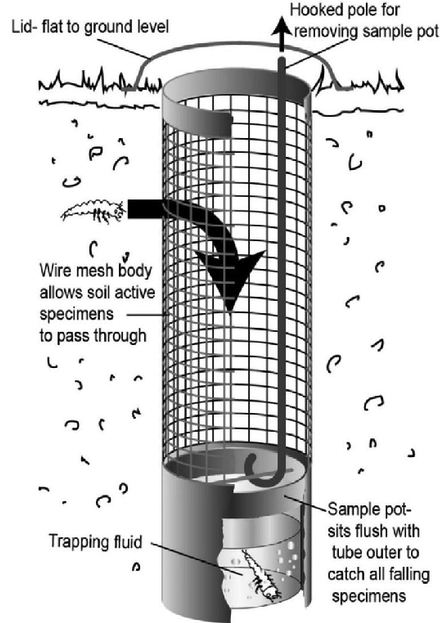
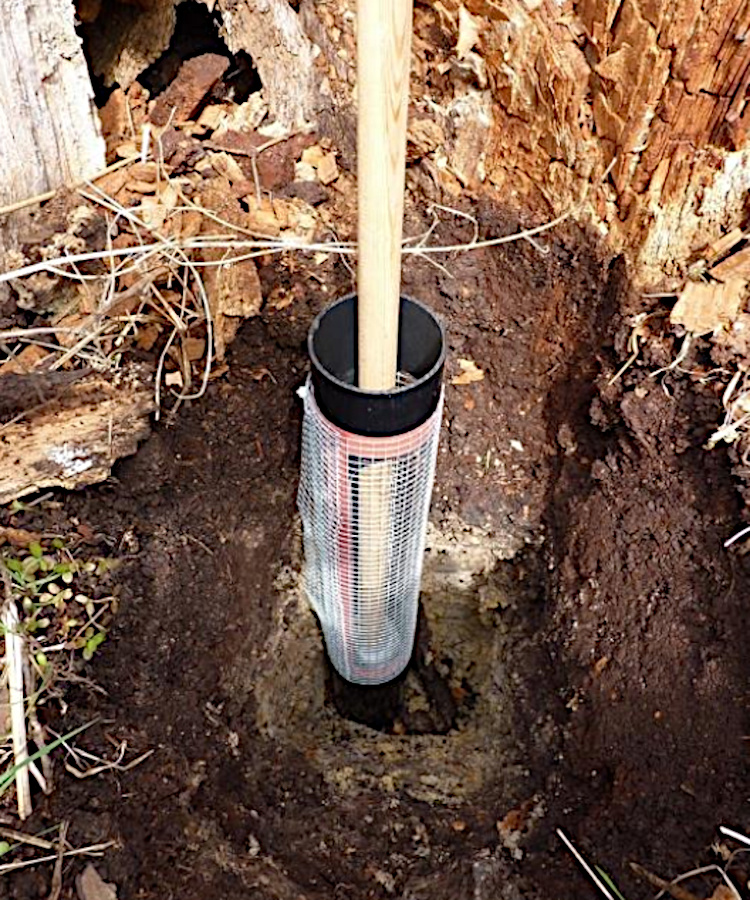
Underground traps are usually set in the ground near decaying logs or in debris. The trap consists of a pipe, usually 30-50 cm long, with variously sized holes in the pipe casing. A sieve with a mesh size of 5 x 5 to 15 x 15 mm is placed on the tube. The pipe is buried vertically in the ground or in rubble. A suitable attractant is placed under the lid of the tube at the top and a container with a fixing fluid is placed at the bottom into which the trapped insects fall. This type of trap can also be operated as a subsistence type. In this case, we omit the fixative fluid at the bottom of the tube and replace it with some sawdust, moss or leaves as a possible hiding place for the trapped insects. Bury the traps in a suitable place, e.g. next to a rotting log or in rubble areas.
Collecting beetles in invertebrate nests
A) Ants
Ant nests are home to many species of beetles, which we refer to as myrmecophilic. There are three groups of beetles that live in anthills based on their relationship with ants:
- symphylls are beetles that are somehow useful to ants (they usually produce sweet juices that the ants like, which in turn provide food for the ants)
- synoecta are beetles that are merely suffering guests in anthills (usually feeding on various debris, moulds or excrements and using the anthill as a shelter with a constant temperature and humidity)
- synechterans are beetles that have a hostile relationship with ants (these beetles feed on the ants themselves and their developmental stages)
For ants that live under rocks or in wood, we perform trapping with tweezers and an exhaustor after the rock or wood is removed. We look for beetles among the ants both on the uncovered stone or wood and in the part of the nest that was under the stone or wood. If we encounter ants of the genus Formica, which form typical mounds, try placing a larger flat stone on top of the mound. After some time (2 - 3 hours), turn the stone over and observe if there are any myrmecophilic beetles on the underside.
For forest species of the genus Formica, which make their nests in the form of familiar mounds, we do something else. In season, we note the location of the mounds we want to explore. The actual hunting is then carried out in winter, when the ants are buried deeper in the nest. From the central part of the nest we take a few blades of trouch from a depth of about 30 cm. We then sieve the brood with a sieving sieve and take the sieve home on a white mat or place it in an eclectus. We then adjust the pile so that the ants, burrowed in the lower parts of the anthill, do not freeze.
B) Bees
For honey bees, beetle hunting consists of a regular inspection of the hive by the beekeeper, who is assisted by us, to see if any beetle visitors have settled in the hive. The inspection can be carried out both during the season and after the end of the season, when we help to clean the hive.
We use tweezers and an exhaustor for this activity.
If we come across a nest of wild bees, we follow the same procedure as for wasps and hornets.
C) Wasps and hornets
At the outset, it must be stressed that we only destroy wasp and hornet nests in season if they pose any threat to us or our loved ones. In this case, a specialist company is usually called in to professionally dispose of the nest. In this case, however, we will not be able to find out whether the nest was inhabited by any interesting beetles. If we decide to dispose of the nest ourselves, it is a difficult and dangerous job.
The procedure for destroying a wasp or hornet nest:
1. It is best to dispose of the nest very early in the morning when most of the wasps or hornets are present. You can also do it late in the evening, but wasps are least active until the morning.
2. Allow for the possibility that wasps may attack unexpectedly. A wasp that stings you will also mark you with a pheromone that will prompt the rest of the swarm to attack. Dress well, seal your trousers and sleeves so that wasps can't get into them. Gloves, a well-covered neck, a covered head and face, and tight-fitting goggles to keep the wasps out are important.
3. Use an effective spray against wasp nests. Duracid Vespe or Antivespe Kollant spray is recommended. Handle the nest for up to 24 hours after the treatment to be on the safe side.
CAUTION: Nests in the ground usually contain more than one entrance.
An easier alternative is to wait until the nest is empty - wasps and hornets both die at the end of the year, only the queen survives the winter. For wasps and hornets, the period of activity is from early April to early November.
Collection of beetles in nests and burrows of vertebrates
Interesting species of beetles are found in the nests of various mammals. For example, many species of the families Dermestidae, Histeridae, Leiodidae, Ptinidae and Staphylinidae can be found here.
Among mammals we usually explore burrows and nests of moles, mice, gophers, hamsters, rabbits, marmots, badgers or foxes. For example, if we find a mole's nest, we remove the top of the soil and collect the contents of the nest (the mole has long since fled) for sifting. And how do we recognise a mole's nest? We take a long, sturdy stick and use it to gradually walk around the molehills. If the stick suddenly goes slightly into the ground, we have found a mole's nest. It takes a little practice at first, but soon we will be able to find the mole's nest quite quickly.
For larger burrows, we use a specially adapted scoop on a longer handle to carefully remove parts of the passage. We take particular care with larger vertebrates such as fox or badger. They can even bite their intruder if threatened.
Another way to trap beetles from burrows and nests is to set traps at the entrance to the burrow. Prepare clumps of moss and grass and wrap pieces of meat in them. Then place the clumps at the entrance to the burrow and weight them down with stones or partially cover them with earth. After a few days, we sift these baits on a sieve.
Interesting beetles can also be found in the nests of some birds, such as pigeons, doves, shorebirds, but also various birds of prey. The contents of the nests are simply sifted on a sieve. In this way, we can catch, for example, representatives of raptors or carrion birds. We do not destroy the nests we find, we sift their contents and return them to their original place. We check the nests of raptors in cooperation with ornithologists. Interesting findings can be made, for example, during checks of bird boxes. Most of the beetles found in bird nests are very small. An exception is the Tenebrio molitor, which likes to inhabit large flat nests of storks.
Collecting beetles from high tree floors
The collection of beetles from high treetops is usually the preserve of tropical areas. It is not so common in our latitudes.
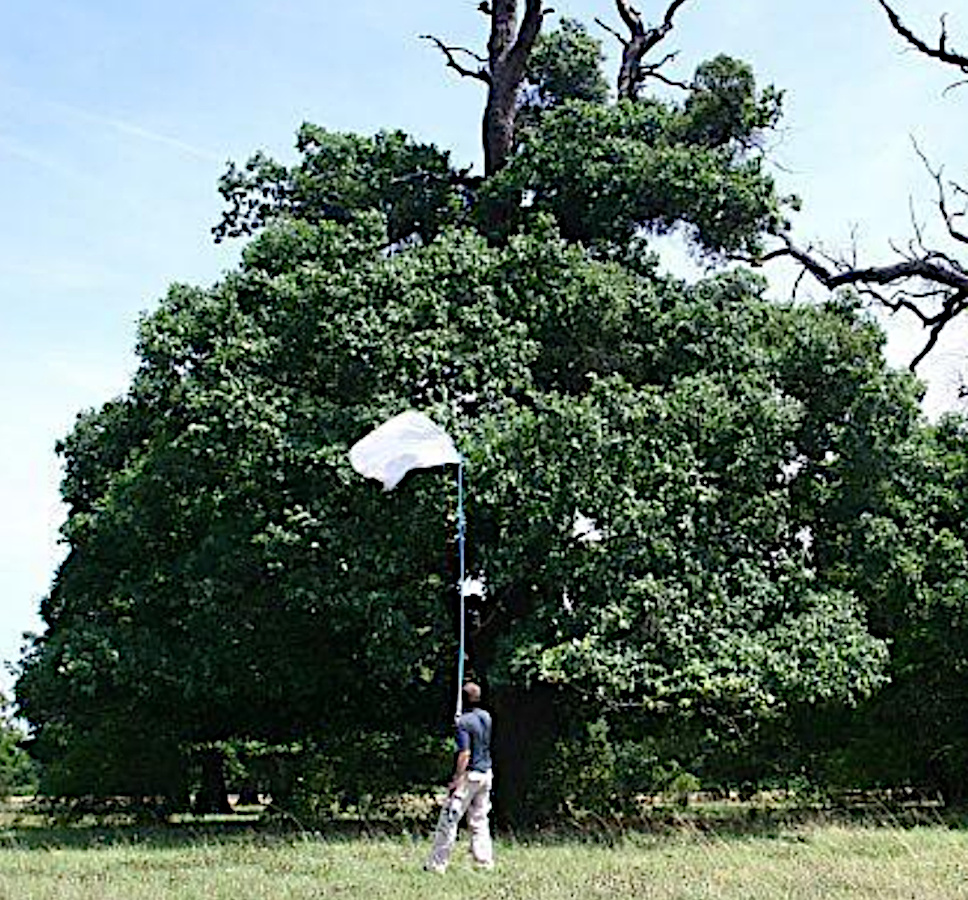
For collecting beetles flying in the higher levels of trees, we can use a classic fly net on a sufficiently long handle, which is usually 8-10 m long. However, working with such a long sweep net is quite difficult.
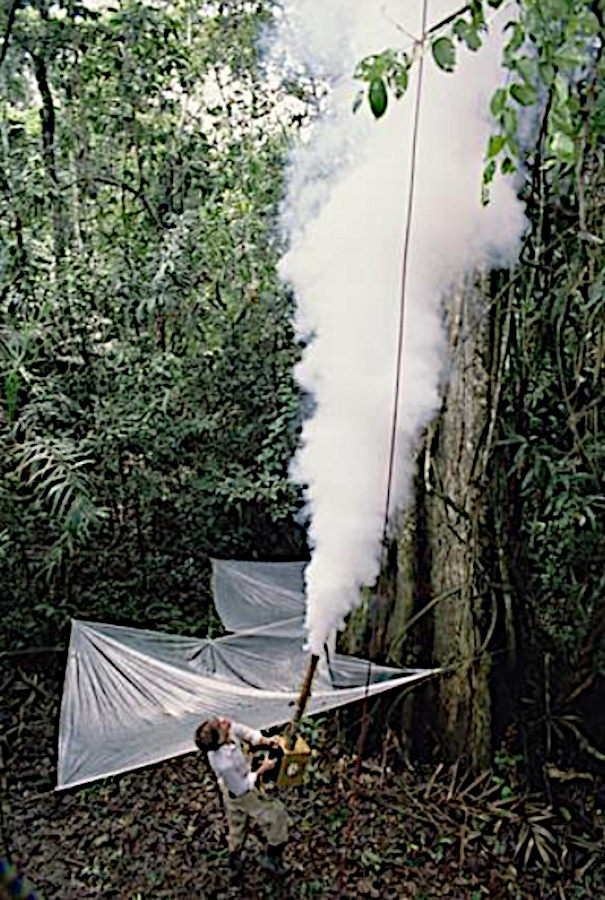
Another method of catching beetles from the upper floors of trees consists of spreading large sails around a group of trees and applying a fumigant (insecticide) to the crowns of these trees. The fumigant is either shot into the tree canopy and sprayed there or released using a special sprayer. It is then left for some time and the fallen individuals are collected from the underlying canvas.
Collection of beetles on the banks of water bodies
The banks of rivers, lakes and ponds form another habitat in which beetle catching can be carried out. If the bank is sandy or muddy and wet, 'bank trampling' methods can be used. The method consists of gradually treading the bank, moving only very slowly in one direction. The weight of the body pushes the air out of the underground passages and forces the bugs hidden in these passages to the surface. There we then use tweezers and an exhaustor to catch them.
The second method is to hunt on rocky or otherwise hard or dry banks. Using a container, we pour water over such banks and again wait for the water to drive the bugs to the surface. There again use tweezers and an exhaustor to catch them.
This second method can be improved by using a water net. On the shore, drive two boards or general boards (e.g. sheet metal) into the ground so that they form a sort of funnel towards the water. Place a water net at the mouth of the funnel. Now start to water the bank so that the water flows through the funnel towards the water surface. The bugs that have washed up will be trapped in the water net.
Collecting beetles in caves and sinkholes
In these special habitats, we can find a number of wet-loving and dark-loving species that we would otherwise only encounter quite rarely. We pay attention already at the entrance of the cave, where we carefully examine the space under the stones, the invaded wood and the top layers of the soil. Other species can then be found on the walls of the cave itself. In addition to tweezers and an exhaustor, we also use sifting and trapping. We either use conventional earth traps or place bait, wrapped in crumpled paper or canvas, on damp areas of the cave. After a few days we pick up the bait and trap the bugs or sift the (meat) bait in a sifter. Smelly meat, cheese or human faeces serve well as bait. In caves where bats reside, we also sift out part of their guano, including the layer of soil underneath.
If we get into a sinkhole, it is a good idea to cut down the vegetation on the walls or even on the bottom of the sinkhole.
In conclusion, it should be said that the Czech Republic does not typically have cave beetles. You can find beetles that specialise exclusively in cave life, for example in the southern parts of Europe (Balkan Peninsula, Greece, southern France).
Collecting flying beetles using an auto-network
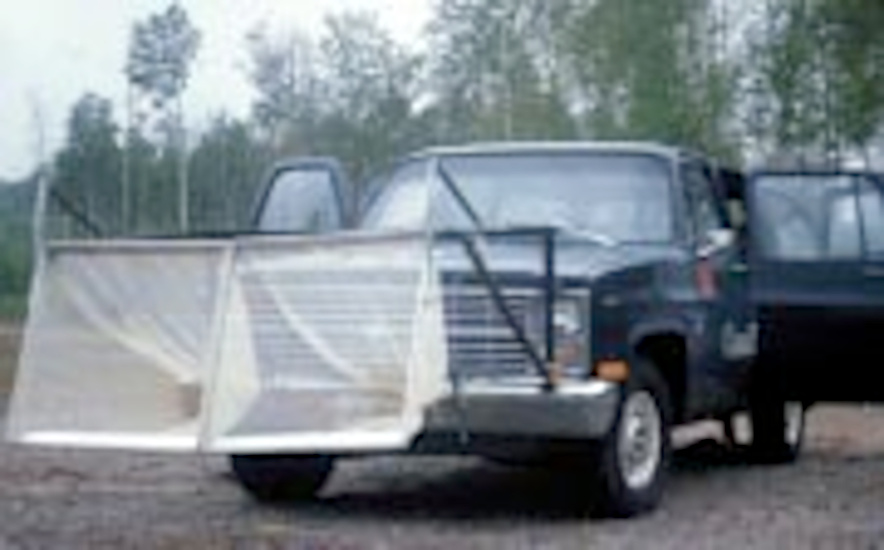
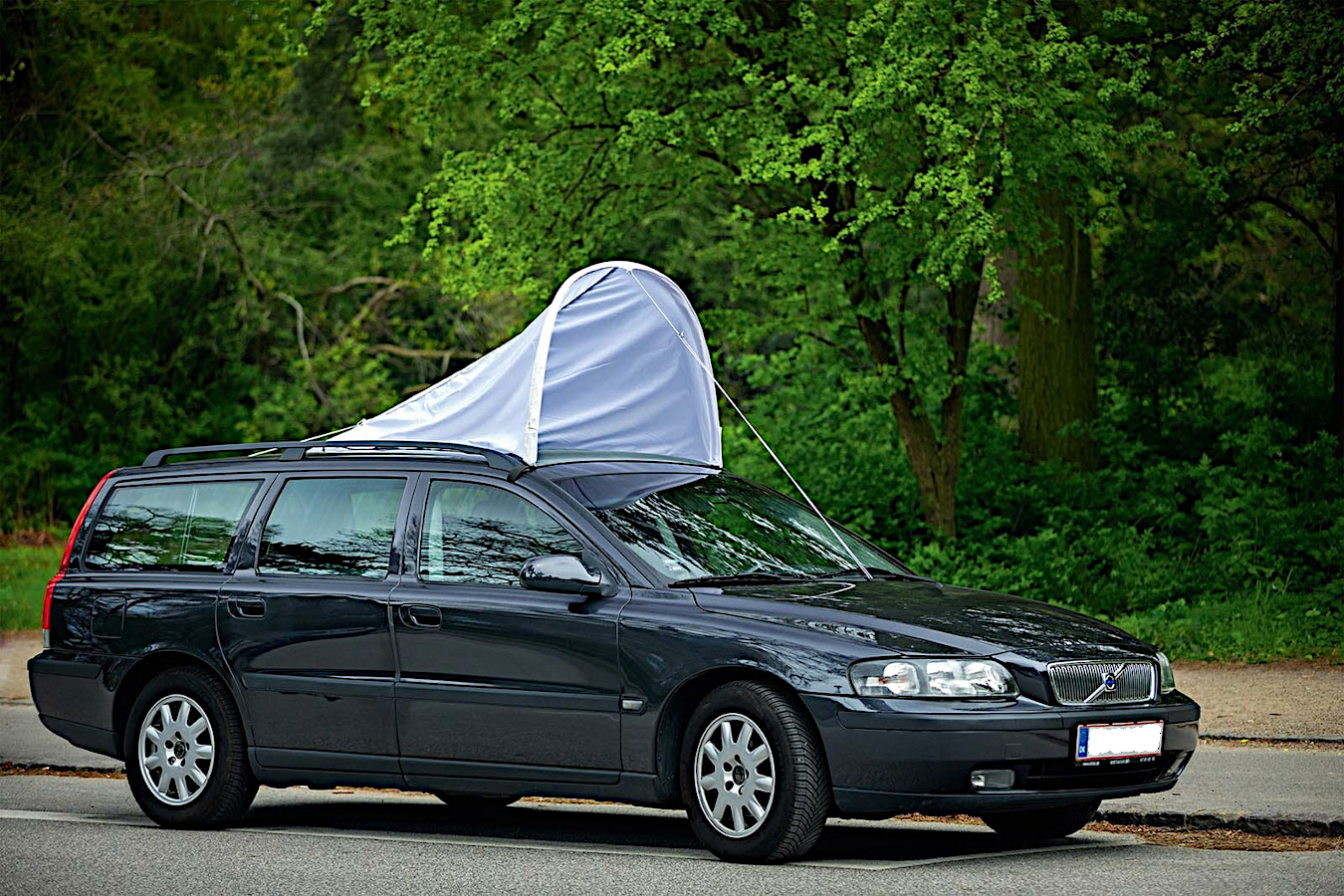
This way we can collect beetles in a slow moving car on which a frame with a large fly net is placed. The frame is placed either on the front of the car or on its roof. Such collection can be carried out off the public road.
Collection of crawling beetles using a vacuum cleaner (suction sampling)
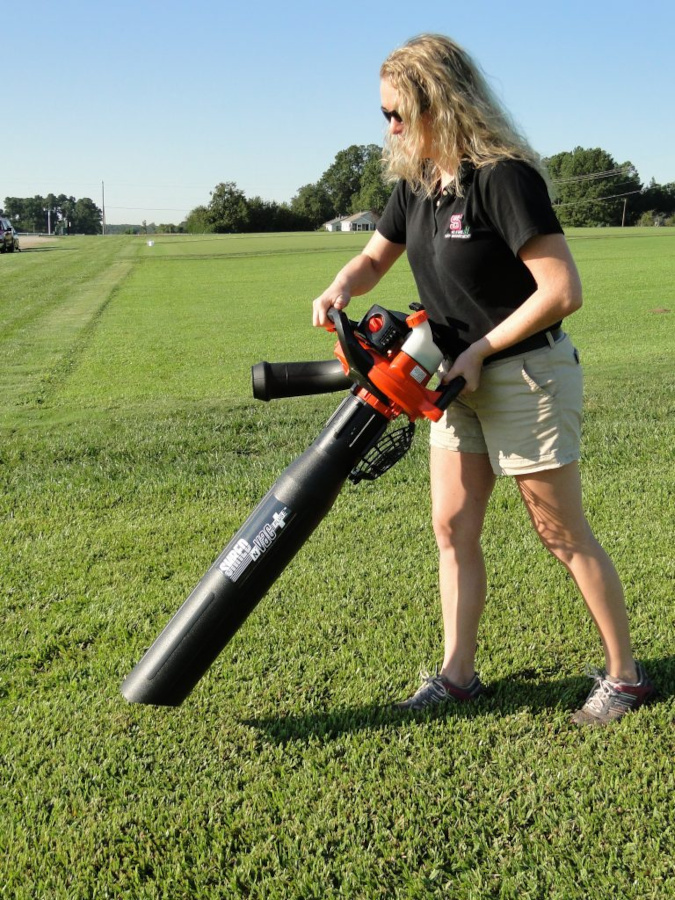
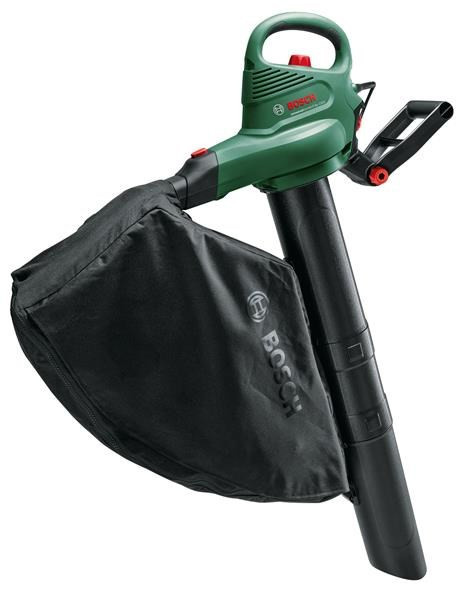
The use of modified garden vacuum cleaners (vacuum traps, aspirators) is suitable for relative assessment of insects from dry and low vegetation (up to 15 cm) or soil. The airflow is produced by a hand-held 'vacuum cleaner'. When applied, it is sucked from top to bottom, with very little horizontal trapping. Even when used correctly, the efficiency is only 50% and only around 10% for large beetles. The use of a small vacuum cleaner is also suitable for rodent nests and flowers. The material from the vacuum cleaner is processed by hand washing or by using an eclecting machine.
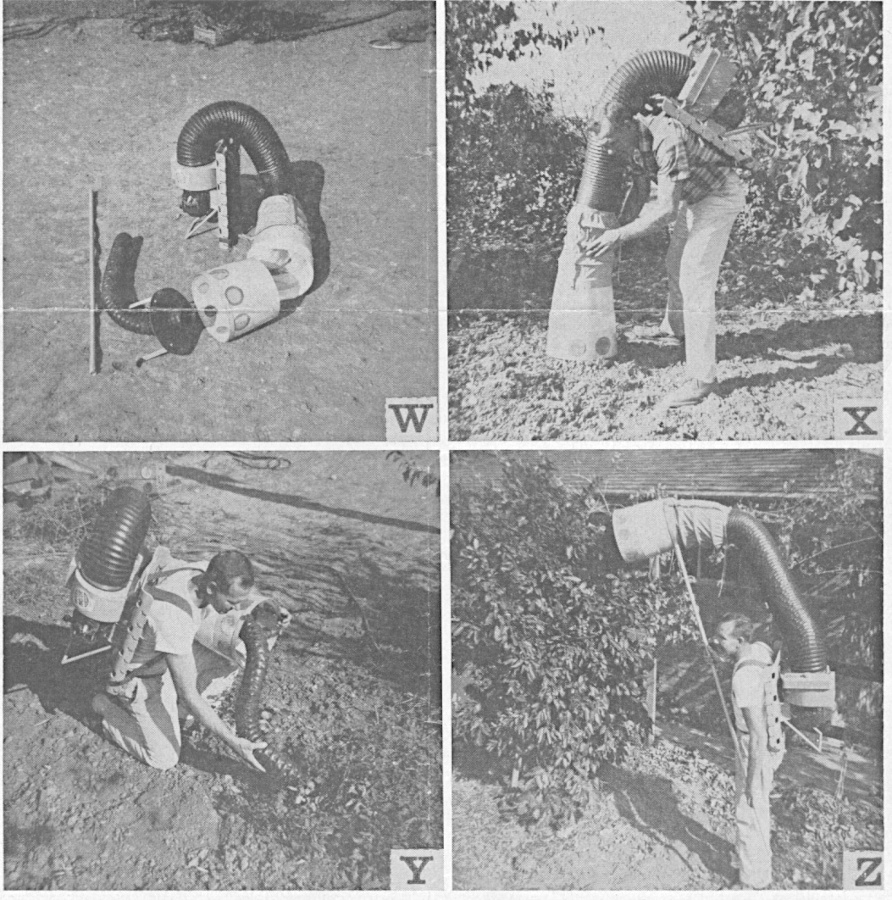
The vacuum cleaner used for collecting crawling beetles is nowadays usually a modified garden leaf vacuum cleaner. The modification consists mainly in removing the device for crushing the sucked material and adjusting the size of the suction tube.
The figure shows examples of a modern garden vacuum cleaner as well as pictures of the original design, published in 1961 (although the first prototype dates from 1959) - Dietrick, E.J. (1961) An improved backpack motor fan for suction sampling of insect populations. Journal of Economic Entomology, 54, 394-395.
Collection of beetles on cadavers (necrophagous beetles)
Collecting beetles on carcasses can yield interesting catches for the collector, even if the environment in which the collector is working is not very appealing. The community of beetles found on carcasses changes with the age of the carcass. Different species will be found when the carcass is "fresh" and quite different species will be found on a carcass that consists of only skin and skeleton.
This kind of hunting is either random on the found carcass or for this purpose we set an earth trap, in which we put as an attractant a carcass found in nature (mouse, mole, ...) or a feeding mouse, bought in a specialized shop (used for example for feeding snakes). Always use protective equipment (soft rubber gloves, respirator) when collecting on a found carcass (especially larger ones such as deer or wild boar).
Do the actual collection with tweezers and an extractor, using only a special type of extractor (electric, balloon, blower) for hygiene reasons.
Collection of beetles in vertebrate faeces (coprophagous beetles)
Vertebrate faeces are another interesting environment in which to catch beetles. In our latitudes, this is mainly the droppings of horses, cows, villages, goats, forest animals and, not forgetting human faeces, which are very attractive to many beetles.
Again, this may be accidental hunting, where the necessary droppings are found, for example, on a forest path or in a pasture, or a set ground trap containing droppings as an attractant. The age and moisture of the droppings is very important. Fresh droppings may contain residues of livestock anti-parasitics which are toxic to coprophagous beetle larvae, reducing their diversity and numbers.
The actual collection is carried out with tweezers and an extractor, and for hygiene reasons only use a special type of extractor (electric, balloon, blowing). In order to find all the 'burrowed' beetles, sometimes it is impossible to avoid crushing the droppings with the hands. Therefore, use soft rubber gloves or wash your hands thoroughly after collecting.
When collecting, it is advisable to dig under the found droppings with a spade and transfer the soil layer and the droppings to a plastic sheet. This will also help you get bugs that have started to build tunnels under the droppings. It is best to transfer the cow droppings into a larger bucket that you pour water over. By washing the droppings, the beetles will float to the surface, from which you can then collect them with tweezers.
Collecting beetles in floodplains
Collecting in floodplains is most often done in early spring, when the snow is melting and river levels are rising. the "big water" takes with it humus, debris, twig and larger branch fragments and much other material. With this material the river carries many insects. When the water recedes, the bank is left with an embankment.
We sift out the finer material from the riprap and take the riprap home. At home in the warmth, the insects begin to come to life and emerge. We pick it up with tweezers and an exhauster, just like the millet we brought in. We keep the alluvium for some time, as it often hatches new individuals.
It is important that we label each specimen with the word "alluvium", as the specimens found are not from the place of discovery. Failure to label these specimens in this way would cause confusion in the distribution data.
