
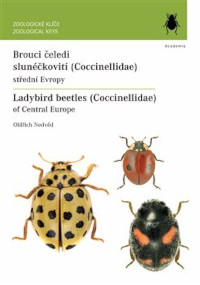
 With an estimated number of over 450,000 described species,the Coleoptera are the largest order of insects and the largest order in the entire animal kingdom in terms of number of species. This incredible diversity - with around 7,000 species occurring in the Czech Republic - places high demands on entomologists and makes determination (i.e. reliable identification of species) a complex but absolutely necessary skill.
Beetle identification is crucial for understanding ecological relationships, biodiversity monitoring, conservation, solving problems in agriculture and forestry (pests) and for applied fields such as forensic entomology. A thorough knowledge of beetle morphology and the methodology of working with determination keys is essential for successful determination.
1. Key morphological characters
The basis for determining each beetle is a detailed study of its body structure. Beetles are easily distinguishable from other insect orders by a characteristic feature: the front pair of wings is transformed into hard, heavily chitin-reinforced trusses (elytra). The trusses serve as a strong protective cover for the blanched hind wings and much of the rump. The study of specific markings on different parts of the body is the mainstay of determination.
1.1 Body proportions and surface
On first sight, the general body shape (e.g. elongated in carpenters, flat in dwarfs, oval in swifts), size and colouration are assessed. It is also necessary to examine the surface texture of the trusses, which is often species-specific - it may be fine or coarse mottling, striations, graining, shagreen (skin-like microstructure) or, conversely, high gloss. These micro-details are usually only visible under a magnifying glass or microscope.
Head and antennae
The head bears essential features. The mouthparts of beetles are usually biting and their shape is adapted to feeding specialization. The antennae are the key identifying organs, and their shape and number of segments are determinant for many families, genera and species. The most common types are thread-like (e.g., in shorebirds), stamens (e.g., in grebes), saw-like (e.g., in carrion beetles), or fan-shaped (e.g., in chromis). In addition, in many species, the shape of the antennae differs between males and females (sexual dimorphism).
Thorax and limbs
The thorax is made up of three segments. The prothorax bears a dorsal shield (pronotum), the shape and surface (punctation, keels, margins) of which are another important distinguishing feature. A scutellum is often found between the bases of the scutes.
The limbs (three pairs) are crucial for identification at the family level. It is essential to count the number of foot links (tarsomeres) on each pair of feet (the so-called tarsal formula or tarsal formula). The most common formulas are 5-5-5, 5-5-4 or 4-4-4. In some species, males have enlarged forefoot links fitted with attachment quills, a feature that helps distinguish the sexes and often the species themselves.
Sexual organs
In a large number of taxonomically difficult genera and species, the external morphology is so variable or identical that reliable determination is not possible without examination of secondary sexual characters and copulatory organs. In males, the aedeagus (external sexual organ) is examined, the shape, sclerotized parts and size of which are species-specific. Microscopic preparation of the genitalia is often necessary for certain determination, which requires careful removal of the organs from the end of the hindgut, usually after prior softening of the beetle.
For more information regarding beetle morphology, see the Morphology  menu.
menu.
2. Methodology and tools for determination
The process of determination relies on a combination of knowledge of morphology, the use of specialised tools and the study of relevant literature.
2.1 Determination keys and literature
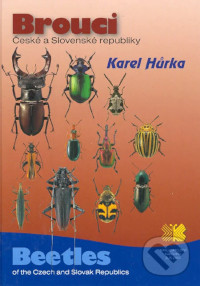 The main tool is the determination key, which is most often constructed as a dichotomous key. This guides the user from general groups (order, family) to more detailed ones (genus, species) by selecting from a pair of contrasting descriptions (e.g., stamens vs. thread-like antennae). Keys are specific to different geographic areas and taxonomic levels (e.g., key for families, key for species in genus X). The entomologist must be able to accurately interpret the terms and symbols used in the key.
Keys should always be completed:
- atlases and pictorial publications to provide visual verification of the determination,
- faunistic and taxonomic revisions of the group.
2.2 Equipment
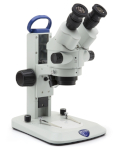 Basic technical equipment is essential for working with keys:
- Binocular magnifier (stereomicroscope): allows observation of the specimen at magnifications of 10× to 100× in a three-dimensional image. It is absolutely essential for the study of small morphological features on the surface of the body and limbs.
- Preparation needles and tweezers.
- Scale (ocular micrometer): For accurate measurement of body dimensions and individual parts (e.g. antennae length).
2.3 Contextual data
Accurate identification of the beetle does not stop at morphology. To confirm the identity, contextual data from the collection site must also be taken into account:
- Location and habitat: e.g. the species is only known from sand dunes, mountain peat bogs, or oak bark.
- Date of collection: It helps to distinguish species with different phenology (period of activity).
- Ecological data: food (e.g. found on a particular plant), stage (adult, larva), activity (diurnal/ nocturnal).
For further information regarding determination keys and equipment, I recommend visiting the Determination and Organization of the Collection section under the Topics ⟶ Collection menu.
3. Significance and modern challenges
Reliable beetle determination is a fundamental building block of entomology. Only correctly determined species are of scientific value in museum collections and ecological studies. An error in determination can lead to misleading scientific results. In modern entomology, determination is increasingly being extended to molecular methods. DNA barcoding allows rapid and accurate identification, especially of larvae or body fragments, and helps to resolve controversial cases where the external morphology appears identical (so-called cryptic species). However, despite the development of molecular techniques, classical morphological determination remains an indispensable skill and a cornerstone of every entomologist's field and laboratory work.
4. Observed characters in determination
For the actual determination, we follow the guidelines of the specific determination key we use. However, there are groups of characters that we focus on very often. These are mainly the following main characters:
4.1 Overall morphology
- Body size (usually given in millimetres)
- Overall shape (elongated, oval, hemispherical, flat, cylindrical)
- Colouration and pattern
- Presence or absence of hairs or scales
- Surface glossiness (metallic, matt, silky gloss)
4.2 Head
- Shape and number of antennal segments
- Size and shape of eyes
- Shape and armament of mandibula
- Presence or absence of extension of the head in the trunk (rostrum)
- Sculpture of the surface of the head
- Ratio of head width to pronotum width
4.3 Thorax
- Shape and sculpture of the pronotum
- Presence and shape of the scutellum
- Tarsal formula (number of foot links)
- Shape and articulation of tibia
- Relative length of tarsus links
- Presence of suckers or extended links
4.4 Elytra
- Sculpture (dotting, striations)
- Termination (rounded, truncated, elongated)
- Presence of keels or bumps
- Colouring and drawing
- Length of trusses (may be shortened as in the helminths)
- Presence and type of hairs
4.5 Abdomen
- Number of visible sternites
- Relative length of first sternite
- Shape of last sternite
- Presence of sculpture or pubic hair
- Size and shape of male genitalia (aedeagus)