
Beetles (order Coleoptera) are the most numerous order of animals on Earth with more than 450,000 described species. The morphological diversity of beetles is enormous and reflects their ecological variability. From tiny species measuring fractions of a millimetre to giant species reaching lengths of over 15 cm, from aquatic to desert species, from predators to specialised phytophagous species, all show specific morphological adaptations that are key to their identification. A thorough understanding of the beetles morphology and knowledge of the relevant terminology is essential for successful beetle identification. Systematic study of morphology and regular work with determination keys gradually leads to the acquisition of a routine that allows faster and more accurate identification. It is important to start with common and easily recognizable species and gradually move on to more problematic groups.
|
Remark: The final subchapter consists of a clear Czech-English-Latin glossary in which, in addition to the translated terms, individual terms are also briefly explained in terms of location and functionality. |
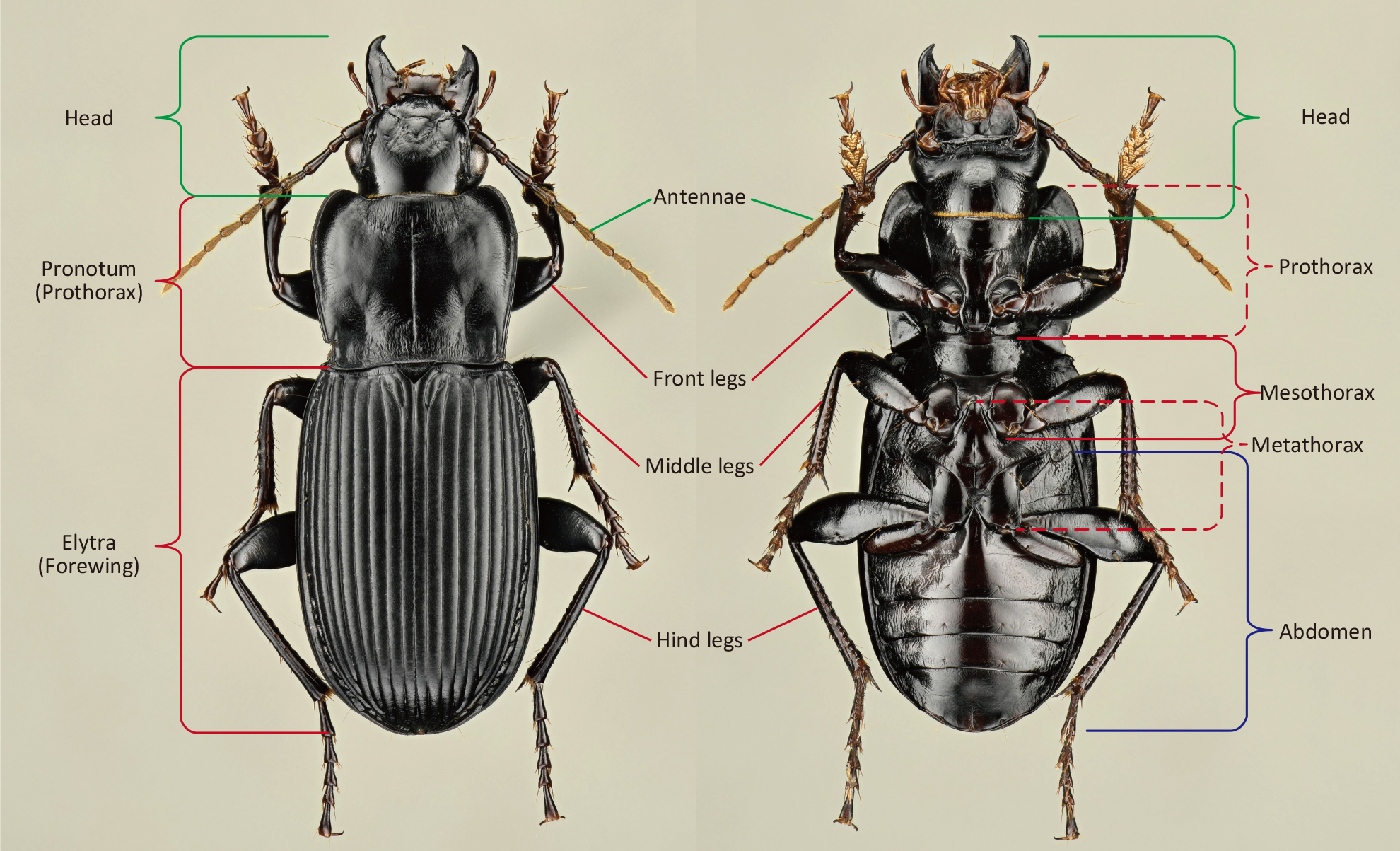
The body of the adult beetle consists of three basic compartments:
- The head (Latin caput) - the first and anterior compartment of the body, bearing the sensory organs and oral appendages.
- Thorax - (Latin thorax) the middle compartment, to which the legs and possibly the wings are attached.
- Abdomen (Latin abdomen) - the posterior compartment containing most of the internal organs, often ending only with the posterior segments.
In beetles, the antennae (antennae) and elytra (elytra) are additionally very important elements - the stiffened forewings that cover the hindwings (membranous) and often the entire rump. For the purposes of determination, it is important to note that the shape, proportion and appearance of these basic parts (e.g., length of pronotum, number of antennal segments, shape of elytra) tend to be characteristic of the genus or family.
Dorsal and ventral views of the main body parts of the beetle
Detailed view of the ventral parts of the beetle
 Legend: (a) mandibles (mandibulae), (b) maxillary palp (palpus maxillaris), (c) labial palp (palpus labialis), (d) gular suture (sutura gularis), (d) hypopharynx (hypopharynx), (e) lamellate club (clava lamellata), (f) scape (scapus), (g) lower lip (labium), (h) gula (gula), (ch) neck, (i) antennal root socket, (j) prosternum (prosternum), (k) coxa (coxa), (l) trochanter (trochanter), (m) femur (femur), (n) tibia (tibia), (n) tarsus (tarsus), (o) tarsal claw (ungues tarsales), (p) onychium (onychium), (q) mesosternum (mesosternum), (r) metasternum (metasternum), (r) epimeron (epimeron), (s) epipleuron (epipleuron), (š) episternum of metathorax (episternum), (t) sternum (sternum), (t) tibial spurs (calcaria tibiae), (u) episternum of prothorax (episternum), (v) episternum of mesathorax (episternum), (x) hind coxa (coxa), (y) trochanter (trochanter), (z) anal sternum (sternum anale), (z) compound eyes (oculi compositi)
Further examples of views of the abdominal parts of beetles in the families Cicindelidae, Dytiscidae and Hydrophylidae:
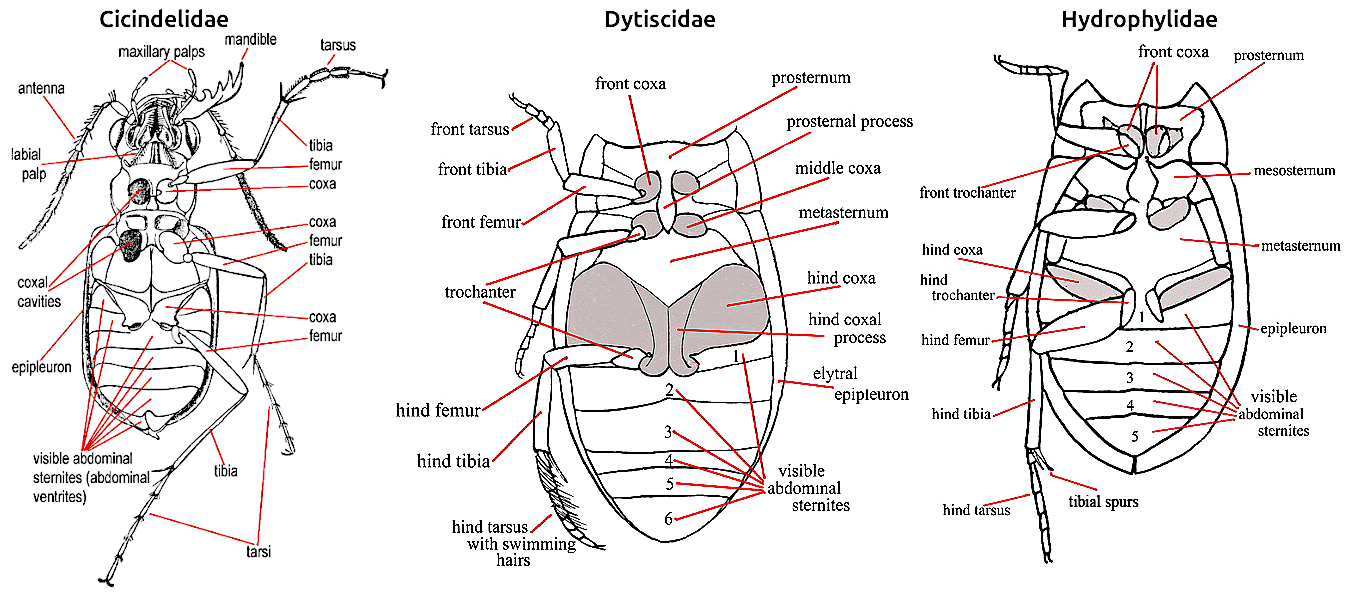
The main concepts relating to the body of the beetle as a whole
| Czech | English | Latin |
| Hlava | Head | Caput |
| Kusadla | Mandibles | Mandibulae |
| Složené oči | Compound eyes | Oculi compositi |
| Tykadla | Antennae | Antenna |
| Hruď | Thorax | Thorax |
| Předohruď | Prothorax | Prothorax |
| Mesathorax | Mesathorax | Mesathorax |
| Metathorax | Metathorax | Metathorax |
| Štít (protonum) | Pronotum | Pronotum |
| Štítek | Scutellum | Scutellum |
| Krovky | Elytra | Elytra |
| Noha | Leg | Crus |
| Kyčel | Coxa | Coxa |
| Stehno | Femur | Femur |
| Holeň | Tibia | Tibia |
| Chodidlo | Tarsus | Tarsus |
| Drápky chodidla | Tarsal claws | Ungues tarsales |
| Zadeček | Abdomen | Abdomen |
| Sklerit | Sclerite | Sclerite |
| Pygidium | Pygidium | Pygidium |
