
3. Abdomen (Abdomen)
The abdomen is the posterior compartment of the beetle body, adjacent to the thorax, and represents a key anatomical region for a number of physiological processes. This part of the body contains most of the digestive, excretory, respiratory and reproductive organs. From the point of view of morphology, the abdomen is very important in taxonomy, as it contains distinctive species and lineage characters, especially in the structure of the tergites, sternites, lateral membranes, genitalia, or the density and distribution of pubic hair.
In many groups of beetles, the shape and function of the abdomen has evolved in relation to ecology - for example, in soil-dwelling species, more segments are often hidden and the membranes are flexible, whereas in surface-running beetles the rump is more rigid and arched. In aquatic species, modifications of the spiracles and hairs to form an air film can often be observed.
Glossary of basic terms relating to the morphology of the beetle's abdomen
| Czech | English | Latin |
| Zadeček | Abdomen | Abdomen |
| Hřbetní ploténka | Tergite / tergum | Tergum |
| Břišní ploténka | Sternit / sternum | Sternum |
| Boční část | Pleura / pleurite | Pleuron |
| Spirakulum (Dýchací otvor) | Spiracles | Spiraculum |
| Pygidium | Pygidium | Pygidium |
| Paramery | Parameres | Paramerae |
| Kladélko | Ovipositor | Ovipositor |
3.1 Sternity and tergites
The abdominal segments (segmenta abdominalia) of beetles usually consist of 10 - 11 segments. In adults, however, only 6-7 tergites and 5 sternites are usually visible, with the posterior segments reduced and hidden under cover plates or integrated into the genitalia.
Each abdominal segment consists of:
- Dorsal plate (tergite) - the dorsal part of the segment, usually hidden under the rafters
- Abdominal plate (sternite) - the ventral part of the segment, visible when viewed from below
- Lateral plates (pleurite) - lateral parts of the segment
The different parts of the segments are rigid but connected by flexible intersegmental membranes (membranae intersegmentales) that allow movement, stretching and participation in respiration. In females, the last few segments may be heavily modified to promote oviposition.
The number of freely visible abdominal sternites and their shape are important for determination. In species with shortened trusses (e.g., staphylinids - Staphylinidae), the last tergites and sternites are freely visible, allowing study of their coloration and shape.
The abdomen is covered by chitinized plates whose shape and structure have important determinant properties. The surface may be:
- Smooth (smooth, laevis)
- Granular (granular, granulatus)
- Striated (striated, striatulus)
- Hairy (setose, setosus)
The setae (setae) may be short, long, clinging or protruding, sometimes scaly. Its density and orientation tends to be taxonomically valuable (e.g., in Lamellicornia, Curculionidae). In some groups the abdomen bears trichobothria (vibration and airflow sensors).
3.2 Respiratory system (Systema respiratorium)
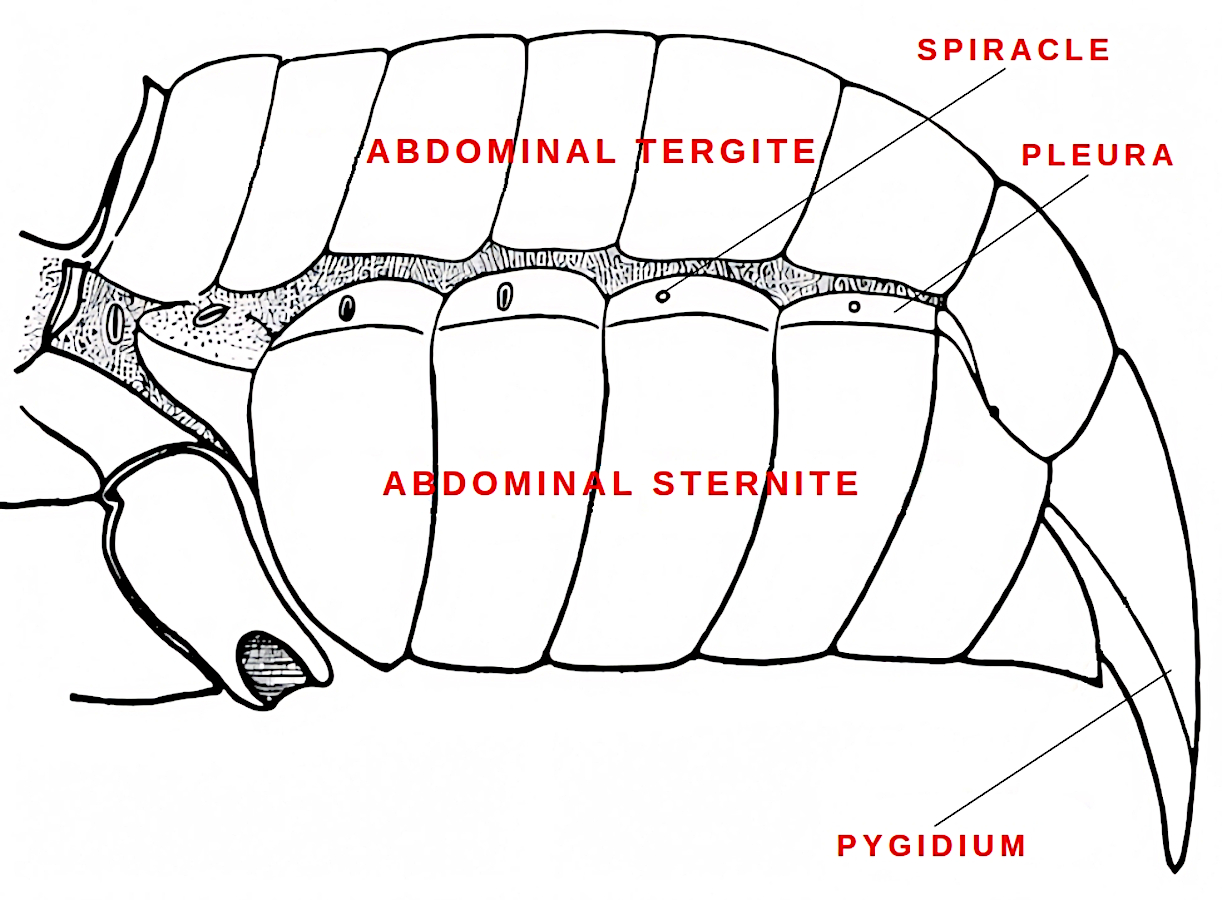
The spiracles (spiracles) are paired openings on the sides of the body that lead to the tracheal system. Each article of the abdomen has a pair of spiracles. Air enters the spiracles and is distributed into increasingly fine tubes (tracheae) throughout the body. The spiracles can be opened and closed by special muscles, which minimizes water loss. Spiracles may also be protected by hairs or tags against mechanical damage and flooding.
The spiracles on the side of the body
3.3 Reproductive system (Genitalia)
In many taxonomically difficult and closely related species, the external morphology is so variable or identical that reliable determination is not possible without examination of the genitalia. This is an unambiguous determinant.
Example of a beetle aedeagus |
Male
The male reproductive apparatus is extremely important for taxonomy because its shape, size and sclerotized parts are strictly species specific. This is especially true for some families such as Carabidae, Staphylinidae or Curculionidae. The main parts of the male reproductive organ are:
- Aedeagus (aedeagus)
- Parameres (paramerae)
- Endophallus (endophallus), often turning during copulation
Female
Female possesses structures for oviposition and egg storage:
- Ovipositor (ovipositorium), may be needle-like, hidden or reduced
- Spermatheca (spermatheca), sperm reservoir with chitinous capsule
Differences in the structure of the spermatheca and ovipositor are of diagnostic importance, especially in small families.
For the study of the genitalia, microscopic preparation (removal of organs from the end of the hindgut after prior softening of the whole individual, e.g. in potassium hydroxide solution) is necessary.
Pygidium
Pygidium (pygidium) is the last visible tergite. It may be covered by a truss or protrude freely. In many beetles it is an important distinguishing character.
Importance in identifying
- Visibility of the rump - in some families (e.g., Staphylinidae) the trusses are shortened and the rump protrudes prominently.
- Shape and size of pygidium, presence of bulges or grooves - an important character for some groups.
- Number and arrangement of sternites, presence of protuberances or glands may be diagnostic.
- Spiracle (breathing holes) and their position/number are a less common character, but sometimes used.
