
4. Other important morphological structures
4.1 Exoskeleton
Unlike vertebrates, beetles do not have an internal skeleton. Instead, they have an exoskeleton - an external skeleton made of chitin that serves a number of functions: protection, mechanical support, prevention of desiccation (water loss), and as an attachment site for muscles. The exoskeleton is usually heavily sclerotized (hardened).
In beetles, the exoskeleton is particularly well developed - many groups have very thick hardened areas ("sheets") called sclerites, separated by elastic membranes. A typical structure is the elytra (elytra) - transformed forewings that are part of the exoskeleton and serve as protection for the hindwings and body. Research shows that the exoskeleton of beetles is crucial to their evolutionary success - for example, strong hardening may serve to protect them from predators.
Functions that the exoskeleton performs in beetles:
- Protecting the body from mechanical damage (e.g. when moving in rough environments or when attacked)
- Protection from desiccation (cuticle as a barrier)
- Muscle attachment site (for legs, wings, internal muscles)
- Under certain conditions, also aid in keeping air under the wings or in adapting to the environment (e.g. drought)
- Structurally, the exoskeleton is composed of layers: e.g., the insect cuticle (generally) contains an epicuticle, a procuticle, an epidermis, and a basement membrane.
4.2 Surface structures
Surface structure in insects refers to the various textures, reliefs or ornamentations on the cuticle (e.g. grooves, grooves, pits, ridges, spines, scales). In beetles, these structures may be a sculpture of the exoskeleton. Surface structure influences appearance, function (e.g., defense, coloration), and is often an important deterministic trait.
For example, a study in Poecilus lepidus (Carabidae) showed sexual dimorphism in elytral surface structure - males have a nearly smooth, shiny elytra, while females have a scalloped (sculptured) surface. In beetles with metallic or iridiscent luster, surface texture (micro/nano-texture) is often key to producing this effect. For example, variations in surface sculpture, multilaminar structures and refractive index have been identified in some Buprestidae. Thus, surface texture can affect both mechanical properties (e.g., stiffness, light reflection) and visual properties (coloration, gloss).
Beetle body surfaces can exhibit different types of sculpture that are important for determination. Below is a small list of examples of beetle surface structures:
- Smooth (smooth, glabrous, laevis) - without sculpture
- Glossy (shiny, nitidus) - with high gloss
- Matte (dull, mat, opacus) - without gloss
- Finely punctate (finely punctate, subtiliter punctatus)
- Coarsely punctate (coarsely punctate, grosse punctatus)
- Densely punctate (densely punctate, dense punctatus)
- Sparsely punctate (sparsely punctate, sparse punctatus)
- Scabrous (rugose, rugosus) - with irregular wrinkles
- Reticulate (reticulate, reticulatus) - with a reticular structure
- Granular (granulate, granulatus) - covered with small granules
Functions of surface structure in beetles:
- Helps regulate the reflection or absorption of light (leading to effects such as gloss, dullness, iridescence)
- May have a defensive function (e.g. light reflection, surface roughening)
- Helps in taxonomy - surface relief is often a characteristic feature of a species
- May affect adhesion, friction, movement in the environment
The surface of the exoskeleton is covered with tiny hairs, bristles or hair-like formations growing from the surface of the insect cuticle, called setae, which enhance the perception of touch and sound. In beetles, these structures form part of the surface structure of the body - they grow from the surface of the exoskeleton and may be mechanoreceptive, sensory, protective or adhesive.
The seta usually consists of a shaft growing out of the cuticle, sometimes terminating in a specific terminal plate - e.g. in adhesive setae. The shape of the terminal plate can vary: for example, several types have been distinguished in mandelines - pointed, spatulate and discoidal. In some beetles of the adhesive types, the pedicel of the setae is relatively long, terminating in a plate that has tiny nanostructures and uses capillary or van der Waals forces to adhere to the substrate.
Setae can occur on various parts of the body - on the head, chest, legs, but also in special functions (e.g. on tarsi - the feet of beetles, for adhesion to smooth surfaces). In the adhesive cells of the feet (tarsi) of beetles, there is a dense layer of adhesive setae, typically focused on contact with the substrate. For example, in males of some species, special types of setae are found only on certain pairs of legs.
Setae types (examples)
- Pointed setae - simple, tipped setae. Less effective than other types for adhesive functions.
- Spatulate setae - wider terminal part, larger contact area.
- Disc-shaped (discoidal) setae - large terminal plate, sometimes concave centre and higher margin, allowing the formation of a capillary layer for better adhesion.
- Other variations may be branched, filamentous, setae - different morphological variants of setae in Arthropoda in general have been described in the literature.
Example of different setae shapes

Function of setae within the surface structure of the beetle body:
- Sensory function
Some setae serve as mechanoreceptors (sensing air movement, touch) or as chemoreceptors (sensing odors). Although the detailed function of a particular seta is often less well described in beetles, the possibility exists in general. - Adhesive / grasping function
Particularly in beetle legs - adhesive setae allow adhesion to smooth or plant surfaces, which is aided by the shape of the terminal plates and the presence of fluid between the plate and the substrate. - Protective and mechanical function
Setae can increase surface roughness, which may make it more difficult for predators to grasp, or assist movement through the environment (e.g. in soil, amongst leaves). They may also protect the front of the body or the rump. - Aesthetic / taxonomic function
The occurrence, density, shape, and orientation of setae is an important feature for identifying species or genera in many beetles. Thus, the superficial structure of the body, including the setae, forms part of the morphological character. - Interaction with colouration and surface texture
Setae can affect how light is reflected from the surface, and can partially hide or alter the appearance of the cuticle, thus affecting the visual effect (gloss, dullness) and colouration in terms of taxa.
When describing the morphology of a beetle, the presence/absence of setae, their length, colour, density and arrangement - particularly on the scutellum, head and posterior. Thus, it is important for taxonomy and morphology to note whether the setae are fine or robust, simple or complex (branching), and how they relate to the overall surface structure of the body.
4.3 Colouration
Colouration in beetles refers to the colours and patterns on the body surface (skin / elytra), which can be produced by two basic mechanisms:
- Pigmentary coloration - dyes in or under the cuticle (e.g., melanins, pteridins, flavonoids, and carotenoids), with melanins inducing brown, gray, and black colors, pteridins inducing yellow, orange, red, and white colors, and flavonoids and carotenoids inducing yellow to red colors;
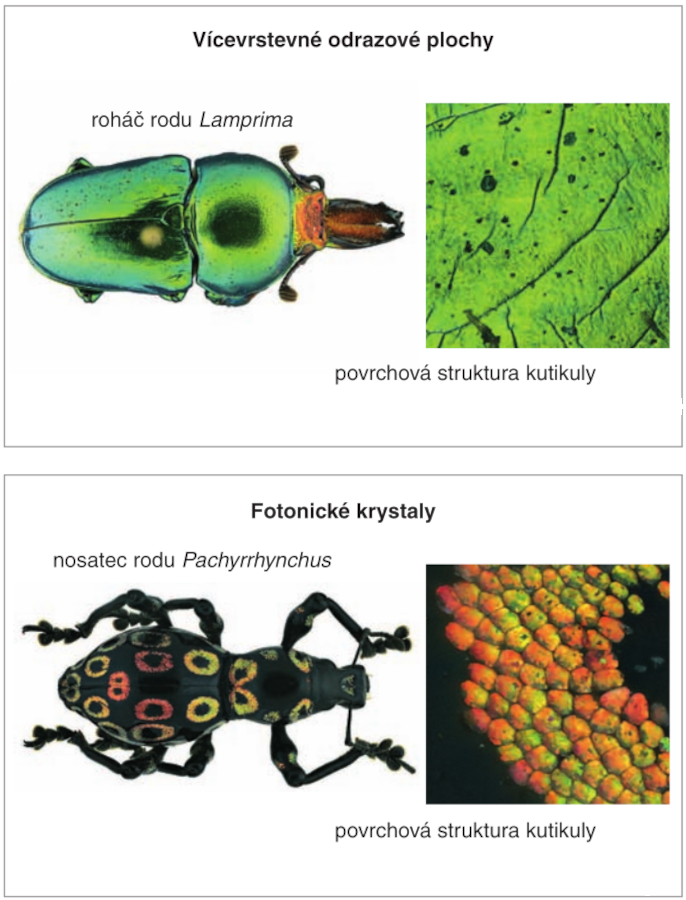
- Structural staining - colour induced by micro/nanostructure of the surface (interference, diffraction, scattering). For example, interference phenomena caused by microstructures on the surface of the body lead to metallic and iridescent colors.
Many beetles have brilliant metallic or iridescent colors, which in a large proportion are due to structural coloration. Colour performs various biological functions such as camouflage, warning colouration (aposematism), mimicry, communication between individuals, temperature or water regulation. Coloration is linked to surface texture - i.e., the texture and sculpture of the cuticle can influence how the color looks (matte vs. glossy) and what optical effects are produced.
The main functions that coloration performs in beetles:
- Camouflage - color and patterns help beetles blend into their environment or confuse predators.
- Warning colouration/aposematism- bright colours signal annoyance or poisonousness.
- Sexual and interspecies communication - coloration can signal sex or readiness to breed.
- Temperature/water regulation - light vs dark color, shiny surface or matte surface may affect sunlight absorption or water evaporation.
- Induce optical effects - gloss, metallic appearance, changing colour with viewing angle (iridescence) due to structural effects.
Examples of structural (Fig. A,B,C) and pigmented (Fig. D) colouring
 |
| A |
 |
| B |
 |
| C |
 |
| D |
5. Conclusion
Beetle identification is a process that begins with a rough orientation based on overall appearance and continues with microscopic study of individual details. The entomologist proceeds from general characters (antennae shape, tarsal formula - family identification) to detailed and subtle characters (elytra punctation, protonum proportions, aedeagus shape - species identification) usually using dichotomous keys. Mastery of morphology, its terminology, and precise work with binocular magnification are absolutely essential for this activity. Every character - from the shape of the forehead to the number of tarsomeres - plays an important role in placing the beetle in the correct taxonomic category, which is the basis of any further scientific, ecological or applied research.
