
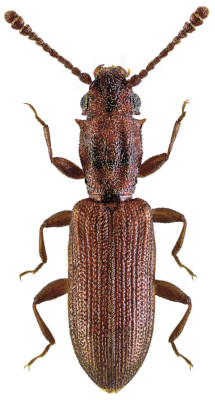
Welcome to the website of the project "Lexikon of Beetles of the Czech Republic". The Lexicon provides useful information both for those interested in nature from among the general public, as well as for amateur entomologists or professional workers from museums, the academic community, nature conservation organizations and others.
Its main goal is to provide comprehensive information about beetles recorded in the territory of the Czech Republic. In addition, it tries to help amateur entomologists in their orientation in the tools and methods used for collecting, preparing and creating an entomological collection. An integral part of the Lexicon is also a glossary of terms, which helps in orientation in the many technical terms used in this field.
Lexikon also has a news section, which provides current information from monitored sources. Together with notifications of upcoming events, this makes Lexikon a dynamic project where you will always find something new whenever you visit it.
History of the project
The "Lexikon beetles of the Czech Republic" project was born in 2020, when I returned to my old hobby - entomology - after about 37 years. So I started looking for information on the internet to find out as much data as possible that I could use.
While searching the Internet, I was surprised to find that I could not find any website that would collect comprehensive information about beetles living in the Czech Republic. I found only relatively comprehensive websites about Czech longhorn beetles or click beetles. There are also websites that provide partial information about the occurrence of beetles in a certain area, or the AOPK find database, or the very interesting Biolib project. For example, Germany or Poland have such websites, although the German website contains photos of only 1/3 of Germany's beetles. In addition, these foreign websites contain more discovery data and provide very little information about the bionomy of individual species. The website from Great Britain was more cooperative in this regard, but unfortunately it stopped working in 2024 due to technical problems.
Based on these facts, I decided to try to offer such a website with comprehensive information about the beetles of the Czech Republic. I gradually thought about the content and structure of the website. In the fall of 2023, I started my own implementation. I have spent almost my entire professional life searching for and analyzing information, and I use this experience in the preparation of this project as well.
Scope of information
The project "Lexikon of beetles of the Czech Republic" contains the following areas of information:
- overview of methods and tools used for collecting, preparing and creating a collection of beetles;
- information on faunistic squares, used as indicative data on the occurrence of individual species;
- information about bioindicator groups, used as an indicator of the "quality" of the given habitat;
- a glossary of terms and abbreviations used in this field;
- current catalogs and atlases of individual families;
- species cards with a summary description of individual beetle species;
- cards of higher taxonomic groups (from order to family) with summary characteristics of the given taxonomic group;
- pest lists;
- invasive species overview;
- beetle morphology with pictures, supplemented with the appropriate description;
- identifying bugs (this part will only be added in later stages of the project, while I expect to publish both dichotomous and interactive keys);
- news section, providing up-to-date monitored information from the field (priority focus on the order Coleoptera and the Europe area);
- links to interesting resources;
- a library, providing abstracts or full texts of articles, selected journals or books.
License
The entire project is created under the Creative Common BY-NC license. This means that you are free to use the information from this project for non-commercial purposes, provided that you indicate the source from which you took it. More information about the project and how to cite can be found in the imprint  .
.
Figure: Schmidt, 2014