
Block "Introducing"
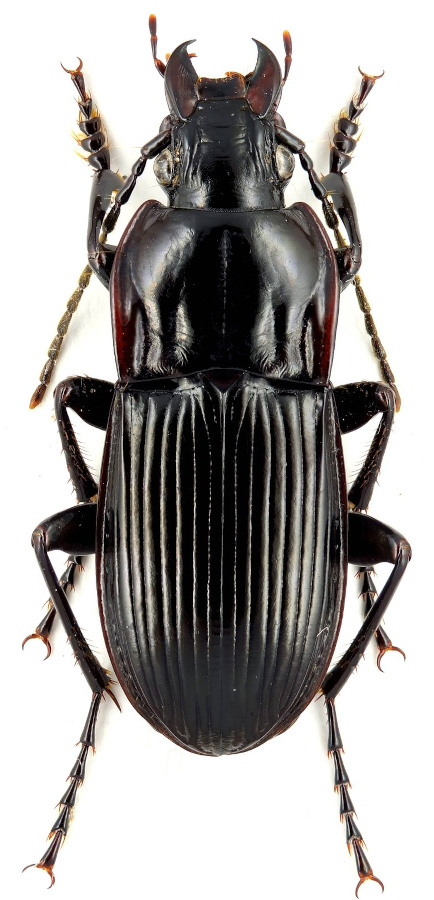
Abax (Abax) parallelepipedus parallelepipedus (Piller & Mitterpacher, 1783)
 Family: Carabidae
Size 15.8 - 20.8 mm. It is all black. The protonum has two longitudinal depressions on each half and one narrow groove runs through the middle of the shield. Males are shiny, females are dull.
Adults are active from April to September. It is brachypterous. It occurs in forests of all types, from lowlands to mountains. It is a common species, widespread throughout the country. It can be found under moss, stones, bark of dead wood or in rotten trunks.
Adults and their larvae feed predatorily on insects and snails. They go hunting both day and night. After laying, females surround their eggs with a layer of soil. Larvae can be found under stones or in wood. Larvae overwinter, sometimes adults too.
Picture source: main: Bleich
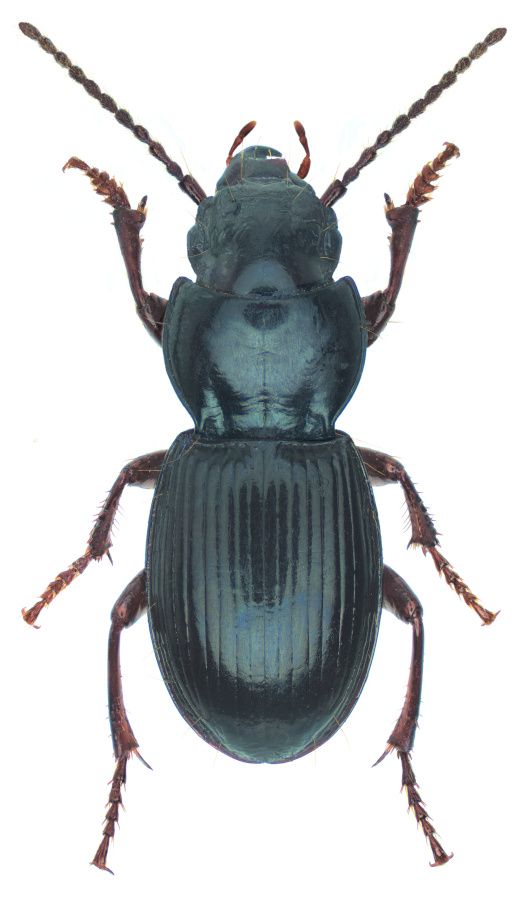
Abax (Molops) piceus piceus (Panzer, 1793)
 Family: Carabidae
Size 10 - 13.4 mm. The body of this species is black to tarry brown, the legs and appendages are brown. The protonum is clearly cut out on the sides in front of the hind horns, the hind horns are large and almost rectangular.
Adults occur from April to September. It is a species of better preserved forest habitats, from lowlands to mountains. It most often stays under stones, logs or in moss. It is brachypterous. Both larvae and adults are predators, hunting invertebrates. It occurs in most of our territory.
This species is known to care for its offspring, which is unique among ground beetles. The female stays around the egg mass and protects them until the larvae hatch.
Picture source: main: Schmidt, 2021
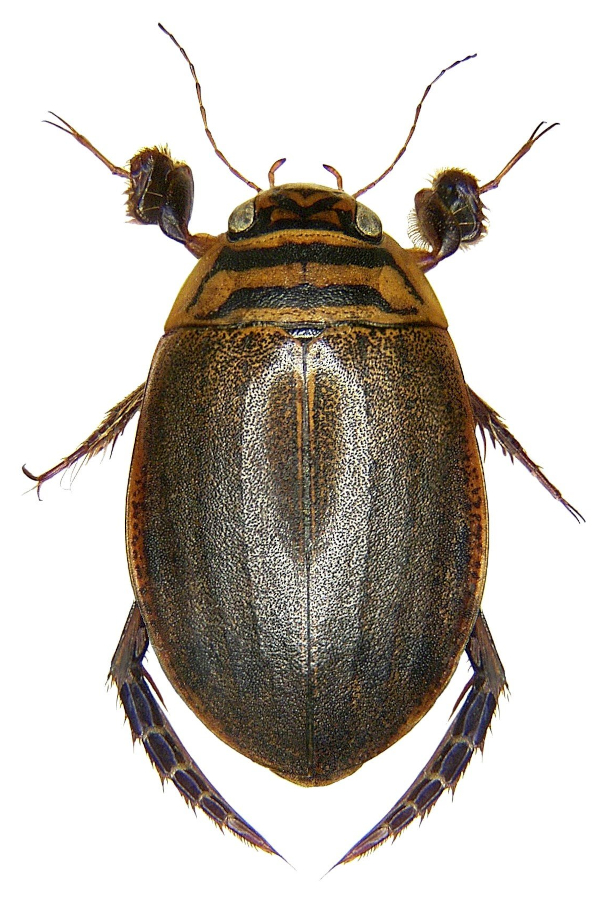
Acilius (Acilius) sulcatus (Linnaeus, 1758)
 Family: Dytiscidae
Adults are oval, dorsoventrally flattened and approximately 14.4-18.2 mm in size. The coloration on the elytra is typically yellow-black. The hind legs have dense swimming furrows. Males have smooth elytra and bowl-shaped expanded articles with 'suckers' on the fore (and mid) feet, females have 4 distinct grooves with setae on the elytra (marked sexual dimorphism). There is a conspicuous yellow transverse band on the shield (pronotum).
Adults are encountered most of the year, often March to October in Europe, sometimes year-round (with adults overwintering in water). It inhabits temporary and permanent stagnant and slow-flowing waters (pools, ponds, peat bogs, slow streams). It is a flyer, so it readily colonises new pools. In tanks without fish it can become a dominant species and serve as an indicator of predators (or lack thereof). In the Palaearctic it is widely distributed throughout Europe, North Africa (Algeria), western and eastern Siberia to the Russian Far East (Sakhalin), as well as in Iran, Kazakhstan, Turkmenistan, Kyrgyzstan and Mongolia. It is a common, widespread species in the Czech Republic. Both adult and larvae are predatory. Adults prey on aquatic invertebrates and small vertebrates (e.g. tadpoles or fish fry) and select prey according to size. Larvae often prefer small crustaceans (e.g. Daphnia). It is active day and night and actively pursues prey.
It usually has one generation per year (it is univoltine). Adults overwinter in deeper, unfrozen waters. Mating takes place in spring and autumn. Females lay eggs on or in aquatic plants. Larvae hatch after about a week and take about 30 days to develop. They pupate in soil/soil near shore and the pupal stage lasts 16 to 28 days.
Image source: main: Schmidt, 2008
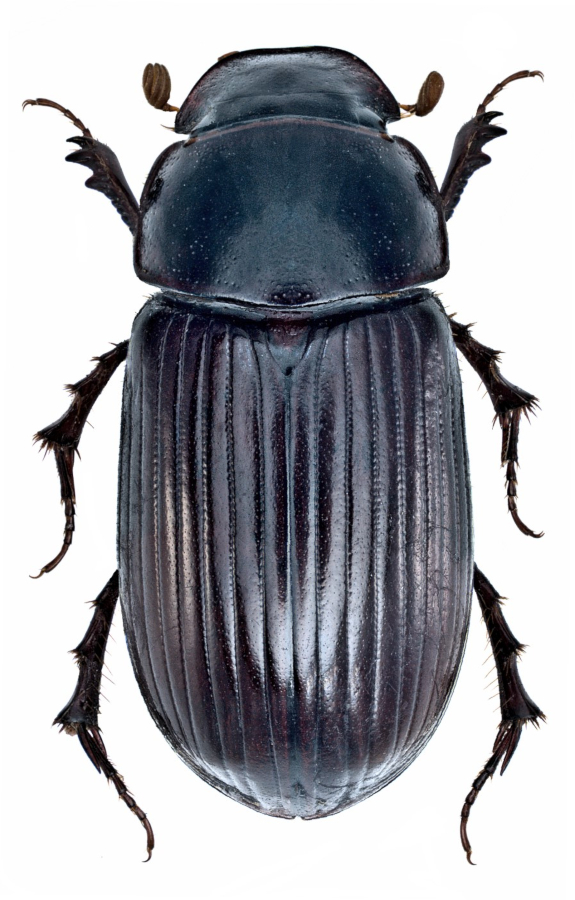
Acrossus rufipes (Linnaeus, 1758)
 Family: Scarabaeidae
Body length ranges from 9 to 13 mm. Adults are typically dark brown to black. The head, pronotum and elytra are dark brown to black, sometimes with a reddish tinge. The elytra are strongly striated. The key distinguishing feature is the texture of the surface of the pronotum. On the black pronotum there is an even coverage of fine punctures (punctures), among which larger and coarser punctures are scattered. The legs (especially the tibiae) are often reddish-brown, which contrasts with the dark rest of the body - hence the species name (red-legged).
Adults are active mainly in late summer and autumn, roughly from July to November. It belongs to the so-called autumn dung beetle species. It is a coprophagous species, i.e. it feeds on faeces, and therefore its occurrence is closely linked to sites where large livestock (e.g. cows, horses) graze - typically pastures, meadows, fields, forest edges, orchards, or even gardens near these areas. The species has a Palaearctic distribution. This means that it is found throughout Europe, Asia, North Africa and has also been introduced into some areas of North America. Across the Czech Republic, Acrossus rufipes is widespread and occurs practically all over the territory from the lowlands to the foothills. It is a species that is strongly attracted to artificial light and often flies to light sources, especially at night. It is a typical coprophage, which means that it feeds mainly on herbivore excrement. It prefers horse and cattle droppings.
Mating takes place in late summer and autumn when adults are most active. The female lays her eggs in soil chambers under the droppings or directly in the droppings, which serve as food for the larvae. This is a typical behaviour for dung beetles. The larvae develop in the soil and feed on the dung. As a rule, they overwinter in the larval (or pupal) stage and the adults hatch the following year. They usually pupate in spring and a new generation of adults emerges in late summer. Thus, it has one generation per year (monovoltine).
Picture Source: Schmidt, 2016
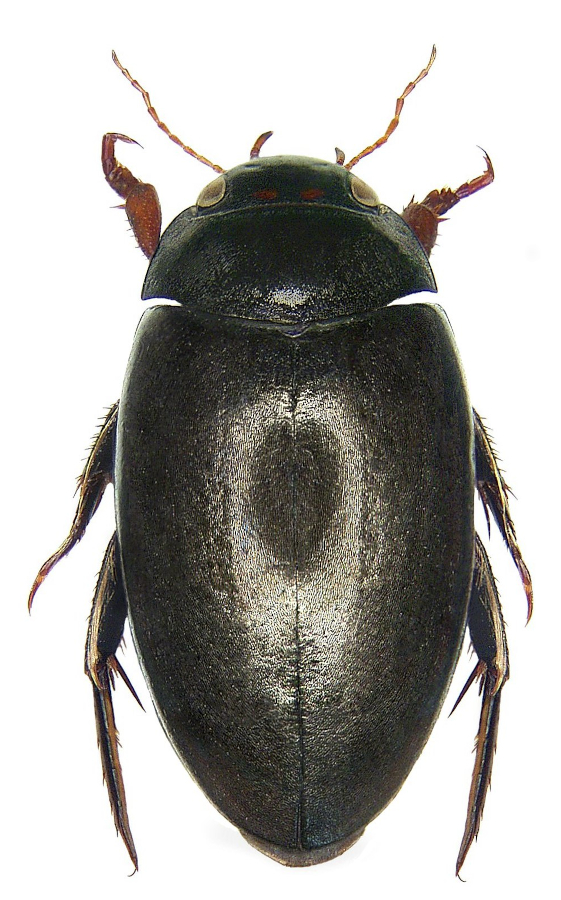
Agabus (Gaurodytes) bipustulatus (Linnaeus, 1767)
 Family: Dytiscidae
Size of the adult is 9.5 - 11.6 mm. The body is oval, smoothly arched and adapted for swimming. The head has an unbroken groove on the anterior margin of the tusk. The shield is uniformly black and there is fine reticulate microsculpture on the scutes. The antennae are often light brown, as are the forelegs. The hind legs are flattened with dense floating setae.
In our conditions, the species is commonly recorded throughout most of the year. It prefers stagnant to gently flowing waters such as pools, ponds, and slow creeks. It prefers sites with abundant aquatic vegetation. Adults may be attracted by light or polarized reflection. Distribution is very wide: Palearctic (including Europe), Afrotropical region, Middle East and North Africa. In Europe it is absent only on a few islands and small territories. Adults and larvae are predators of aquatic invertebrates.
Females lay their eggs in the webs of submerged parts of aquatic plants or on other submerged substrates. Larvae live in the water and molt three times before pupating. Pupation takes place out of the water - the larva leaves the water and makes a chamber in moist soil near the surface. The hatched adult crawls back into the water.
Image source: main: Schmidt, 2008
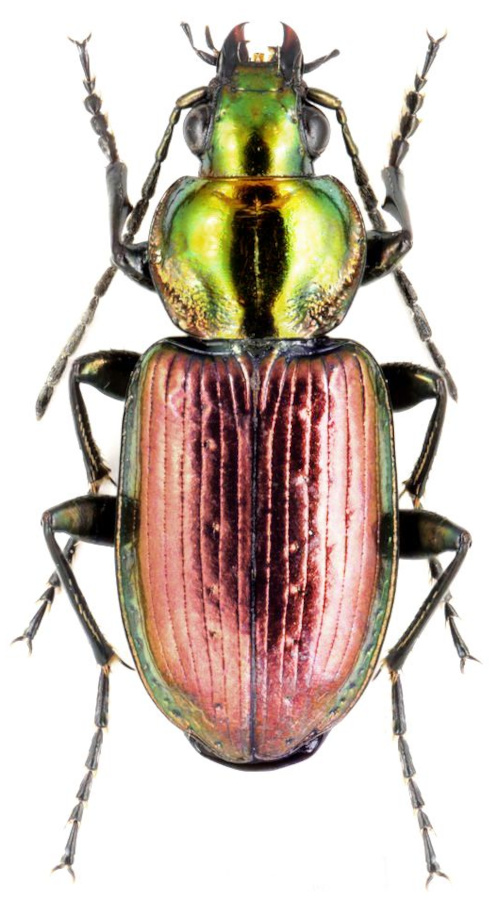
Agonum (Olisares) sexpunctatum (Linaeus, 1758)
 Family: Carabidae
Size 7.5 - 9.9 mm. The body is black, the head and protonum are most often blue-green and the elytra are bright red-copper with a green border. It can also be bronze-green, blue, purple or brass-black with frequent transitions when the protonum and elytra are different in color. There are typically 6 holes on the elytra, but the total number can be 1 to 10.
Adults most often from April to September. It is abundant in semi-humid to very humid habitats without shading, such as meadows, pastures, sandbanks, overgrown water banks or damp forest glades. The beetles live from lowlands to mountains, but are most numerous in the hills. They run along field roads, hide under the old bark of stumps and previously felled trees, crawl into moss, old leaves, under stones and under old wood. It is a macropterous species.
Both the beetle and the larva are predatory. They hunt insect larvae and other small animals. The adults overwinter. Mating takes place from April to May. Adult beetles hatch in July and August.
Picture source: main: Pinterest
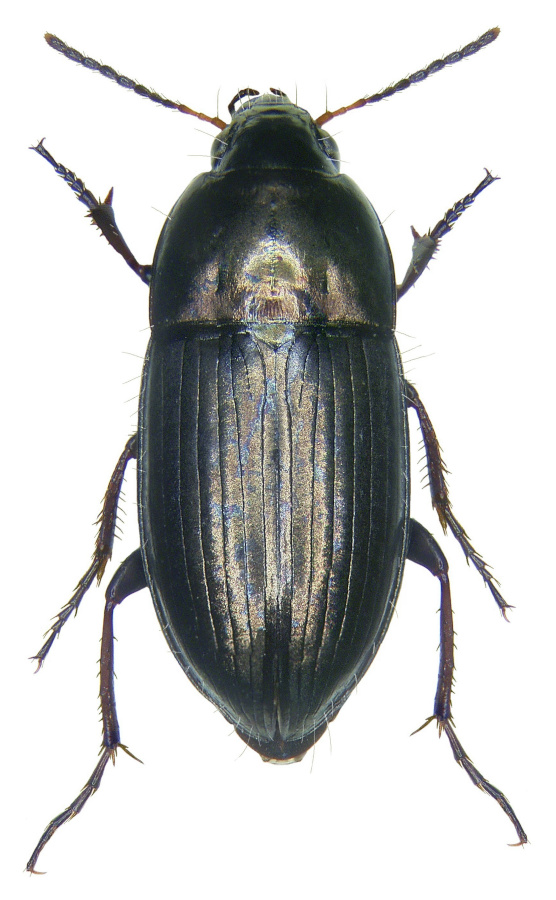
Amara (Amara) aenea (DeGeer, 1774)
 Family: Carabidae
Size 6.1 - 8.4 mm. The body is relatively flat, broadly oval. Elytra with shallow grooves that do not deepen before the tip of the elytra. The color of the elytra is usually metallic brass. However, there are also individuals with black, green or blue to purple elytra. The first three segments of the antennae and the tibia are light red-brown. The appendages are black.
Adults are found almost all year round, from March to November. It is a macropterous species, it has been observed in flight. It is a very abundant species, which is widespread from the lowlands to the mountains. As a eurytopic species of open habitats, it mainly seeks out the edges of fields and field roads, dry meadows, borders, steppes and also ruderal habitats.
The adults survive the winter, reproduction takes place in the spring and the larvae develop during the spring and early summer. The new generation hatches in late summer and autumn. The larva is probably omnivorous, adults feed mainly on grasses, plant seeds and insect larvae.
Picture source: main: Schmidt, 2024
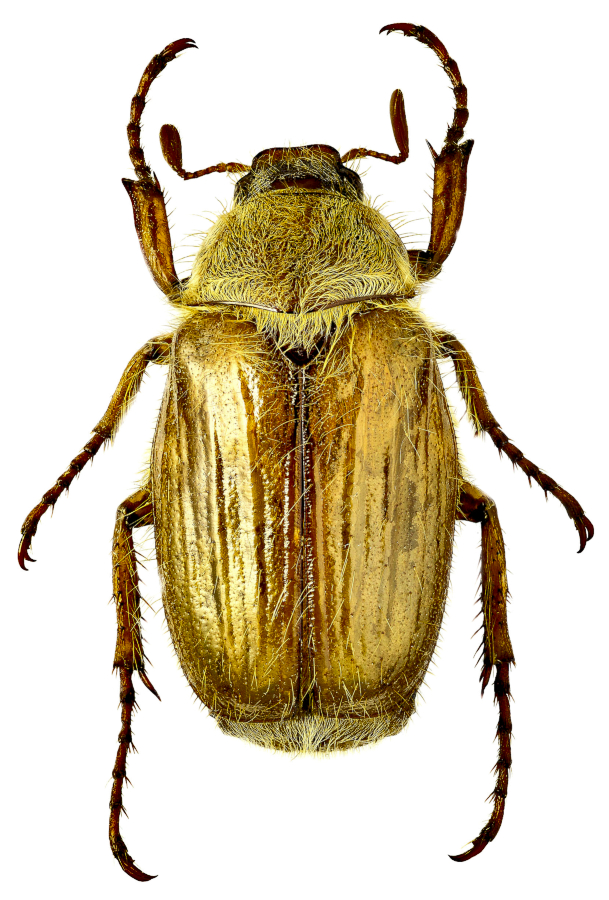
Amphimallon solstitiale solstitiale (Linnaeus, 1758)
 Family: Scarabaeidae
Adults reach a length of 14 - 18 mm. The body is usually yellowish to rusty (yellow-brown), less often brown. The entire body is heavily hairy, giving it a slightly velvety appearance. The elytra are longitudinally ribbed - they usually have three protruding grooves on them. The antennae are club-shaped and fan-shaped (lamellate). Both males and females have a stalked antennae. Males have it longer and with more petals (plates) than females.
Adult beetles are active mainly in the summer months - usually from June to August. Adults are mainly active at dusk (when they swarm and fly) and at night. They are strongly attracted to light. They fly quite clumsily and may bump into objects or people. Typical habitats are meadows, field margins, parks, gardens, copses, scrub or light woodland edges - generally dry to moderately moist open habitats with a herbaceous understorey. It is widely distributed in Europe, central and western Asia, except in the far north. It also occurs in North Africa. In the Czech Republic it is abundant and common from the lowlands to the hills. Adults are polyphagous, feeding on the leaves of various trees and herbs. They prefer the leaves of fruit trees (or deciduous trees in general) and sometimes feed on needles and bark of coniferous trees (e.g. young pine trees). The larvae are underground pests that feed on the roots of grasses and herbs.
Mating occurs in June and females lay eggs in the soil during July. The female lays 30 to 45 eggs in soft soil, usually 10 to 20 cm deep. The larvae hatch from the eggs in 4 - 6 weeks, then develop in the soil where they feed on the roots. Larval development is relatively long and usually takes 3 years, or up to 4 years in colder areas. The larvae overwinter deeper in the ground. The length of the pupal stage is shorter (months), then the adult hatches and emerges the following season. The adult beetle hatches from the pupa usually in spring or early summer and its life is relatively short, at most 2 months.
Picture Source: Тилли, 2017
Anchomenus dorsalis dorsalis (Pontoppidan, 1763)
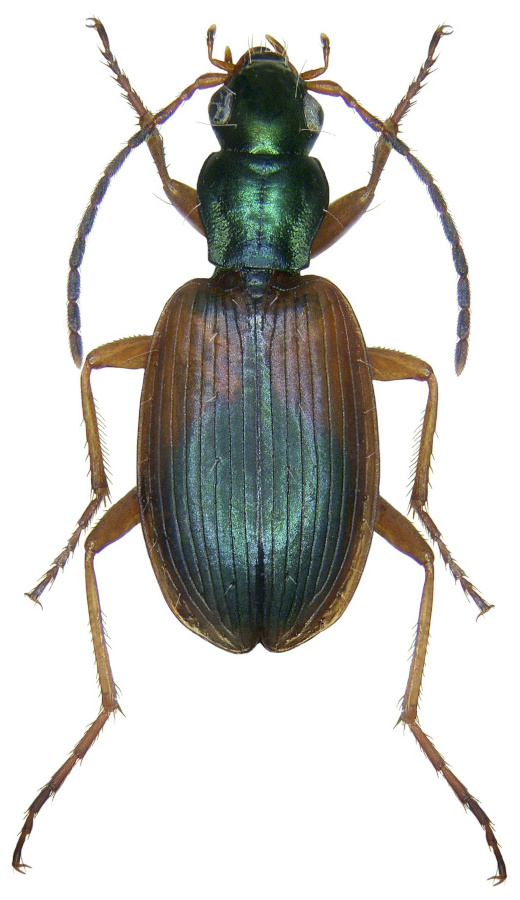 Family: Carabidae
This very mobile ground beetle reaches a size of 5.8 - 7.5 mm. Its color variability is considerable. Most often, the head and protonum are beautifully metallic green, the elytra are brownish-yellow with a large green spot in the last two thirds of their length. However, the elytra can also be completely red-orange or blue and the metallic blue spot can be suppressed or not at all distinct. All individuals have reddish-yellow legs and antennae segments.
Adults can be found from the end of March to the beginning of November from the lowlands to the mountain valleys. It inhabits dry and slightly moist fields, pastures, small clearings, shrubby slopes, forests and gardens. It is often found in larger numbers under stones. Adults have the ability to fly. Like most ground beetles, they are predatory. Their food includes aphids, caterpillars and other small insects.
Picture source: main: Schmidt, 2008
Anisoplia (Anisoplia) villosa (Goeze, 1777)
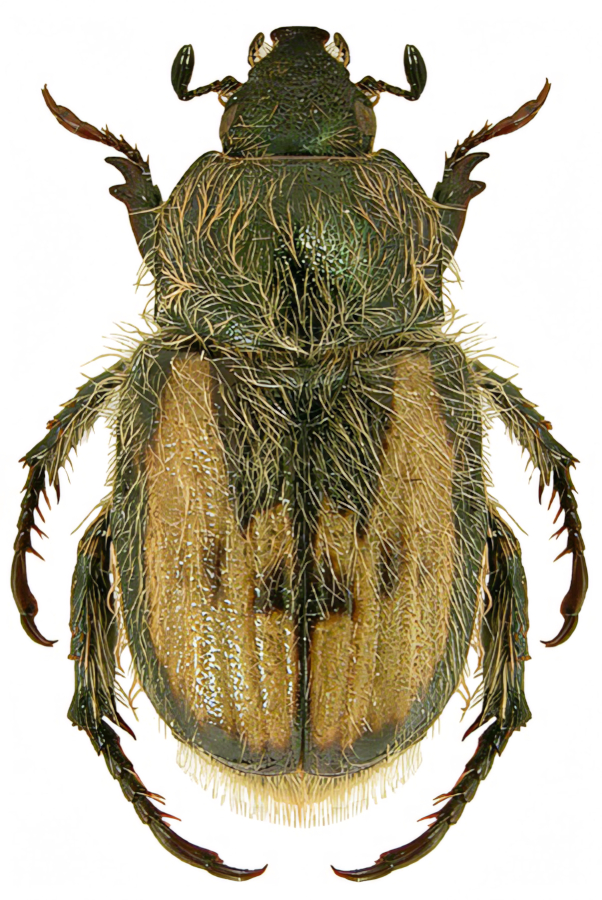 Family: Scarabaeidae
Size of the adult is 10 - 11 mm. It is a medium-sized beetle with characteristic hair. The head, pronotum, legs and antennae are black (the pronotum may sometimes be metallic greenish). The elytra are brown, often with black spots or patterns, less often completely black. The head and pronotum bear thick, light and erect hairs. The anterior half of the scruff is as long as on the shield, gradually becoming shorter towards the back. The underside of the abdomen has dense and erect hairs. It has a characteristic clypeus shape, which is strongly tapered at the base and resembles a snout.
Adults are found from late May to late July, sometimes into mid-August. This is a typical summer phenology, when the beetles appear in open habitats and are often observed in grasslands where they feed. Adults inhabit open habitats and are often observed on grasses on whose flowers they feed. They prefer open meadows, prairies, sandhills and dry grasslands. It is found in western, central and southern Europe. In the Czech Republic, it occurs locally but is rather rare; records are known mainly from south-western and southern Bohemia. Imaga feeds on grasslands where it nibbles on grass flowers. They can often be seen attached to grass blades during daytime activity. The larvae are saproxylophagous, which means that they feed on the decomposition of organic material in the soil, specifically dead wood and the humic component of the soil.
Reproduction takes place in the summer (June - July) when the adults emerge. After mating, the females lay their eggs in the soil. The exact length of the development cycle for A. villosa is not detailed in the available literature, but a two-year development cycle has been recorded for related species in the genus Anisoplia. A. austriaca larvae feed on plant roots and humus. The larvae overwinter in the soil and resume development in spring. Pupation takes place in the soil in late spring or early summer. Pupae then develop in late May and adults emerge in late June.
Picture Source: Borowiec
