
 Faunistic grids and other forms of georeferencing species occurrence data address a fundamental biogeographic problem: how to record and visualize spatial information about an organism's occurrence on Earth. Georeferencing is the process of assigning geographic coordinates to a biological record. There are three main forms, which differ in their level of accuracy and applicability:
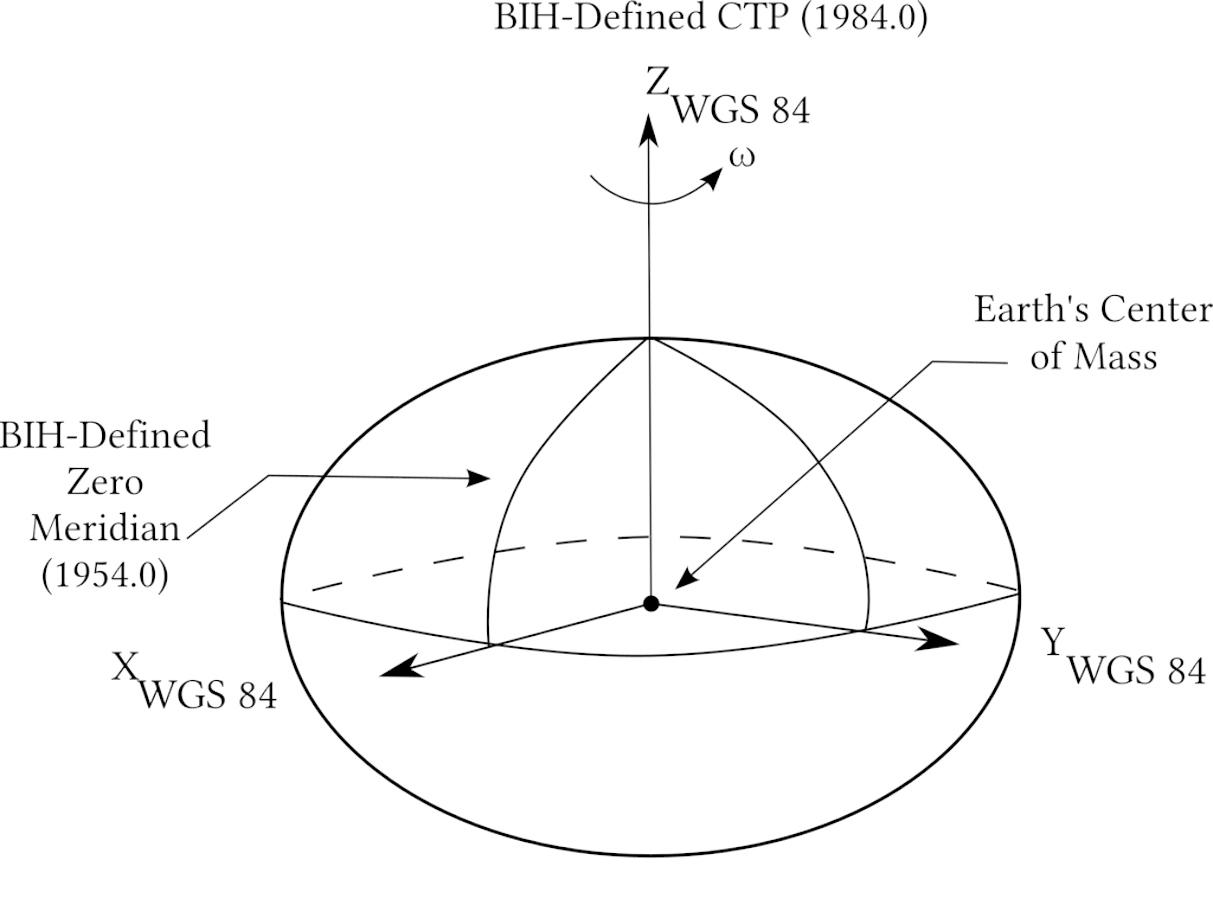
- Precise Coordinates (Point Data): this is the most accurate method, where a specific latitude/longitude pair (Latitude/Longitude) is assigned to a record, usually in WGS84 format (used by GPS). It allows for detailed ecological and microhabitat studies.
- Faunistic grids (Gridded Data): a finding is not assigned to a point, but to the entire area of the square. This is a compromise between accuracy and practicality, ideal for atlases and legacy data.
- Administrative Units (Polygon Data): a finding is assigned to the name of a larger territorial unit (state, region, protected area). Least accurate, but often the only option for very old or incomplete records.
Why Faunistic Grids?
The concept of faunistic grids is based on dividing a map area by a regular grid of squares of equal size. Instead of giving the exact coordinates of each record (e.g. GPS coordinates), the record is assigned to the corresponding square in which it is located. This approach has several advantages:
- Standardization: it provides a consistent framework for comparing data collected by different researchers at different times.
- Data aggregation: It helps to process a large number of individual finds into a clear map.
- Anonymization: To some extent, it protects the exact locations of rare and endangered species that could be threatened by ill-advised collection.
Apart from the aforementioned standardization, the main theoretical reason for the existence and use of faunistic grids in entomology is the processing of historical data. Most museum collections from the 19th and 20th centuries do not contain GPS coordinates. The locality is described verbally, e.g. "the surroundings of Křivoklát forest, collected by Novák 1920". Exact coordinates cannot be assigned to such a record. The smallest standardized area in which a find can be placed with reasonable certainty is often a faunistic grid. Only through this aggregation is it possible to plug hundreds of thousands of historical data into modern distribution atlases and track historical range changes.
The need for standardized mapping emerged with the development of scientific faunistry in the 19th and 20th centuries. A key turning point came with the post-war development of field research and the drive to create pan-European and national distribution atlases. One of the earliest and most important standardised systems was introduced for mapping the flora of Central Europe (Mapping European Flora - MEF), and this methodology was subsequently adapted for faunistics. The greatest expansion and formalisation occurred with the advent of global coordinate systems.
Global use
The use of faunistic grids varies from region to region, and is strongly linked to the availability of detailed mapping and the tradition of field research.
- Europe and North America: Here, grid square mapping is the main method for atlas projects. These regions have a rich history of faunal research and have developed standardized systems (e.g., UTM in the USA and Europe, MGRS/UTM on military maps).
- Other regions (e.g. Africa, Asia, South America): In many areas, gridded mapping is less widespread, mainly due to lack of historical data, fewer active researchers and sometimes the absence of a suitable uniform map base. In these regions, it is more common to rely on precise GPS coordinates or to map on the basis of administrative units (provinces, states).
Examples of the use of UTM in different regions
| Region/System | Common coordinates | Use in entomology | Comment |
| North America | UTM (NAD83), WGS84 | Research, monitoring, range models | UTM standard in scientific publications |
| South America | UTM (WGS84) | Biodiversity, SDM (Species distribution modelling) | Necessity of a zone due to the vastness of the area |
| western Europe | ETRS89 / UTM | Mapping, databases, atlases | UTM 10×10 km common |
| Scandinavia | UTM (ETRS-TM35FIN etc.) | National databases, scientific mapping | Standard |
| Czech Republic / Slovakia | KFME, WGS84, UTM | Faunistic mapping (KFME), now also UTM | KFME (historically), EU compatible UTM |
| GBIF, iNaturalist | WGS84 (internally converted to UTM) | Global data collection | Coordinates transformable to UTM |
In entomology we primarily encounter two standardized types of square grids: the UTM (Universal Transverse Mercator) and the KFME (Kartierung der Flora Mitteleuropas).
Universal Transverse Mercator
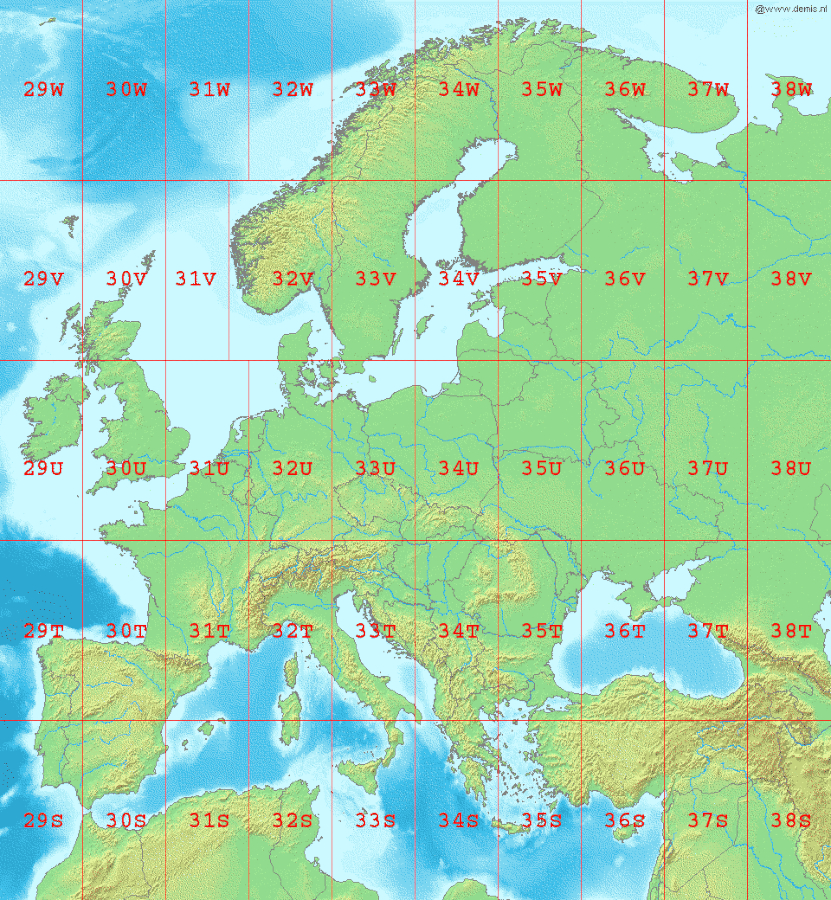 The most widely applied system in the world using faunistic grids is the UTM (Universal Transverse Mercator) system. It is a coordinate system based on orthogonal projection that divides the Earth into 60 zones of 6° longitude. For each zone, a planar cartesian system is defined with axes pointing north and east. The system was developed by the United States Army in 1947. Today it is used in many natural science disciplines because it is metric (making it easier to measure distances and areas), it is unambiguous within a given zone (and thus ideal for GIS analysis), and finally it is GPS compatible (most GPS devices can display it directly). In the context of faunistics, its 10x10 km grid is most commonly used.
UTM is commonly used in ecological studies, biogeography, conservation and biodiversity mapping, including entomology. For example, databases such as GBIF, iNaturalist, Map of Life, or SpeciesLink use WGS84 (geographic coordinates) internally, but convert data to UTM or other projections (depending on location) for spatial analyses. Entomological studies often store data either as WGS84 (lat/long) or directly as UTM Easting/Northing + Zone, especially in areas outside the dense network of standard cartographic squares.
Europe has a single base in the ETRS89 / UTM (European Terrestrial Reference System), which is a version of WGS84 adapted to European tectonics. For example, the Czech Republic is located in the 33U zone (mainly western and central part) and partly also in the 34U zone (eastern Moravia, Silesia). In Western Europe (mainly Germany, Austria, Switzerland, Scandinavia) UTM coordinates are used very often - especially for mapping species distribution, habitat modelling (e.g. using MaxEnt) or precise localization of type specimens in museums. The Scandinavian countries (Sweden, Norway, Finland) have national biodiversity databases (e.g. Artsdatabanken, Artdatabanken, GBIF-SE) that use the UTM network for data display by default. Finally, for example, Germany and Austria have a long tradition of the so-called UTM-MTK grid (10×10 km, 1×1 km), which replaced the earlier faunistic squares.
Kartierung der Flora Mitteleuropas
The system was developed by an international collaboration in Central Europe, with the aim of standardizing data collection for the production of an atlas of the distribution of vascular plants of the whole region. Eventually, its use was successfully extended to faunistic purposes.
It is a regular network of square fields covering a given area, which serves to standardize and facilitate the collection and presentation of faunistic and floristic data. For more detailed information on the KFME system, visit the KFME Method page of this lexicon.
Advantages and disadvantages of faunistic grids
The use of faunistic grids has a number of advantages but also limitations, especially when compared to modern mapping methods using accurate GPS coordinates.
✅ Advantages of using faunistic grids
- Data comparability: they allow aggregation and comparison of data from different time periods and authors.
- Efficiency of collecting older data: they are ideal for processing historical collection data where researchers did not record exact GPS coordinates, but only general locations (e.g., "forest near village X"). In this case, the most accurate localization is the assignment to a grid.
- Creating atlases: these are the building blocks for the creation of large-scale distribution atlases, where the presence/absence of a species is mapped.
- Protection of sensitive species: They provide sufficient precision for scientific purposes, but also make it difficult for potential illegal collectors to accurately track rare sites.
❌ Disadvantages and limitations
- Loss of accuracy: The biggest disadvantage is that you lose the exact location of the find. All finds within a grid (e.g., 10x10 km) are treated as a find in that grid, even though the actual locality is in one corner and all other finds are in the other. This makes detailed study of microhabitats difficult.
- Misassignment: the assignment of a site to a grid can sometimes be erroneous, especially in areas close to the boundary of the grids.
- Non-uniform area: Even with standardized systems (such as KFME or UTM in zone edges), minor distortions occur so that the grids do not have absolutely identical area.
Conclusion
Faunistic grids, especially the 10x10 km UTM and KFME systems, are an invaluable standard for mapping species distributions, especially in the historically rich entomology of Central Europe. Although modern technologies (GPS, GIS) offer more accurate coordinates, square grids remain a key tool for data aggregation, comparison and visualisation, which is essential for scientific research and effective biodiversity conservation.
