
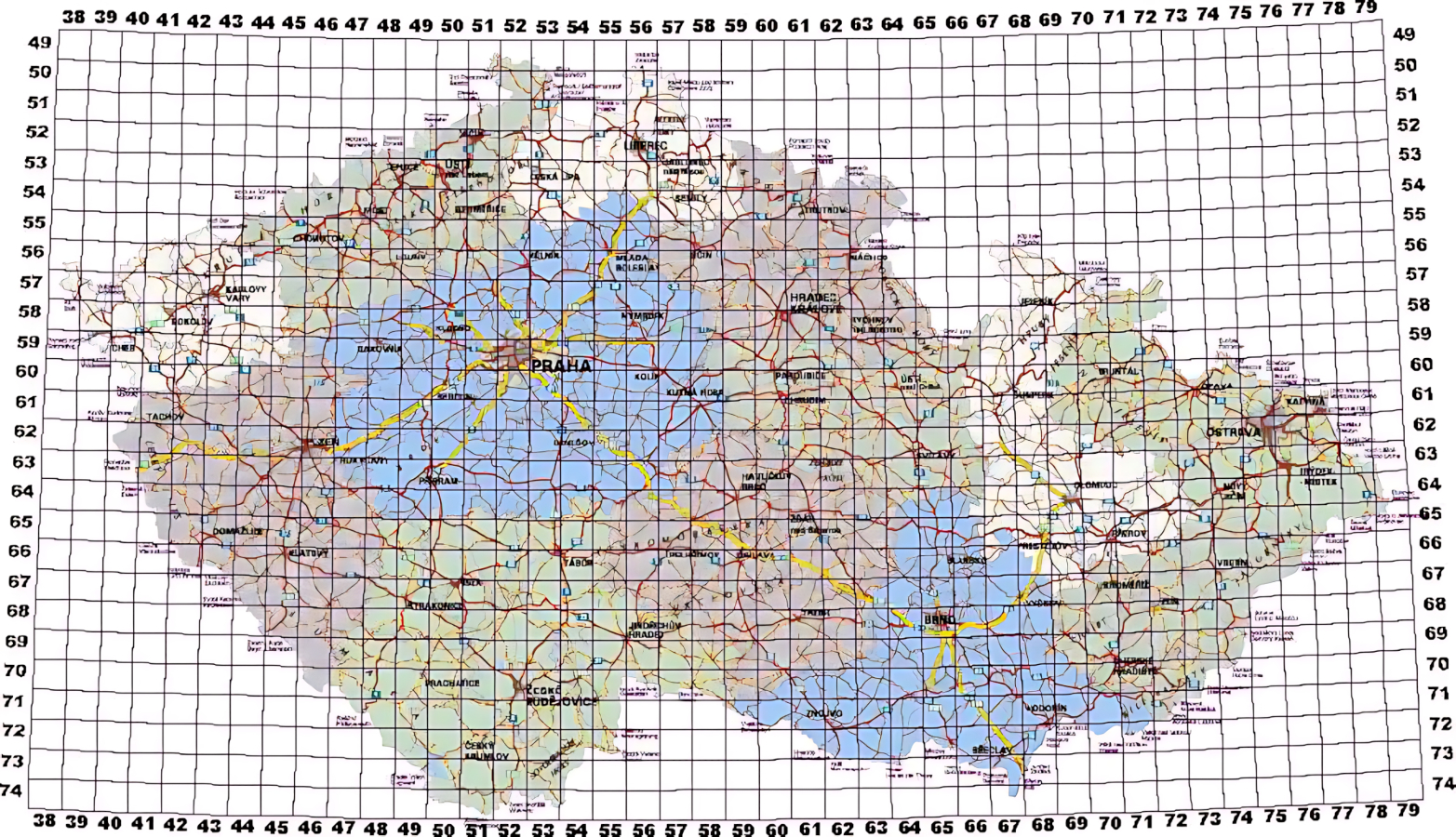
 The KFME system (Kartierung der Flora Mitteleuropas), also called Faunistic Mapping Field, is a specially developed georeferencing system for the needs of biogeographic mapping in Europe. It is the basic standard for most faunistic (entomological) and floristic atlases in the Czech Republic, Slovakia, Germany, Austria and other countries of Central Europe.
The KFME system is based on a grid derived from geographical coordinates and was originally designed for botanical mapping.
Base grid (6' x 10')
The KFME base field is not a perfect square, but a trapezoid, because it is defined using the coordinates of the geographical grid (longitude and latitude):
- Latitude: within 6' (six arc minutes).
- Longitude: Within 10′ (ten arc minutes).
Because of the curvature of the Earth and the convergence of the meridians (the line of longitude), this unit is not an exact square and its size changes with increasing distance from the equator:
- In Central Europe (approximately 50°N) it is about 12.0 × 11.1 kilometres.
- Towards the north, the longitude (10') of the Earth becomes shorter and therefore the area of the square becomes smaller.
Coding of the base grid
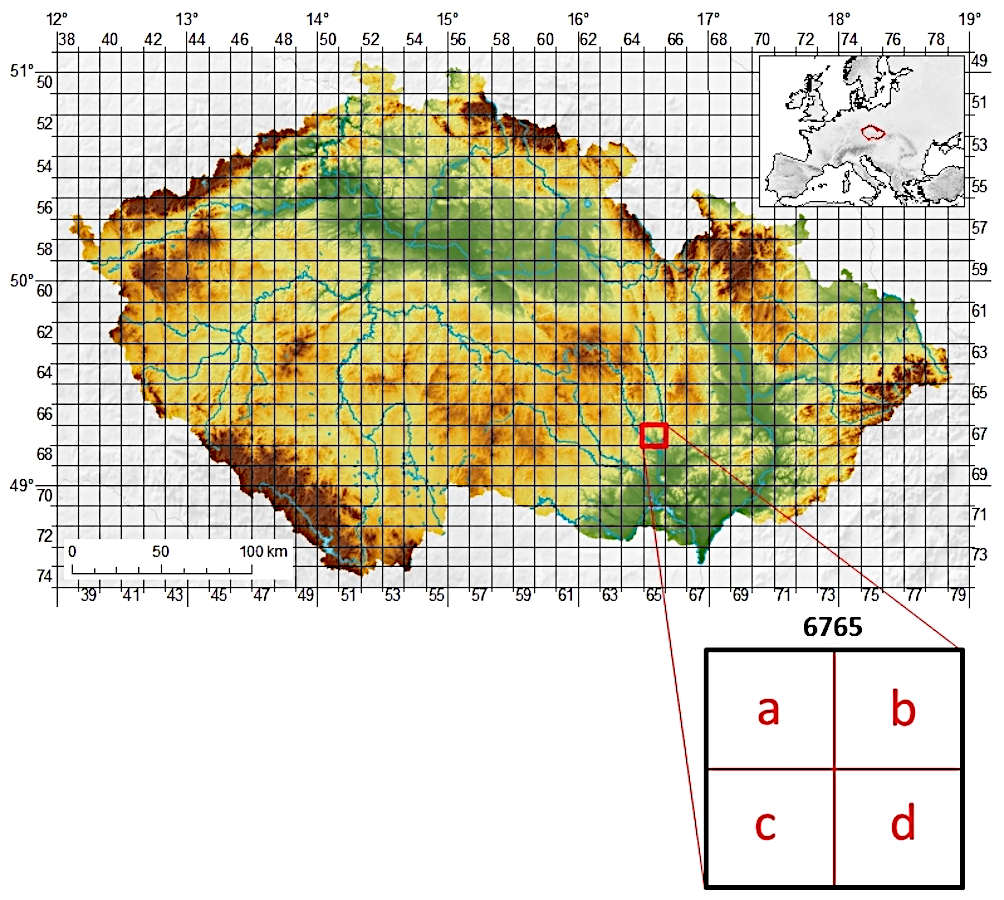 Each base square (approximately 12x11 km) is coded with a four-digit number that identifies its location within Central Europe:
- The first two digits indicate the row: They indicate the serial number from north to south. The smaller the number, the further north the field lies. In the Czech Republic it typically ranges from 49 to 74.
- The second two digits indicate the column. The smaller the number, the further west the field lies. In the Czech Republic it typically ranges from 38 to 79.
Example of a basic grid code in the Czech Republic: 6765 (Brno and its surroundings).
Dividing and deriving sub-squares
For the purpose of more detailed faunistic and floristic mapping in the Czech Republic, the KFME basic grid field is further divided into four smaller sub-grids (quadrants), indicated by letters. Each basic grid is divided horizontally and vertically into halves. These quadrants are usually coded with the letters a, b, c, d (sometimes numbers 1-4, but the letters are standard in the Czech Republic and Slovakia). Each quadrant then has dimensions of approximately 5.6 km × 6.0 km. The orientation of each quadrant is standardised:
- quadrant a (or 1): Northwest quadrant
- quadrant b (or 2): North-east quadrant
- quadrant c (or 3): South-west quadrant
- quadrant d (or 4): South-East Quadrant
Example of a complete quadrant code: 6058c (Indicates the southwest quadrant of base quadrant 6058).
Advantages and disadvantages of KFME for entomology
✅ Advantages:
- Historical continuity and data compatibility: The vast majority of older faunistic and floristic data in Central Europe (since the mid-20th century) are already digitized or recorded in this system.
- Display accuracy: The system is designed to minimise cartographic distortion in the key region of Central Europe, making it ideal for atlas production.
- Regional standard: It is widely accepted among experts in key neighbouring countries, facilitating international cooperation.
- Compact coding: the four-digit base grid code is short and very efficient for regional research needs.
❌ Disadvantages:
- Non-uniform area: The 6′×10′ basic grids do not have an absolutely identical area (due to the earth's curvature).
- Regional limitations: the system is strictly limited to Central Europe and has no global validity, which makes international comparison of data with other continents difficult.
- Conversion from KFME code to modern accurate GPS/WGS84 coordinates is more complex than UTM, requiring transformation keys and special mapping programs.
- Relationship to 10x10 km: Geometric differences between the KFME grid and the precise UTM 10x10 km grid are a source of inaccuracy for modern GIS (Geographic Information Systems) and require a compromise solution in digitisation.
Comparison of KFME and UTM for biological mapping
KFME (Kartierung der Flora Mitteleuropas)
The KFME system was specifically designed for mapping in Central Europe and is defined by 10′ longitude × 6′ latitude.
| ✅ Advantages of KFME (Why it is used in the Czech Republic) | ❌ Disadvantages of KFME (Limitations) |
| Origin and continuity It is a historically established standard for Central European floristics and faunistics, which ensures consistency of data. |
Geometric deformation The base field (quadrant) is a trapezoid, not a perfect square, and its size changes slightly with increasing latitude (smaller in the north). |
| Ease of coding The coding is a four-digit numeric (e.g., 6670), which is simple and can be easily entered in the field without a calculator. |
Regional restrictions The system is specific to Central Europe. When working abroad (outside this region) it is unusable and the data is not compatible. |
| Dependency on maps It is closely related to the division of 1:25 000 topographic maps (the so-called Meßtischblätter) in Germany and other countries, which facilitated work at the time of its creation. |
They are not metric Uses angular minutes, not metres. This makes accurate metric calculations of distances and areas difficult, especially in more complex GIS analyses. |
UTM (Universal Transverse Mercator)
UTM is a rectangular coordinate system used worldwide (except in the polar regions) and is the basis for military and civilian mapping.
| ✅ Advantages of UTM (Global Standard) | ❌ Disadvantages of UTM (Complexity in the field) |
| Metric accuracy It is a rectangular (planar) system based on meters (e.g. 10 km×10 km or 1 km×1 km squares). This facilitates distance measurements and area calculations (GIS analysis). |
Complications at zone interfaces The earth is divided into 60 zones (6∘ of length each). When mapping large areas or across zone boundaries, it is necessary to use different coordinate grids/zones, which is confusing. |
| Global standardisation This is a globally recognised system. Data collected in UTM is easily comparable and compatible with data from almost any other continent. |
More complex notation Coordinates are long number series (in meters) that are more difficult to write down in the field than the KFME code. |
| Minimal distortion The system uses transverse Mercator mapping in narrow zones, which minimizes cartographic distortion in a given zone. |
Distance and area Although the system is metric, it cannot be ignored that at large distances there is still a slight distortion due to projection. |
Both systems are used for network mapping, but the choice depends on the goal of the project:
- KFME: Ideal for historical comparisons and local projects in Central Europe where continuity with older data and established tradition is important.
- UTM: Ideal for modern, international and GIS-intensive projects where metric accuracy, global compatibility and ease of manipulation of data in squares is key.
Because fauna mapping in the country has a strong historical tradition and a large volume of data is already in the KFME, this system continues to be used for continuity and comparability. However, new, professional mapping projects often use modern UTM grids or store data in both formats.
