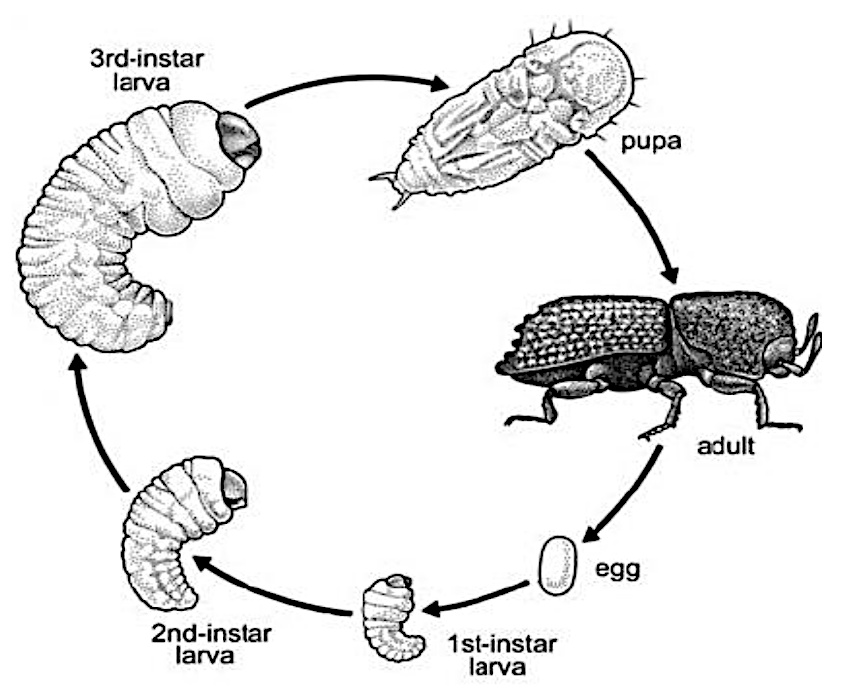
Development: Egg → young larva → adult larva → pupa → adult (imago)
In holometabolous insects, immature stages are called larvae and differ markedly from adults. Insects which undergo holometabolism pass through a larval stage, then enter an inactive state called pupa (called a "chrysalis" in butterfly species), and finally emerge as adults.
The most advanced insects have a life cycle that involves complete metamorphosis. Larvae or caterpillars hatch from eggs, which are completely different in shape and appearance from the adults. The larvae feed, grow, molt several times, and finally pupate. Inside the pupa, the entire body is reorganized until an adult (imago) hatches. In insects with this metamorphosis, the sex of the individual can often be distinguished thanks to the pupa (e.g., in the stag beetle, the pupa with large jaws belongs to the male). However, the aforementioned rules do not always apply: the adults of some beetles resemble the larvae, the females of some mountain moths are wingless, and some Diptera do not have imagoes at all, because their larvae produce many other larvae in their bodies. Wasps, bees, ants, dipterans, beetles, butterflies and moths, caddisflies, fleas, lacewings and silkworms undergo complete metamorphosis. Complete metamorphosis allows the larva to specialize in nutrition and the adult to specialize in reproduction and search for new territory.