Select your language
Select your language


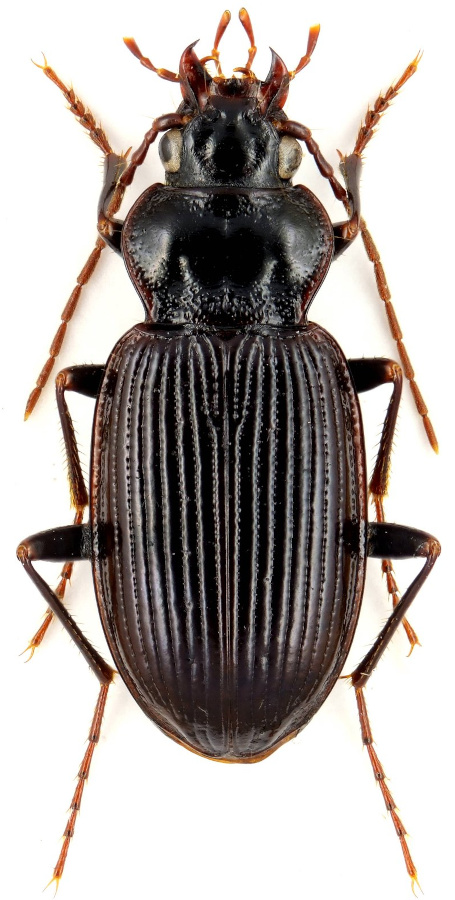 Family: Carabidae
Size 10 - 14 mm. Shiny pitch black to brown. Lateral part of prothorax, epipleura, last segment of rump and appendages are brownish-red to red. The groove of the lateral margin of protonum is wide. Basal segments of hind feet are hairy on top, palps are red. Elytra are longitudinally grooved, with small pits in the grooves.
Adults from the end of March to October. They are most active from June to August, while in July and August they undergo a so-called summer diapause for 5 - 6 weeks, in which development is suspended. After this diapause, they reappear in September and October, mate and females lay eggs. Inhabits forests, meadows or parks from lowlands to hills. Prefers deciduous forests, where they seek out wetter habitats.
Adults are active at night. They mainly seek out springtails, earthworms, mites, spiders and various Diptera as food. They do not disdain even smaller snails, but prefer already dead individuals that cannot defend themselves due to increased mucus production.
Picture source: main: Bleich






Source: Youtube: ZoneA
Language: English
Date: April 07, 2022
Kika Serafín from Živica talked to entomologist Marek Semelbauer about how climate change can affect insects.
Source: RTVS, Čierna Labuť_FM
Language: Slovak
Date: November 13, 2023
Source: Interview ČT24
Language: Czech
Date: January 14, 2024
| 29 Nov 2025 09:00 - 12:00 Entomologická burza České Budějovice |
| 06 Dec 2025 08:00 - 12:00 Mezinárodní setkání sběratelů a chovatelů brouků, motýlů a ostatních skupin hmyzu Bratislava |
| 20 Dec 2025 09:00 - 13:00 Živá exotika Praha |
