
The hard life of insects
Source: Portal Vědavýzkum.cz
Language: Czech
Date: June 06, 2023
Select your language


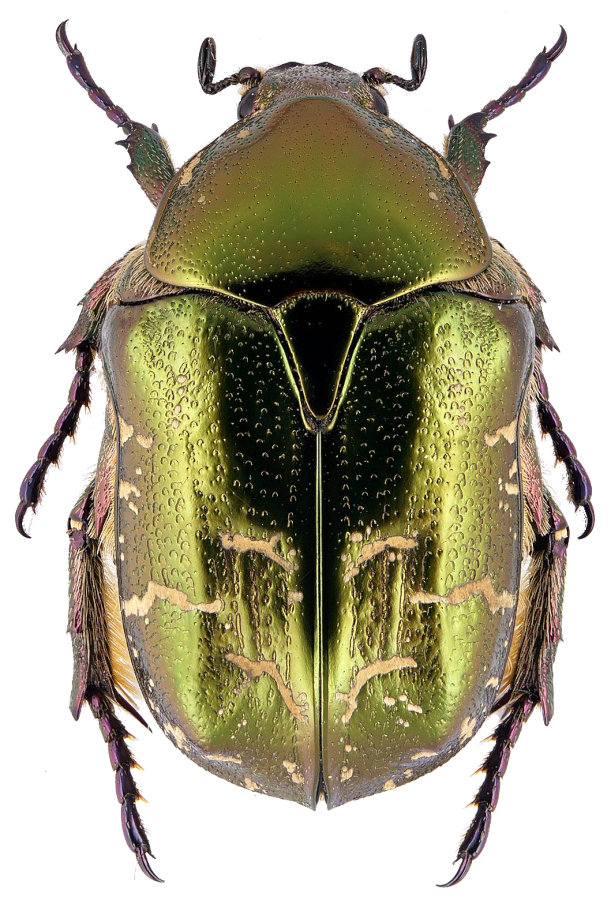 Family: Scarabaeidae
Adults usually measure 14 - 23 mm. This species shows extremely high morphological variation and polymorphism in colouration. The body is oval, distinctly convex, rather robust. The beetle is characterised by a metallic lustrous colouration ranging from bronze to copper to green and blue-green, giving it a beautifully iridescent appearance. The lower body, legs, antennae and sometimes the front of the head are dark purple. There are white to grey spots on the elytra. The upper side of the body is smooth, the underside is sparsely hairy. The elytra have regular rows of spots or stripes. The head bears lamellate antennae, the thick legs are adapted to attach to the flowers.
Adult beetles commonly appear in late spring and summer - in the Czech Republic and central Europe this is mainly May to July (sometimes up to August). It is a diurnally active beetle that is a fast and skilled flyer. This species thrives in a variety of environments, from dense forests to more open and dry steppe areas, indicating its wide ecological tolerance. The species is not tied to a particular habitat type. The beetles can be found in forest edges, woodlands, flowery meadows, steppes, draws, parks and gardens. It is able to live from coastal areas at sea level up to an altitude of 2000 metres. P. cuprea is found throughout Europe and Asia. Its range extends from the Canary Islands, Portugal and Spain in the west to Vladivostok in the Russian Far East and also includes Mongolia and northern China, Pakistan and Nepal. It also extends into Turkey, northern Egypt and Iran. The species is relatively common and widespread throughout the Czech Republic. Adults actively visit flowers and collect pollen and nectar, often perching on the flowers of roses, wild roses and other inflorescences (Asteraceae, etc.). In summer they also browse or supplement their food with ripe fruit and sap. They can thus cause cosmetic damage to fruit/flowers on trees if they are overpopulated.
Mating in Protaetia cuprea takes place during the period of adult activity from May to August. Females select moist, nutrient-rich sites for egg laying, such as compost, dung, soil or organic matter near rotting wood in deciduous trees (especially oaks), or occasionally in tree cavities or ant nests (especially wood ants). Egg hatching and transition to the larval stage occurs after 1 - 2 weeks. In the larval stage, P. cuprea is primarily sapro-xylophagous. They have a particular affinity for deciduous trees, with oaks (Quercus) being the preferred habitat. Despite this preference, larvae may also switch to pure saprophagy, as evidenced by reports of larvae developing in compost piles or forming associations with ant colonies. The life cycle of Protaetia cuprea is typically one year. However, under certain conditions, the beetle can develop more rapidly and adults may hatch in the same year in which the eggs were laid by the parent generation. The reverse is also true; in colder climates, development can take up to two years. Pupation takes place in the soil and the adults hatch in the season of activity.
Picture Source: Bleich






Source: Portal Vědavýzkum.cz
Language: Czech
Date: June 06, 2023
Alpine Longhorn (Rosalia alpina) is a native insect species that is an important representative of the mountain fauna. In recent years, its population has been weakened, therefore it is protected in all countries of Central Europe.
Source: Youtube: NATURE - HISTORY TV
Language: Czech
Date: September 06, 2020
From spring to autumn, insects are everywhere, and then suddenly it gets cold and there is nothing anywhere. But it definitely does not mean that everyone would die.
Source: mujRozhlas, Radio Junior
Language: Czech
Date: December 14, 2023
Source: Youtube: Smithsonian Channel
Language: English
Date: April 10, 2020
| 29 Nov 2025 09:00 - 12:00 Entomologická burza České Budějovice |
| 06 Dec 2025 08:00 - 12:00 Mezinárodní setkání sběratelů a chovatelů brouků, motýlů a ostatních skupin hmyzu Bratislava |
| 20 Dec 2025 09:00 - 13:00 Živá exotika Praha |