
The Fascinating World of Insects
Source: Youtube: Free High-Quality Documentaries
Language: English
Date: December 27, 2021
Select your language


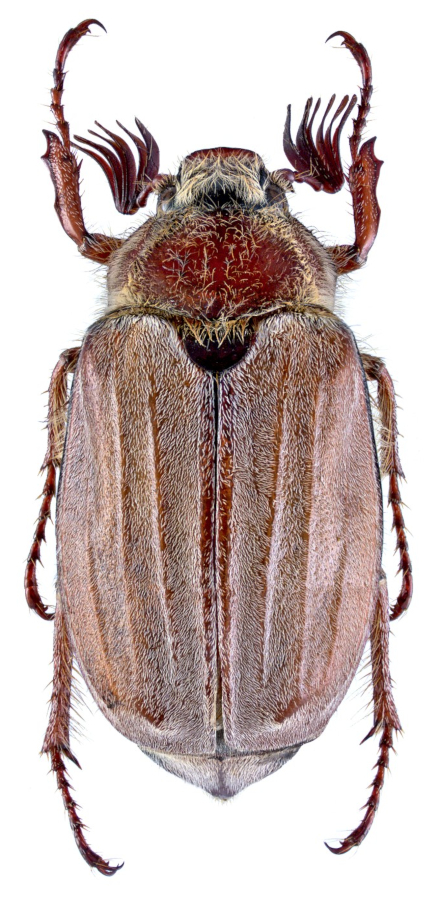 Family: Scarabaeidae
Adults reach a size of 22 - 26 mm. The body is massive, robust and cylindrical, brown in colour. The head and pronotum are darker, covered with a greyish plumage of fine hairs. The elytra are yellow-brown to red-brown. The underside of the abdomen is black to red and there are triangular white patches of dense hairs on the sides of each abdominal segment. The antennae have 10 segments. Males have a 7-articulate elongate flagellum, females have a shorter 6-articulate flagellum. The key distinguishing feature is the pygidium (last abdominal article), which is short and slightly thickened at the end, unlike M. melolontha, which has a long and slender pygidium.
Adults swarm in late April and early May, when they fly to the edges of deciduous forests to feed. The species usually appears in larger numbers a little later in the season than the common chough, typically in June or even July. Unlike M. melolontha, which prefers open areas and agricultural landscapes, M. hippocastani is a distinctly woodland species. It prefers mixed and deciduous forests, especially near oaks, whose roots provide a suitable environment for larval growth and feeding. Its range extends from western Europe to the Pacific coast of China, covering most of Europe except for the northernmost and southernmost areas. In the Czech Republic, it occurs mainly in central and eastern Bohemia and southern Moravia. Adults eat leaves and needles of trees such as oak, birch, maple, lime and pine. Oak trees are the preferred food source for both larvae and adults.
Mating takes place mainly during the evening flight periods at dusk, during which the beetles fly around the treetops. Females lay their eggs in the soil, 10 to 20 cm deep. During its two laying phases, the female lays an average of 24 eggs in the first phase and 15 in the second phase, after which it dies. Larval development usually takes 3-5 years (in colder climates, development can take longer, up to 4 - 5 years) and they feed on plant roots. Pupae metamorphose in summer, a year before swarming, and spend their last winter as adults. Pupation takes place in early autumn and after about six weeks the imago hatches. However, the adult does not emerge from the soil immediately, but remains there until warmer weather when it burrows its way to the surface.
Picture Source: Schmidt, 2014






Source: Youtube: Free High-Quality Documentaries
Language: English
Date: December 27, 2021
Source: Youtube
Language: English
Date: March 15, 2024
Fireflies, known from Jan Karafiát's stories about Broučci, are not only cute glowing creatures, but also fascinating predatory beetles. This year, they were declared Insect of the Year by the Czech Entomological Society.
"Firefly larvae are predatory. They feed on snails or earthworms, and some can even kill small frogs in South America," says Dominik Kusý from the Biodiversity and Molecular Evolution research group at the CATRIN scientific center in Olomouc.
Source: ČRo Olomouc
Language: Czech
Datum: August 6, 2025
Source: Interview ČT24
Language: Czech
Date: January 14, 2024
| 29 Nov 2025 09:00 - 12:00 Entomologická burza České Budějovice |
| 06 Dec 2025 08:00 - 12:00 Mezinárodní setkání sběratelů a chovatelů brouků, motýlů a ostatních skupin hmyzu Bratislava |
| 20 Dec 2025 09:00 - 13:00 Živá exotika Praha |