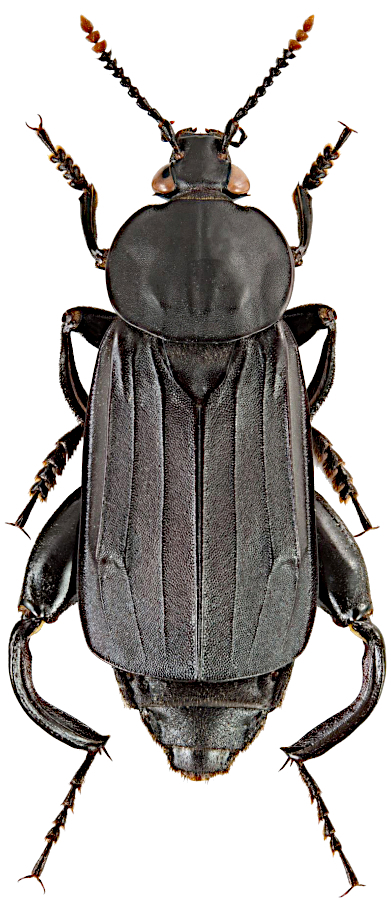
Necrodes littoralis (Linnaeus, 1758)
Family: Staphylinidae
Adults are 15-25 mm in size, glossy black, with longitudinally ribbed elytra that has a characteristic projection at about 3/4 of its length. The elytra is truncate at the back, so that it does not cover 1-3 hind segments. Males, in contrast to females, have more robust hind legs, curved tibiae and enlarged first 4 tarsal segments on middle and fore legs. The three red-coloured terminal antennae are also a characteristic feature of this species.
Adults are active during the warmer part of the year - they are observed from spring to early autumn (April - September). Primarily seeks open landscapes, forest edges, fields, and meadows, but can also occur in mountain regions. It is strongly associated with carrion in a stage of advanced decomposition. It is a typical necrophagous species - feeding on decaying vertebrate remains as well as larvae of bipterans (Diptera). Larvae and adults may consume soft tissues; adults also prey on small insects on carrion. This diet makes the species useful for forensic entomology. It has a Palearctic distribution. It is reported across Europe (e.g., Austria, Czech republic, Hungary, Slovakia, Belgium, France, England) and outside of Europe, it has been observed in South Korea.
Mating occurs mostly at night. The female then lays her eggs in the ground near the carcass, usually in groups of 50-70 eggs. There are three larval stages in total. The first instar moves quickly to the feeding area and is the most vulnerable. The larvae grow, darken, and then burrow to form a pupal chamber after feeding is complete. This species is often found on large carrion and in many forensic cases. Knowledge of its development helps in estimating the time since death.
Picture source: Boža