Lixus punctiventris was collected and reared from larvae and pupae near Przedbórz and in the Holycross Mts (Central Poland). Its development in stems of Crepis biennis L., but less frequently also in Picris hieracioides L. and Senecio jacobaea L., was confirmed, with field and laboratory observations on larval frequency and numbers in stems, timing of pupal stage, ability of the pupa to move actively along larval tunnels, and feeding preferences of young adults. The process of adult emergence from the pupa is showed on a series of combined photos. The 3rd instar larva and the pupa are illustrated. Total distribution of the weevil in Poland is mapped, and general phenology is discussed. The parasitic Aritranis nigripes (Gravenhorst) of the family Ichneumonidae was noticed in the weevils' workings.
Beetles, weevils, Lixini, Lixus punctiventris, Poland, host plants, developmental stages, metamorphosis, biology, phenology, records, stem-boring larva.
Sixteen species of the genus Lixus Fabricius, 1801 were confirmed to occur in Poland, including L. vilis (Rossi, 1790) recorded only twice 130 and 80 years ago, and regarded as uncertain (Wanat & Mokrzycki 2005). Four more species were listed in the Catalogue of the Fauna of Poland (Burakowski et al. 1993), but without consecutive numbers, and these records are regarded as misidentifications or mislabellings. Few of sixteen species are relatively common in Poland and well-known from their large body size (in three species approximately 2 cm). A bright yellow to reddish powder-like excretion is usually covering the whole body of a living beetle. Among the remaining species, L. punctiventris is one of the least known in Poland. It was recorded only from the south, in all from 6 of 25 subregions of Poland, and its records are usually very old (Burakowski et al. 1993). The sole recent finding was in 1994 in the area of river Nida Valley (Stachowiak 1999), the preceeding ones being those in the Segiet Forest near Bytom in Upper Silesia (Polentz 1936) and in close vicinity of Cracow and Przemyśl (Smreczyński 1929, 1955). Other records, even those published recently (Mazur 1994), come from older, mostly 19th century collections.
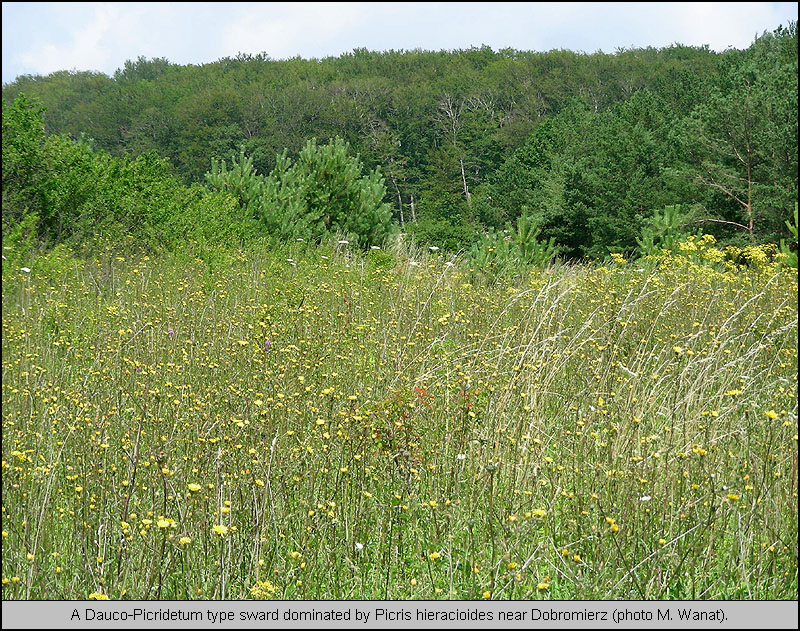
L. punctiventris was discovered in the Murawy Dobromierskie Reserve (Przedborski Landscape Park - PLP) by Ł. Mielczarek in 2005, and further specimens were found in subsequent years by J. Kalisiak and me [Fig. W64.1], [Fig. W64.2]. Repetitive findings of this little known species in PLP induced successful search for its host plants and immature stages. Soon it became evident, that L. punctiventris is locally common in PLP, though it is always very hard to find adult beetles using standard methods, like sweeping or watching host plants. By far a more successful method to record this species is the examination of stems of its host plants, in a proper time allowing to obtain numerous larvae, pupae, and freshly emerged adults. The same method applied in the area of Świętokrzyskie Mts (Hollycross Mts), situated ca. 100 km east of PLP, brought similar results. The weevil occurred in almost every examined site with populations of its host plants present. New localities are listed below, and mapped on [Fig. W64.3] (blue solid circles) together with literature records (red open circles). Major regions refer to the system adopted for the catalogue of the fauna of Poland (Burakowski et al. 1993); both, UTM grid code (square 10 × 10 km) and exact coordinates (decimal) are given for each locality.
- Małopolska Upland: Przedborski Landscape Park: Bukowa Góra Reserve, 14 V 2005, 1 adult, on beech trunk, leg. Ł. Mielczarek; Murawy Dobromierskie Reserve near Dobromierz (DB25; 51.01170/19.92044), 27 IV 2006, 1 adult, leg. Ł. Mielczarek, 3-5 VI 2007, 4 adults, day sweeping low grassland, 16-17 VI 2007, 3 adults, night sweeping - all leg. M. Wanat, 11 VII 2007, 1 adult and several larvae and pupae on Senecio jacobaea, leg. Ł. Mielczarek, 12-14 VII 2007, ca. 10 larvae and pupae on Crepis biennis (3 adults reared), 1 teneral adult and 3 larvae on Picris hieracioides, all leg. and observed M. Wanat, further specimens reared from P. hieracioides by J. Kalisiak in VII 2007; Zabrody (DB34; 50.9647/20.06189), 28 IV 2007, 1 adult, leg. J. Kalisiak; Oleszno (DB34; 50.94556/20.04765), 13 VII 2007, larvae on Crepis biennis, obs. J. Szypuła.
- Świętokrzyskie Mts: Cząstków near Nowa Słupia (EB03; 50.89780/21.10390), 20 VI 2007, 3 larvae on Crepis biennis, leg. M. Wanat; Chęciny, trail to Zelejowa Góra (DB62; 50.81442/20.45538), 9 VII 2007, ca. 20 larvae and 4 pupae on Crepis biennis (7 adults reared in laboratory), leg. M. Wanat & J. Szypuła; Zagaje Grzegorzewskie (EB13; 50.89346/21.16190), 11 VII 2007, 2 adults, larvae, leg. and observed M. Wanat; Chęciny, castle (DB62; 50.79578/20.46065), 14 VIII 2007, 3 adults from stems of Picris hieracioides, 2 pupae in stems of Crepis biennis, leg. M. Wanat.
The weevil was reported by Scherf (1964) as oligophage of several species of the Asteraceae, namely Senecio jacobaea L., S. aquaticus Hill, Crepis biennis L., C. vesicaria L. subsp. taraxacifolia (Thuill.) Thell. The same author provided concise morphological description of the larva and pupa, illustrated with several diagrammatic drawings.
Most frequently inhabited host plant (nearly 100% of studied dozens of well developed plants!) on all studied localities was Crepis biennis, growing abundantly on fallows in Chęciny, along field road to the Zelejowa hill. About thirty plants were taken off the ground and transported to laboratory for control, and in nearly all of them the larvae [Fig. W64.4], [Fig. W64.5] were detected (only two pupae were found in this site on 9 VII 2007, [Fig. W64.6], [Fig. W64.7]). A number of fully grown larvae was left in stems (cut along longitudinal axis and kept intact using rubber rings) until pupation, being controlled in 2 or 3 day intervals. A few pupae obtained in the laboratory were preserved, the rest was kept until emergence of adults, maintained alive for up to 10 days in covered Petri dishes.
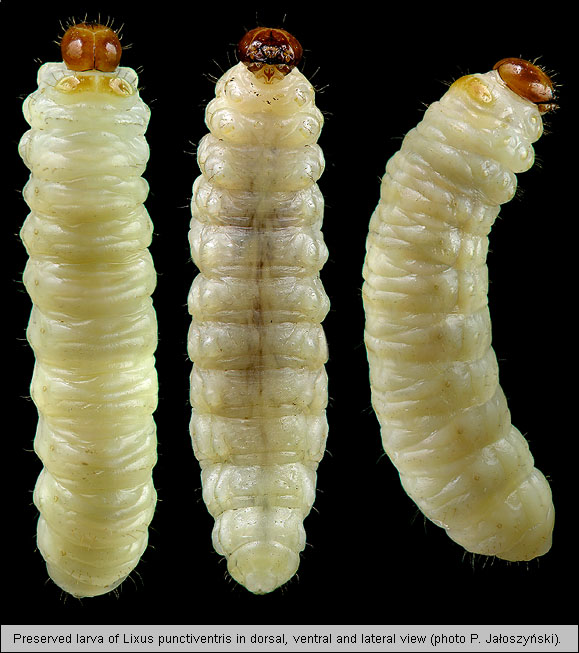
The larvae are cream-colored with a dark testaceous head capsule and paired lightly sclerotised fields on the dorsal side of prothorax [Fig. W64.8], [Fig. W64.9], [Fig. W64.10], [Fig. W64.11], ca. 13-14 mm long as prepupae. They occupy the central tunnel of the stem, up to about 0.5 m above ground level, and their presence and feeding activity do not cause any visible change of the plant [Fig. W64.12]. One to four larvae per stem were observed, of distinctly different size when multiplied, and the largest larva always occupied the bottom of canal in the root neck, at most a few centimeters in the ground. The tunnel of a single larva is usually 10-15 cm long, and when there are more larvae in the stem, their workings are separated with stoppers made of mixed excrements and plant debris. A larva in the root neck produces a very short working and it rarely moves up in the stem. Pupation takes place directly in the tunnel, and no special chamber is built by the larva. The pupa [Fig. W64.13] is able to move fast along the tunnel when disturbed. It is possible thanks to rapid movements of the abdomen and presence of a transverse row of hard spines on most of abdominal tergites, catching on the working wall. Similar rows of spines are known in pupae of other species of Lixus, e.g. L. paraplecticus (L., 1758) and L. bardanae (F., 1787) (Scherf 1964), and such behaviour apparently serves for defence against other larvae still feeding in the same stem.
First adult reared from the pupa brought on 9 VII from Chęciny, emerged on 17 VII, and most adults from the larvae then collected were obtained until 25 VII. Analogously, the pupae found on 12 VII in PLP developed into adults 21-22 VII, so the pupal stage in this weevil can last 7-10 days under laboratory conditions. The signs of forthcoming metamorphosis are: fully dark rostrum, eyes and pronotal disc, and slightly darkened abdominal end in the pupa. Final emergence, i.e. removal of pupal exuvium by the adult, is a surprisingly short process, taking less than 10 minutes. Luckily it could have been documented on a series of photos taken under stereoscopic microscope with digital camera Nikon Coolpix 4500, a selection of them has been combined in a gif file and can be seen as a kind of “film” in [Video W64.1] (the photographed beetle could not free one of its fore legs from the exuvium for long minutes, and finally it was helped with forceps, so the illustrated process is not complete). Normally the removal of pupal skin, starting from head, relies only on intense movements of abdomen and legs, and it can be successfully completed out of the stem tunnel, e.g. in a plastic vial.
For teneral adults it takes several days to harden and to get darker, and they do not feed for at least two days. In the laboratory (already in Wrocław) emerged beetles were fed with leaves of Senecio jacobaea and Hieracium umbellatum L., though not all accepted the latter plant. The red dust-like excretion never forms a thick layer on adults’ bodies in this species, and it appears progressively after a few days of feeding [Tab. W64.1]. It was not produced, or at most scantily developed only at pronotum base and mesanepisterna, in all 3 specimens refusing to eat H. umbellatum.
Another species of the Asteraceae family, recorded as a true host plant for L. punctiventris for the first time, is Picris hieracioides L. It was controlled in Dobromierz and Chęciny, and on both sites weevil larvae were detected in the slightly swollen root neck, but not higher in the stem (except one small larva reported by J. Kalisiak), being usually thinner than in Crepis biennis and devoid of an open central channel. Development in Picris is completed earlier than in Crepis (about 2 weeks in 2007), probably due to earlier oviposition. An almost fully darkened beetle was found there on 12 VII. Unlike on Crepis, a minority of Picris plants contained weevil larvae, only those largest and usually having the stem multifurcate at base.
Senecio jacobaea, the main host listed by Scherf (1964), was found inhabited by the weevil only once by Ł. Mielczarek in the Murawy Dobromierskie Reserve [Tab. W64.2].
Considering a very high rate of infected host plants, which themselves are common and widespread species in Poland, L. punctiventris must not be as rare herein as it results from just a few literature records. Also the range of this weevils in Poland could be expected wider than hitherto documented. A very occasional reception of adult beetles by collectors is probably caused by their habit to spend most time on the ground, not on the host plants, on which they are seen sporadically. Moreover, the beetles are very sensitive on plants, easily show fall-down reaction, followed by long-lasting thanathosis [Fig. W64.14]. It turned out during photographic sessions of reared adults, that they actively avoid climbing plants, do not want to grasp when put on leaves, stems or flowers, and soon rush to fall down [Fig. W64.15].
As it results from Polish literature records, active adults of L. punctiventris are usually collected in the spring, from mid-April to about mid-May (although up to 11 VII in my studies). Like for many lixines, early spring is a time of dispersal of overwintered beetles, and searching by them for the host plants, being still too early for oviposition. A very early adult activity of a stem-boring weevil, living on late-growing plants that produce suitable stems about two months after first weevils become active, may seem evolutionary disadvantageous. Likely, an explanation could be competition for the best plants to oviposit, in which the first eggs are laid as soon as the root neck of (the) plant rosette becomes thick enough to be chosen by females for oviposition, and probably long before the stem becomes proper to grow up. Hence the oldest larva is always in the root neck region, and eventual further inhabitants of the same plant must develop from eggs laid into a grown stem much later on. Considering the estimated time of development of a larva that occupies the root neck as about 6 weeks, and observed differences in size between 3-4 larvae found in the same stem of Crepis, the time of oviposition may be extended to more than a month. An adult parasitoid, identified by M. Schwarz as Aritranis nigripes (Gravenhorst) of the family Ichneumonidae, was found 14 VIII 2007 near the castle in Chęciny in the larval tunnel of the weevil.
I thank Łukasz Mielczarek and Jacek Kalisiak for their valuable observations and sharing data of collected specimens, Jurek Szypuła for his assistance in field studies in PLP and Chęciny, and further laboratory work, Małgorzata Ossowska and Lech Buchholz for their hospitality and logistic help in field studies in Hollycross Mts, Paweł Jałoszyński for excellent photos of preserved larvae and pupae and Martin Schwarz for identification of the parasitoid wasp. Witold Sobolewski, director of the Przedborski Landscape Park, and Stanisław Huruk, director of the Świętokrzyski National Park, are acknowledged for permitting field studies in protected areas under their authority.
Burakowski B., Mroczkowski M. & Stefańska J. (1993): Chrząszcze (Coleoptera) - Ryjkowce - Curculionidae, część 1. - Katalog Fauny Polski, 52 (XXIII: 19): 304 pp.
Mazur M. (1994): Rozmieszczenie ryjkowców (Coleoptera: Rhinomaceridae, Attelabidae, Apionidae, Curculionidae) na Pogórzu Dynowskim i Przemyskim. - Zesz. Nauk. Uniw. Jagiell. Pr. Zool. 40: 35-76.
Polentz G. (1936): Beiträge zur schlesischen Käferfauna. - Zeitschrift für Entomologie, Breslau 18 (1): 2-9.
Scherf H. (1964): Die Entwicklungsstadien der mitteleuropäischen Curculioniden (Morphologie, Bionomie, Ökologie). - Abhandlungen der Senckenbergischen Naturforschenden Gesellschaft 506: 1-335.
Smreczyński S. (1929): Kilka uwag o krajowych ryjkowcach. - Pol. Pismo Entomol. 7: 75-81.
Smreczyński S. (1955): Uwagi o zbiorze ryjkowców (Col., Curculionidae) T. Trelli. - Pol. Pismo Entomol. 23: 83-92.
Stachowiak P. (1999): Obserwacje nad występowaniem w Polsce ryjkowców z rodzaju Lixus Fabricius, 1801 (Coleoptera: Curculionidae). - Wiad. Entomol. 17 (3-4): 183-187.
Wanat M. & Mokrzycki T. (2005): A new checklist of the weevils (Coleoptera: Curculionoidea) of Poland. - Genus 16 (1): 69-117.