|
Weevil News |
http://www.curci.de/Inhalt.html |
No. 45 |
4 pp. |
2nd June 2009 |
ISSN 1615-3472 |
|
Stejskal, R. (2009): Finding circumstances of the weevil Trachystyphlus alpinus alpinus (Penecke, 1894) in Slovenia (Coleoptera: Curculionidae). - Weevil News: http://www.curci.de/Inhalt.html, No. 45: 4 pp., CURCULIO-Institute: Mönchengladbach (ISSN 1615-3472). |
|||||
Finding circumstances of the weevil Trachystyphlus alpinus alpinus (Penecke, 1894) in Slovenia (Coleoptera: Curculionidae)
by
Robert Stejskal (Bítovánky)
with 8 photos
[Stejskal]
Manuscript received: 30th March 2008
Manuscript accepted: 28th May 2009
Abstract
In August 2007, the weevil Trachystyphlus alpinus alpinus (Penecke, 1894) was collected in large numbers at the locality Zgornje Jezersko, in the environs of Kranjska Koča Cottage, Slovenia. Collecting method was sifting alpine grasslands in an altitude of 1500-1750 m a. s. l., especially under the carpets of Caryophyllaceae. Two plant species - Silene vulgaris and especially Cerastium alpinum - bore distinct feeding marks (mines) on/in their leaves, which were most likely created by larvae and adults of this weevil. This observation contributes to the current biological knowledge of this weevil.
Key words
Biology, Curculionoidea, Trachystyphlus alpinus alpinus, host plants, Cerastium alpinum, Silene vulgaris, Slovenia.
Abstrakt
Nosatec Trachystyphlus alpinus alpinus (Penecke, 1894) byl v srpnu 2007 sbírán v hojném počtu na lokalitě Zgornje Jezersko, okolí chaty Kranjska Koča, Slovinsko. Metodou byl prosev trávníků v (sub)alpinskémstupni (1500-1750 m), zejména pod koberci hvozdíkovitých rostlin (Caryophyllaceae). Na dvou druzích rostlin – silence nadmuté (Silene vulgaris) a především rožci alpském (Cerastium alpinum) – byly zjištěny nápadné požerky (miny) na listech, které s největší pravděpodobností způsobil žír larev a dospělců uvedeného nosatce. Pozorování doplňuje dosavadní poznatky o biologii druhu.
1. Distribution and current biological knowledge
In this paper, a detailed report on the finding circumstances of the weevil Trachystyphlus alpinus alpinus Penecke, 1894 in Slovenia in 2007 with data on two possible host plants at the study site is presented.
Trachystyphlus alpinus Penecke, 1894 (= Trachysoma alpinum (Penecke, 1894)) is a weevil distributed in the Alps and Southern Carpathians. It is known from Italy, Austria, Slovenia and Romania [Dieckmann 1986] and Poland [Wanat & Mokrzycki 2005], [Knutelski & Sprick 2007]. Within the species the following subspecies are distinguished: Trachystyphlus alpinus alpinus (Penecke, 1894), T. alpinus beigerae (Smreczynski,1975), T. alpinus italocentralis (Osella & Zuppa 1994), T. alpinus julicus (Osella & Zuppa 1994) and T. alpinus schatzmayri (Osella & Zuppa 1994) [Osella & Zuppa 1994, Alonso-Zarazaga 2007]. T. alpinus beigerae (Smreczynski 1975) is sometimes treated as separate species,T. beigerae (see [Wanat & Mokrzycki 2005]).
The subspecies T. alpinus alpinus, treated in this paper, is restricted to northern Italy (Veneto), Austria and Slovenia [Osella & Zuppa 1994, and Osella, pers. comm.]. According to Alonso-Zarazaga [2007], this subspecies is also distributed in Poland, but this record is probably erroneous [M. Wanat, pers. comm].
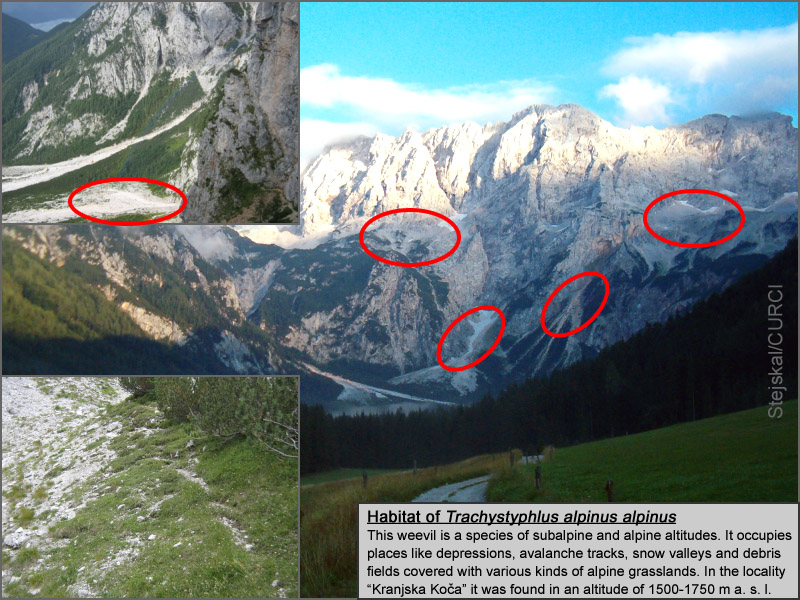
Osella & Zuppa [1994] summarized the ecological data of Trachystyphlus alpinus s. l. While in the Eastern Alps (Austria) it was also collected in the subalpine zone [Franz 1974], in Italy it was not found below 1800 (the Alps) or 2000 m a. s. l. (the Apennines) under stones in depressions filled with snow [Osella 1972, 1977]. In the mountains of Veneto (north-eastern Italy), T. alpinus alpinus is common in some places where snow persists for a long time [Osella, pers. comm.]. Dieckmann [1986] mentioned findings of the weevil also by sifting, pitfall trapping and beating from plants, from May to end of August. Some records fall in September [Osella & Zuppa 1994]. Hence, the species may have hibernated in the adult stage. It seems to be bound on calcareous mountains exclusively [Osella & Zuppa 1994].
It reportedly lives on plants of the family Caryophyllaceae [Dieckmann 1986]. Dieckmann [1986] referred to Franz [1974] who collected several specimens of this species by beating from a Heliosperma species which bore feeding marks on its leaves. According to Dieckmann & Behne [1994], the weevil also lives on Cerastium alpinum L. and its larva is a leaf-miner. The closely related T. alpinus beigerae mines the leaves of Cerastium latifolium L. [Dieckmann 1986].
2. Observations in Slovenia
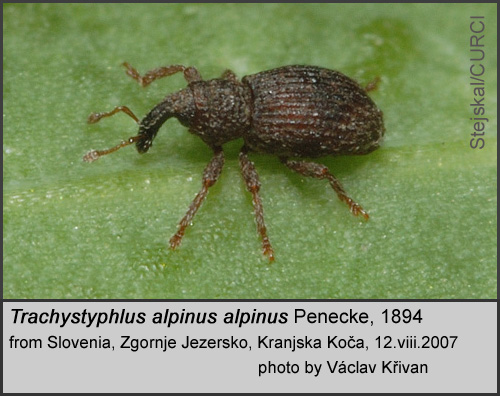
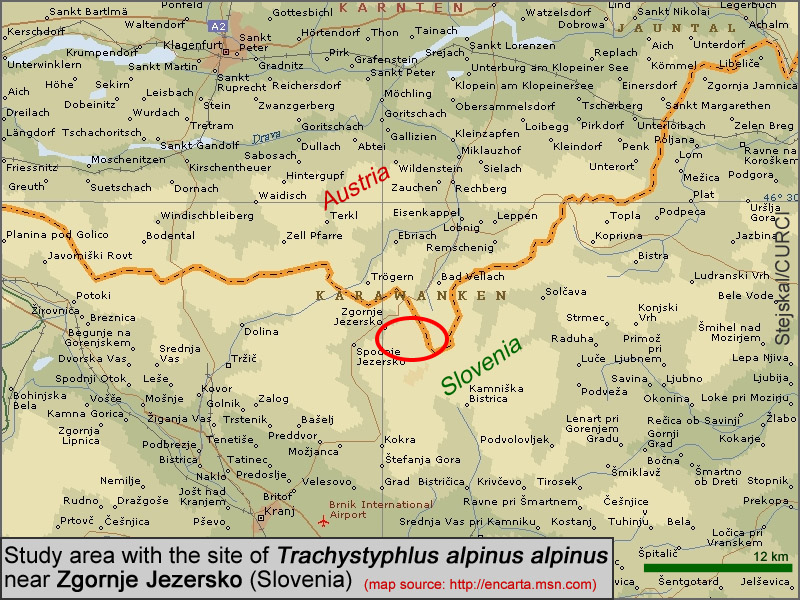
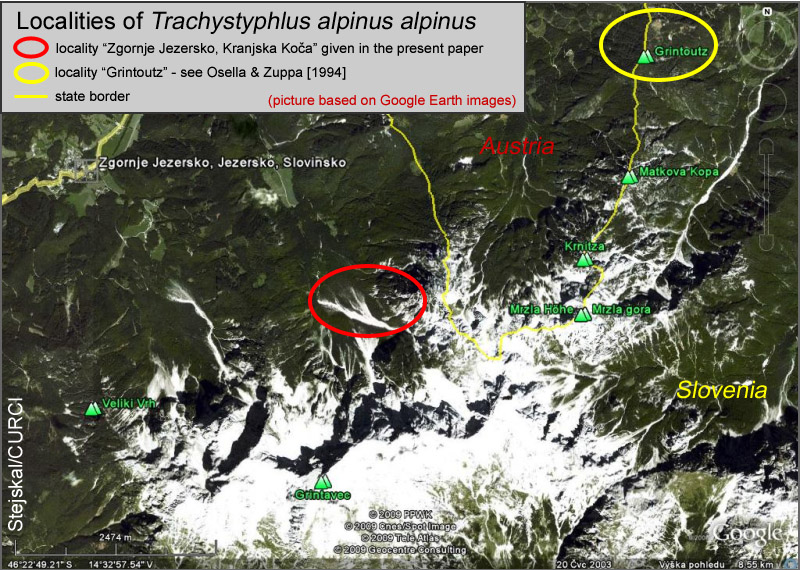
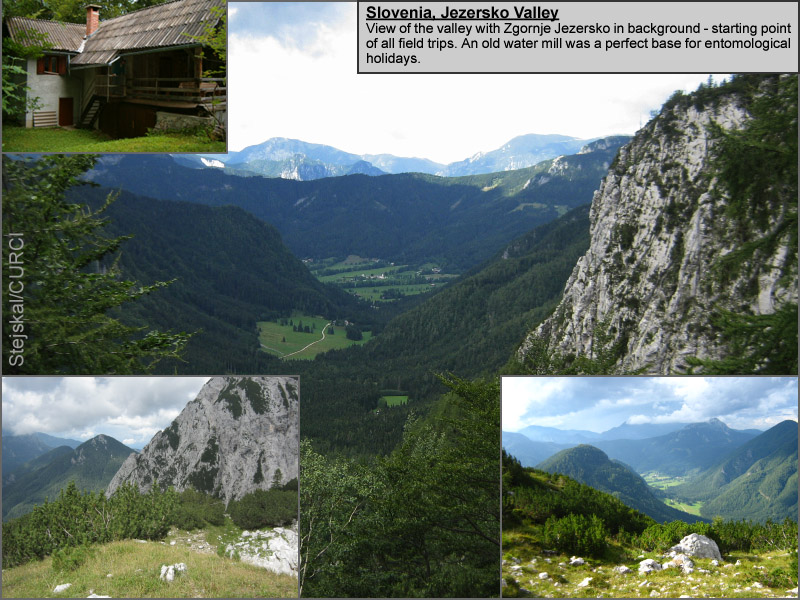
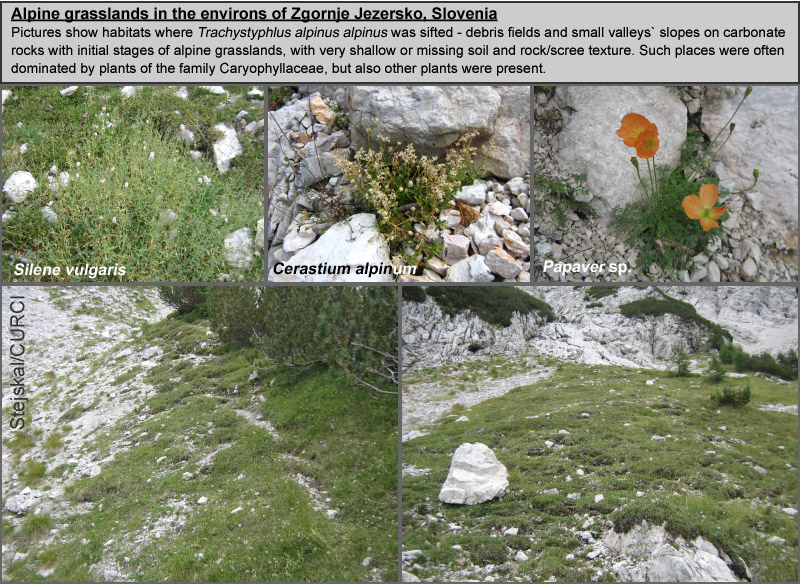
Material collected: Trachystyphlus alpinus alpinus Penecke, 1894 [Fig. W45.08], Slovenia bor., Kamniško-Savinjske Alpe Mts., ca 3 km SE of Zgornje Jezersko, Grintavec Mt., near Kranjska Koča Cottage [Fig. W45.01], [Fig. W45.02], 1500-1750 m a. s. l., 12. viii. 2007, 45 specimens collected by sifting, R. Stejskal lgt., det. et coll. The prevailing habitat where the weevils were collected can be described as Alpine grasslands in the Alps with herbs and lichens on carbonate rocks (habitat code B44) according to the Map of Natural Vegetation of Europe [Bohn et al. 2000/2003].
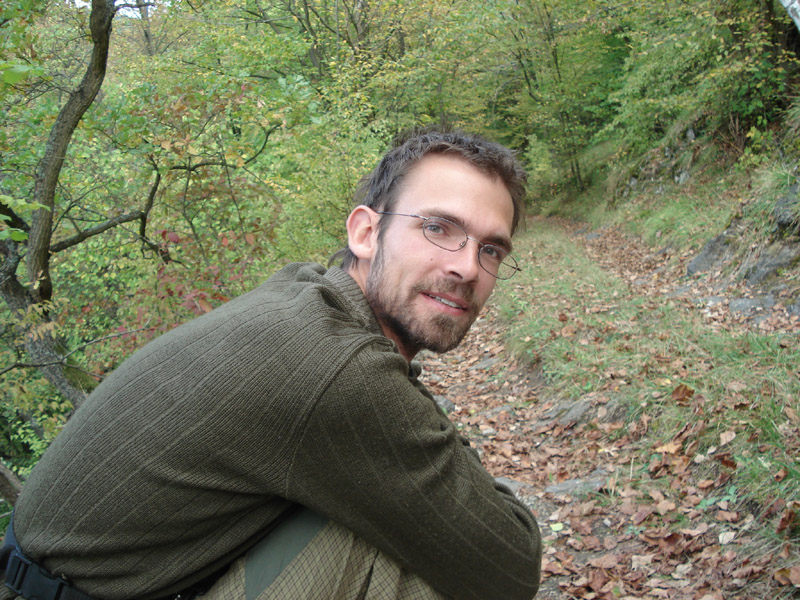
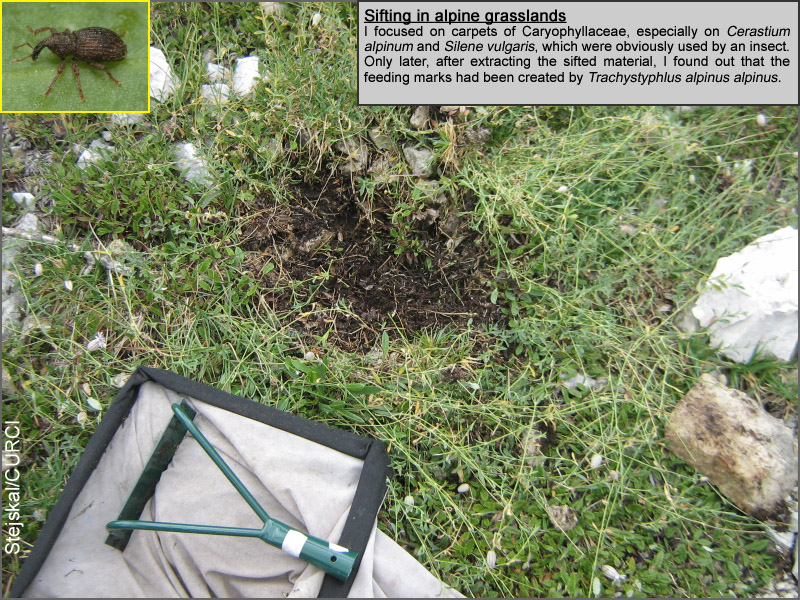
In 2007, I made a field trip in the vicinity of Zgornje Jezersko [Fig. W45.03] with the aim to find some of the local weevils. While following a tourist path in direction from Planšarsko Jezero Lake to the Kranjska Koča Cottage, which seemed suitable for a good weevil collecting for its wide range of (semi)natural habitats, I sifted under the carpets of plants [Fig. W45.04]. Places in elevations from about 1500 to 1750 m a. s. l. were studied, starting in Rhododendron-mountain pine scrub and completing in alpine calcareous grassland [Fig. W45.05].
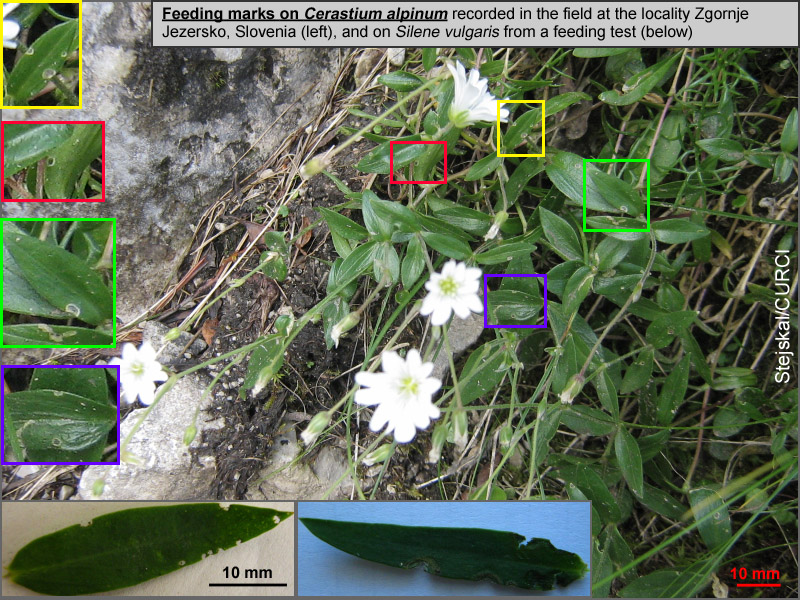
Among sifted plants, the family Caryophyllaceae dominated [Fig. W45.06], and I focused my efforts especially on two species with distinct feeding marks on the leaves. In the field the two plants were only identified as members of the family Caryophyllaceae. The examination of photos resulted later in a more precise identification: Cerastium alpinum L. (probably C. alpinum subsp. alpinum L.) and Silene vulgaris (Moench.) Garcke (probably S. vulgaris subsp. glareosa (Jord.) Marsden-Jones & Turrill), respectively. Especially on Cerastium numerous feeding marks of an insect were apparent, whereas Silene was a less suitable host [Fig. W45.07].
The sifted material (ca 3 kg) was taken to our holiday cottage in Zgornje Jezersko and afterwards extracted. Within two days 45 adults of Trachystyphlus alpinus alpinus and some other weevil species (Otiorhynchus spp. - not identified yet, and Leiosoma cribrum) were obtained from the sifted material. Some specimens of the weevils were kept alive and taken home to the Czech Republic for further study. I kept them in a simple plastic box. In a feeding test, Silene vulgaris subsp. vulgaris (Moench) Garcke (= Oberna behen, Silene inflata) collected in Znojmo (Czech Republic) was offered to the beetles. The beetles apparently fed on this plant creating rounded feeding marks, especially on the leaf margin [Fig. W45.07]. I tested no other plants to discover feeding preferences. No eggs were found on the leaves of the fed plants.
The feeding marks observed on the leaves of the tested plant were very similar to those of the plants in the field. So it is very likely that both, Cerastium alpinum and Silene vulgaris, were used by the studied weevil. My finding of two possible host plants of different genera shows that T. alpinus alpinus can feed oligophagously on plant species of the family Caryophyllaceae. Under extreme climatic conditions, specialization on a single host plant could be a handicap. Thus, this weevil is able to colonise the most easy available host plants of the family Caryophyllaceae in its alpine environment.
Acknowledgements
I am most grateful to Peter Sprick (Curculio-Institute, Hannover) for his comments on the manuscript and Giuseppe Osella (University of L’Aquila) for help with literature and comments on the species distribution. My thanks go also to Marek Wanat (Museum of Natural History, Wrocław), Vit Grulich (Masaryk University, Brno) for their help with plant identification and Václav Křivan (Štěměchy) for the photo of a living adult of Trachystyphlus alpinus alpinus.
3. References
Alonso-Zarazaga, M.A. (2007):
Curculionoidea. In: Fauna Europaea Version 1.3 (19. April 2007). URL: http://www.faunaeur.org
Bohn, U., Neuhäusl, R. with contributions by Gollub, G., Hettwer, C., Neuhäuslová, Z., Raus, Th., Schlüter, H. & Weber, H. (2000/2003):
Karte der natürlichen Vegetation Europas / Map of the Natural Vegetation of Europe. Maßstab / Scale 1 : 2 500 000. Münster (Landwirtschaftsverlag) (Explanatory Text with CD-ROM, Legend and Maps).
Dieckmann, L. (1986):
Beiträge zur Insektenfauna der DDR: Coleoptera - Curculionidae (Erirhinae). - Beitr. Ent., 36(1): 119-181. Berlin.
Dieckmann, L. & Behne, L. (1994):
Ergänzungen und Berichtigungen zu Freude-Harde-Lohse "Die Käfer Mitteluropas", Band 11, 1983, 93. Familie: Curculionidae, p. 259-298, In: Lohse, G. A., Lucht, W. H. (1994): Die Käfer Mitteluropas, 3. Supplementband mit Katalogteil. - Goecke and Evers, 403 pp. Krefeld.
Franz, H. (1974):
Die Nordost-Alpen im Spiegel ihrer Landtierwelt IV, Coleoptera 2. - Universitätsverlag Wagner, 705 pp. Innsbruck, München.
Knutelski, S. & Sprick, P. (2007):
Report on weevil species collected in several regions of the Polish Western Carpathians in August 2004, (Coleoptera: Curculionoidea). - Snudebiller, 8: 245-258. Mönchengladbach.
Osella, G. (1972):
Notulae Curculionidologiche, II. - Bollettino dell'Associazione Romana di Entomologia, 27(3/4): 53-62. Roma.
Osella, G. (1977):
La Curculionidofauna dei pascoli d´alta quota d´Alpi ed Appennino. - Animalia, 4: 223-276. Catania.
Osella, G., Zuppa, A. M. (1994):
Gli Orthochaetini italiani. - Mem. Soc. ent. ital. Genova, 72: 277-309. Genova.
Wanat, M. & Mokrzycki, T. (2005):
A new checklist of the weevils of Poland (Coleoptera: Curculionoidea). - Genus, 16(1): 69-117. Wrocław.
Author:
Ing. Robert Stejskal PhD.
Bítovánky 9
675 26 Želetava
the Czech Republic
e-mail: rstejskal@centrum.cz