|
http://www.curci.de/Inhalt.html |
No. 44 |
5 pp. |
10th February 2009 |
ISSN 1615-3472 |
|
|
Skuhrovec, J. (2009): Biology and host plants of Donus
velutinus (Boheman, 1842) (Coleoptera: Curculionidae: Hyperinae). -
Weevil News: http://www.curci.de/Inhalt.html, No.
44: 5 pp., CURCULIO-Institute: Mönchengladbach (ISSN 1615-3472). |
|||||
Biology and host plants of Donus velutinus (Boheman, 1842) (Coleoptera: Curculionidae: Hyperinae)
by
Jiří
Skuhrovec (Prague)
With 36 photos
Manuscript
received: 18th November 2009
Manuscript
accepted: 27th January 2009
Abstract
New observations on biology, ecology and on two host
plants of Donus velutinus (Boheman, 1842) in western Romania are
presented. Saxifraga rotundifolia L. is recorded as host plant for the first time, and Rumex alpinus L. is confirmed as host
plant. Life strategy and development of this mountain weevil are
described, and larva, imago and host plants are shown by photos.
Key words
Biology, host plants, Saxifraga
rotundifolia, Rumex
alpinus, larva, pupa, Coleoptera, Curculionidae, Hyperini, Donus velutinus, Romania.
Zusammenfassung
Neue Beobachtungen zur
Biologie, Ökologie und zu zwei Wirtspflanzen von Donus velutinus (Boheman, 1842) in
West-Rumänien werden vorgestellt. Saxifraga
rotundifolia L. wird zum ersten Mal als
Wirtspflanze beschrieben, und Rumex
alpinus L. wird als Wirtspflanze bestätigt. Lebensweise und Entwicklung
dieser montan verbreiteten Rüsselkäferart werden charakterisiert, und Larve,
Imago und Wirtspflanzen werden mit zahlreichen Fotos vorgestellt.
1. Introduction
The genus Donus currently includes more than 100 Palaearctic species distributed primarily in the
European and Asian mountains, with several exceptions
in lowlands [Skuhrovec & Borovec 2007] [Skuhrovec 2008]. Their host plants belong to
several plant families, several species are monophagous, but the majority of
them are oligophagous or polyphagous.
The genus is currently divided into
two subgenera: Donus s. str. and Altaiodonus Legalov, 1999 (= Lepidoglanis Legalov, 1997) [Alonso-Zarazaga & Lyal 1999]. Legalov [Legalov 1997] established the subgenus Lepidoglanis
(preoccupied), with the type species Glanis
cupreus Legalov, 1997, by original designation, but did not explicitly
include any other species to this new subgenus. Unfortunately, I am not able to
recognize any differences between these two subgenera, despite I know the
description of Altaiodonus. This is why I do
not distinguish these subgenera here and in other papers, e.g. [Skuhrovec 2008].
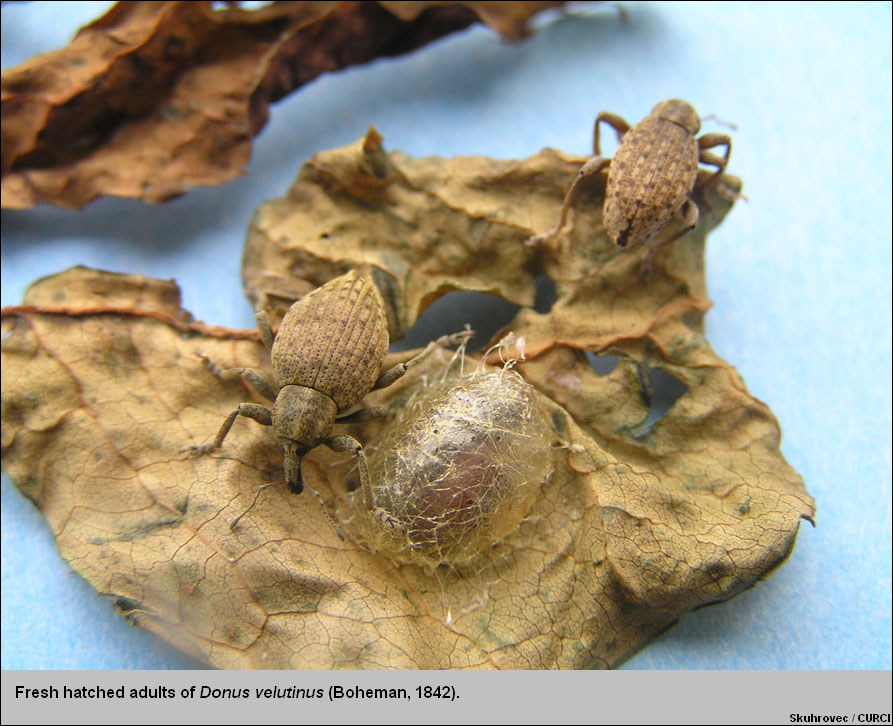
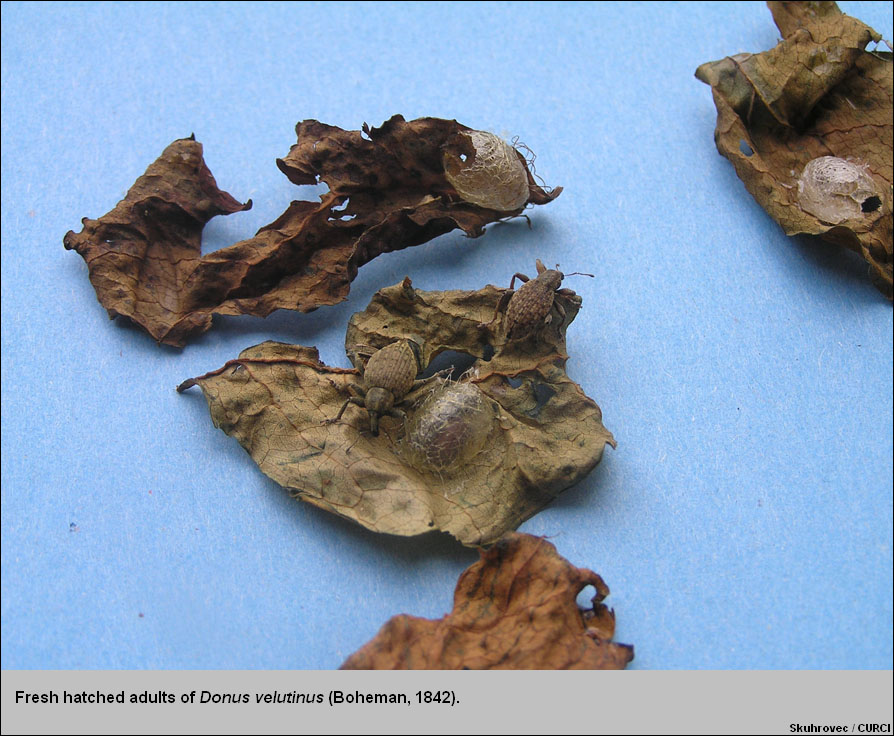
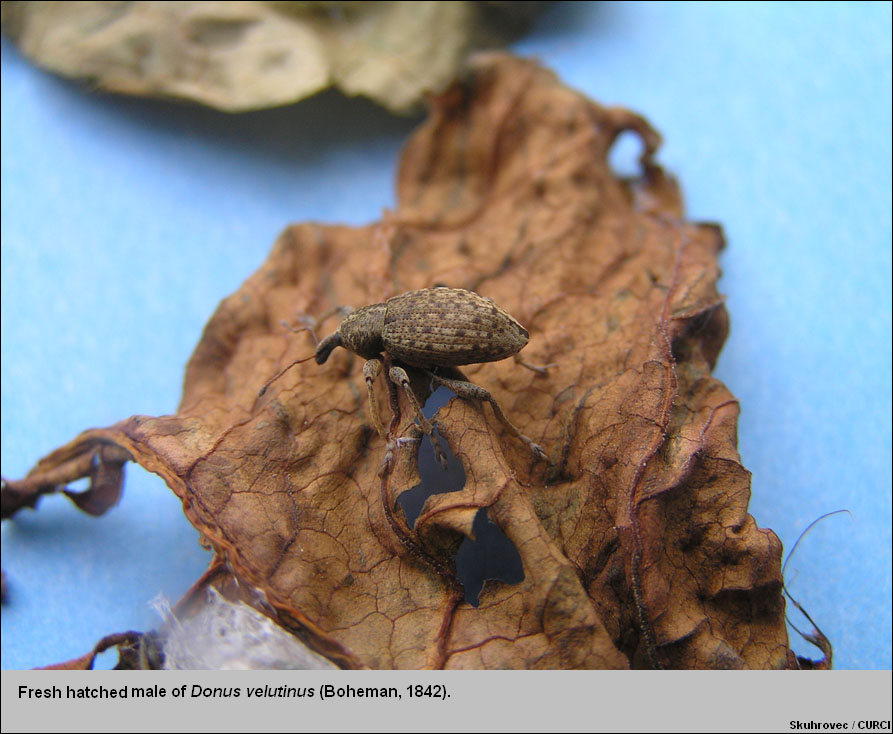
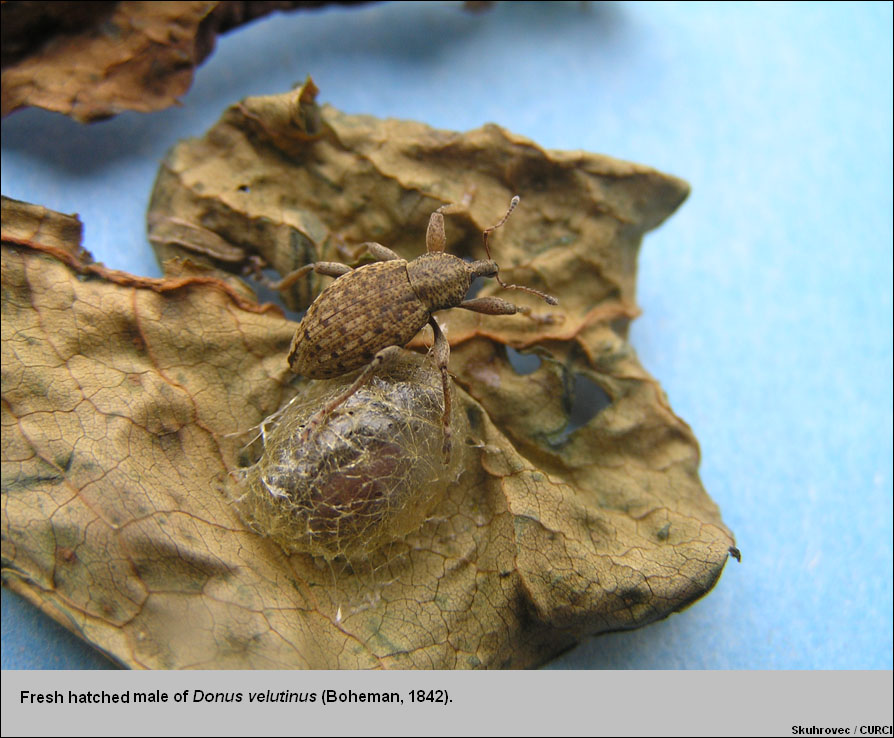
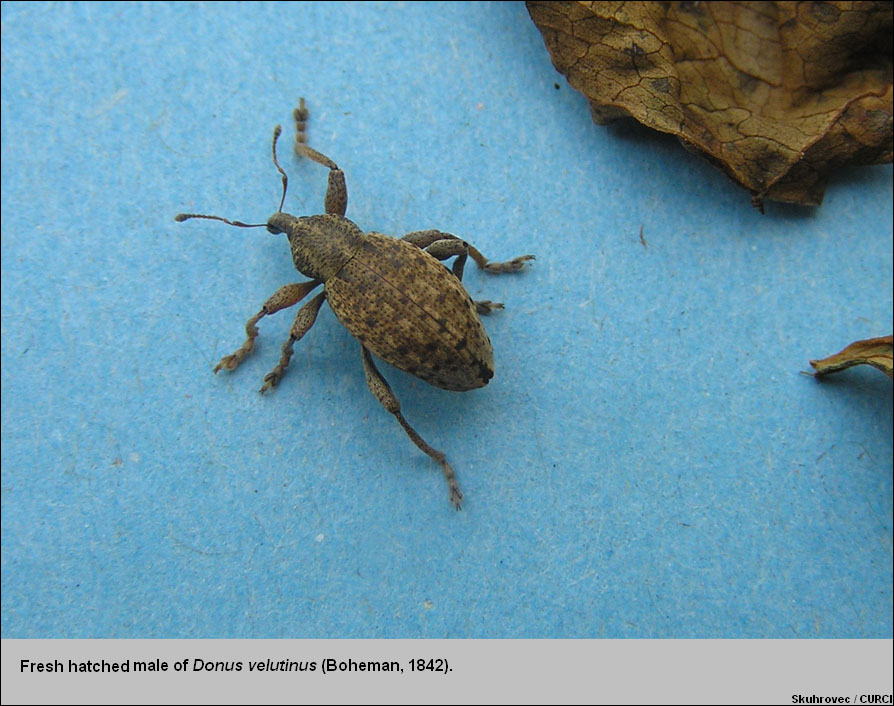
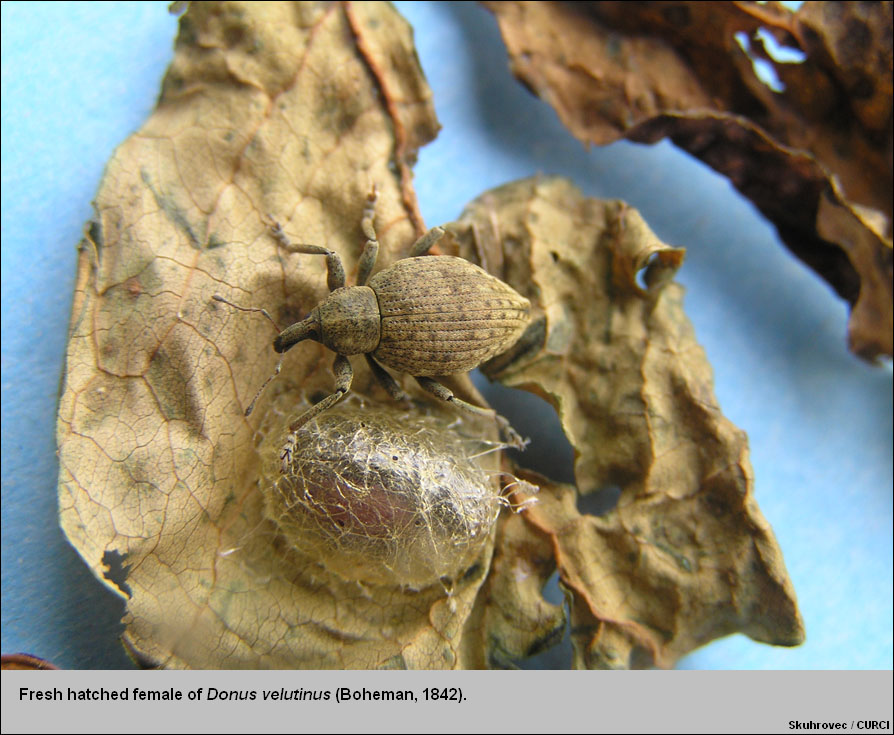
Donus velutinus
(Boheman, 1842) [Fig.
W44.01] [Fig.
W44.02] is a mountain
species which occurs on the banks of creeks [Koch 1992]. The species is distributed over Czech Republic
(?),
In the present paper, new observations on biology and
habitat of Donus velutinus (Boheman, 1842) in western Romania are
presented. Data on a new host plant are given, and another plant is confirmed
as food plant for the larva. Information about the host plants of this species
was obtained by rearing larvae to the adult stage with plants only from the
original habitat. The biology of this species is compared with that of other Donus species.
2. Material and Methods
The
weevils have been collected during the 5th International Meeting of the
Curculio-Institute which took
place in NW-Romania (Transylvania) in July
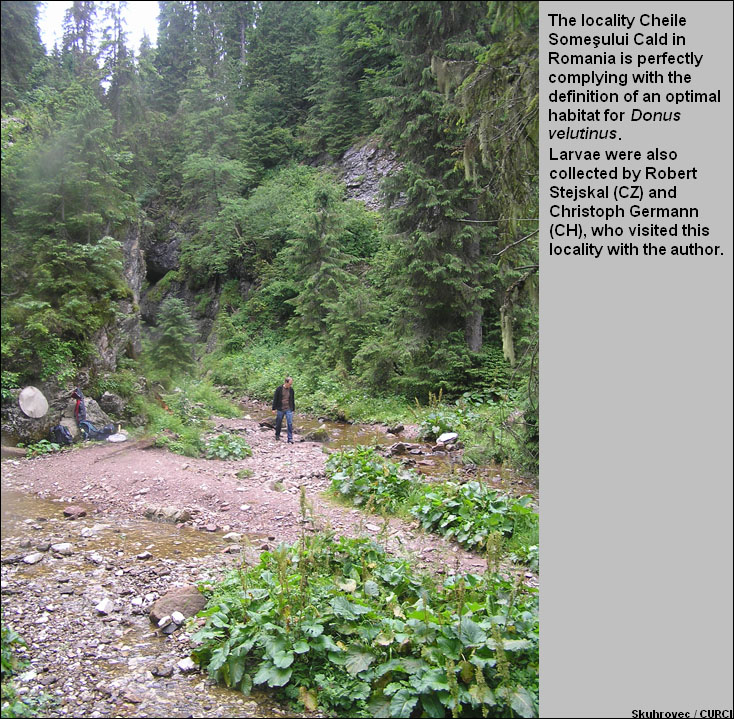
2008. The exact collecting data, written on the labels, are: ROMANIA: Apuseni Mts. / Muntii Bihori: Cheile Somesului Cald / 70 km WSW Cluj,
1270 m / N 46o37’95’’, E 22o42’55’’ / lgt. J. Skuhrovec, 25.vii.2008). Larvae were also collected by Robert Stejskal (CZ) and Christoph Germann
(CH), who visited this locality with the author.
3. Results
Biology of Donus velutinus
Koch [Koch 1992] classified Donus velutinus as a stenotopic, hygrophilous species occurring on creek banks. He characterizes it as
polyphagous species which develops on four host plants from four different
plants families: Aconitum napellus L.
(Ranunculaceae), Stellaria nemorum L.
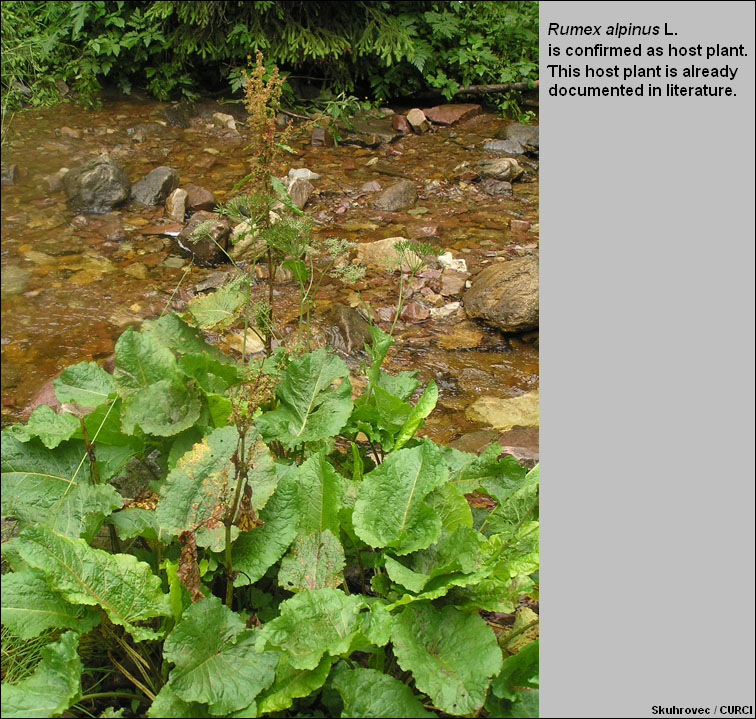
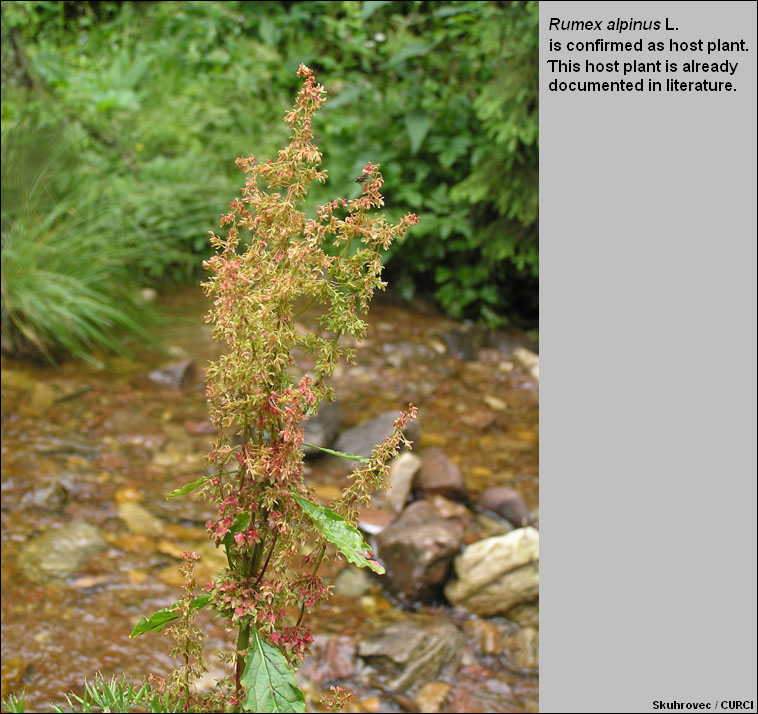
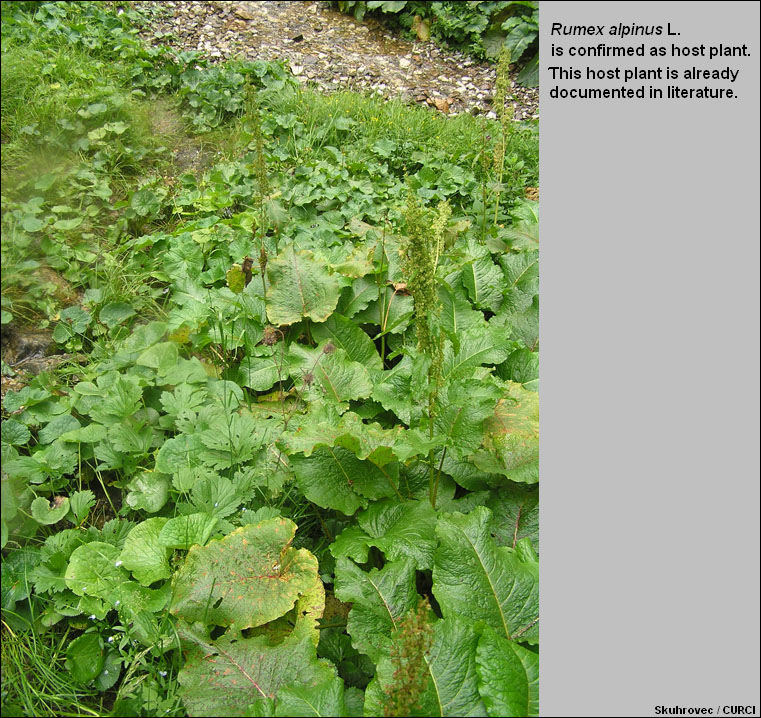
(Caryophyllaceae), Rumex alpinus L. (Polygonaceae) [Fig. W44.03] [Fig. W44.04] [Fig. W44.05] and Doronicum austriacum Jacq. (Asteraceae).
Dieckmann
[Dieckmann 1989] mentioned only three host plants: Aconitum napellus, Stellaria
nemorum and Doronicum
austriacum, not Rumex alpinus.
Roubal [Roubal 1941] listed also Salvia glutinosa L. (Lamiaceae) as host plant, but this potential host plant has never been
mentioned again. Roubal did not
specify his observations, and therefore, the credibility of this information is
not very high.
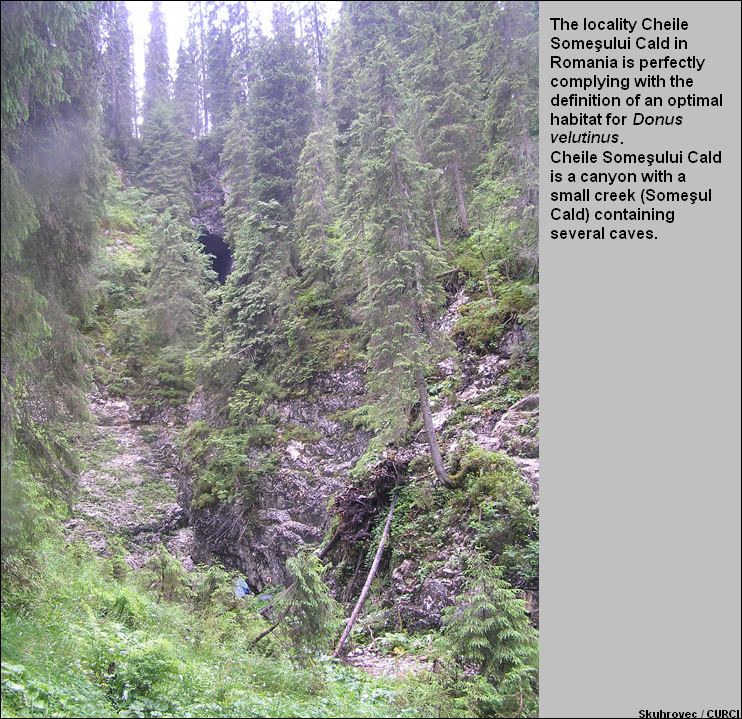
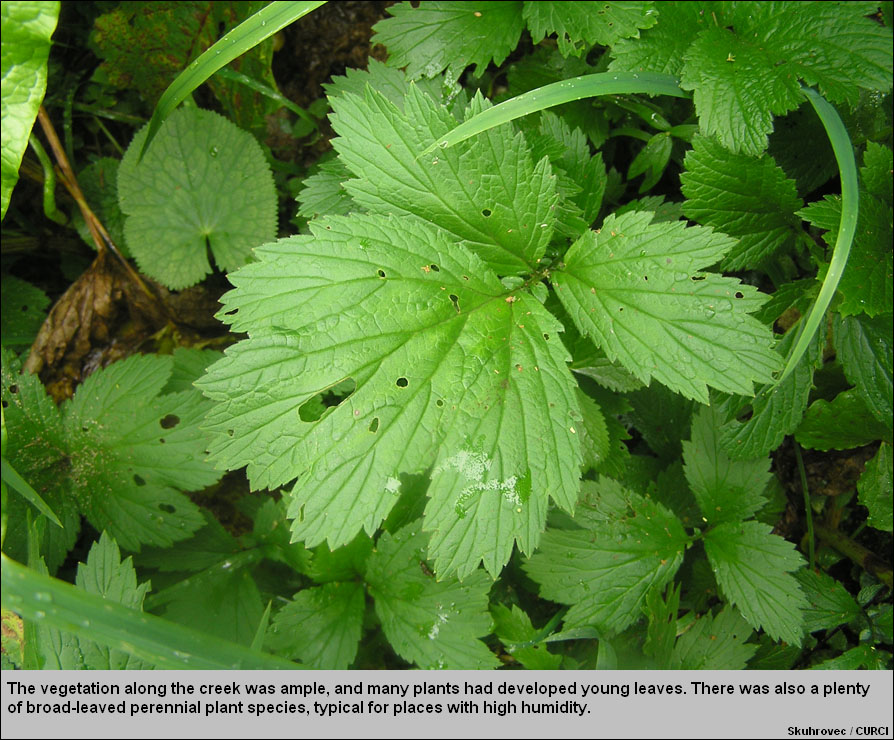
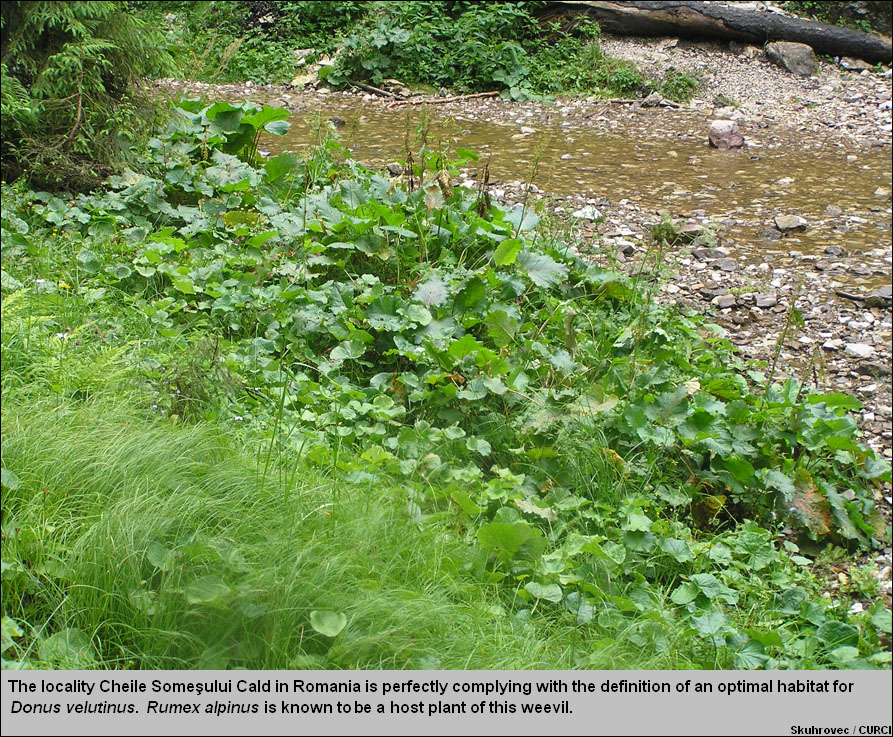
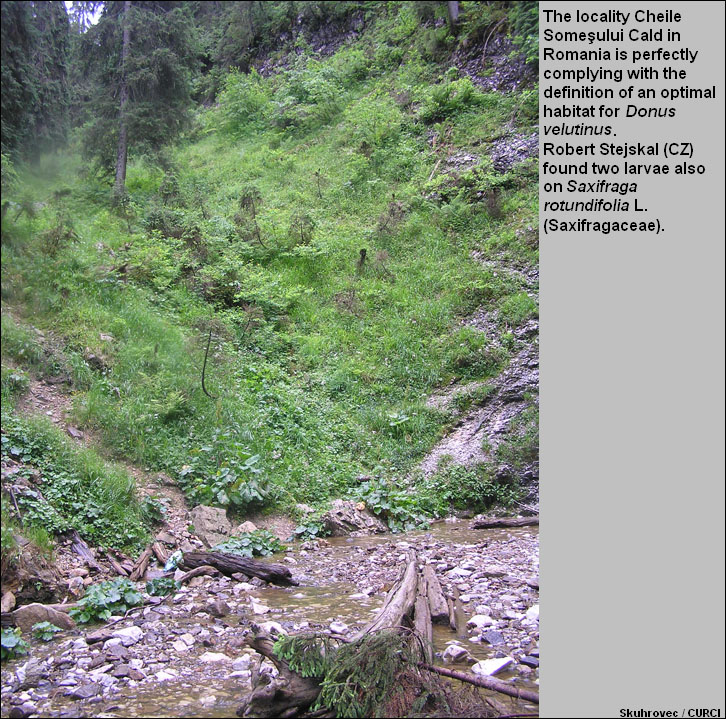
The locality Cheile Someşului Cald in
The main aim of this investigation was to
find larvae of Donus species. The first step was to sweep all the different plants along the banks of
the creek. The first larva was collected by sweeping Rumex alpinus L. after a short time [Fig. W44.09]. The individual search for
larvae on a definite plant began immediately after the identification of the
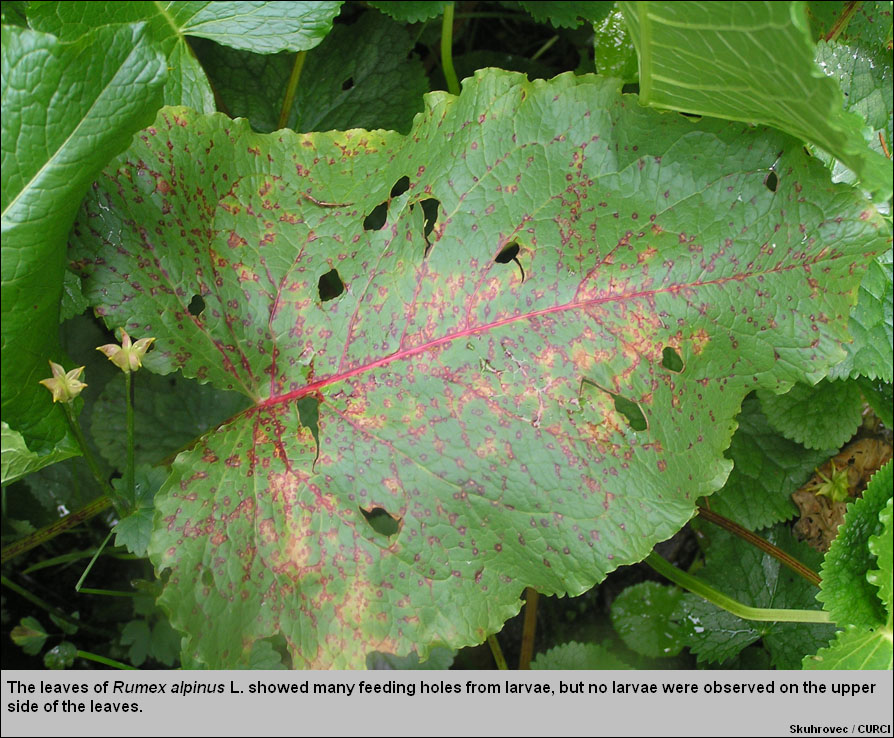
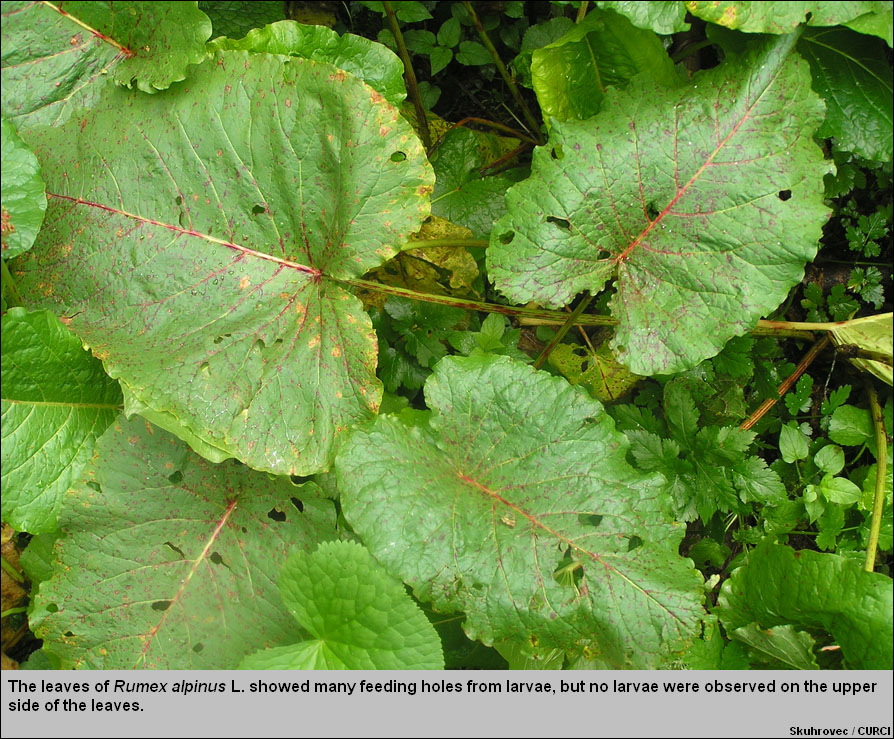
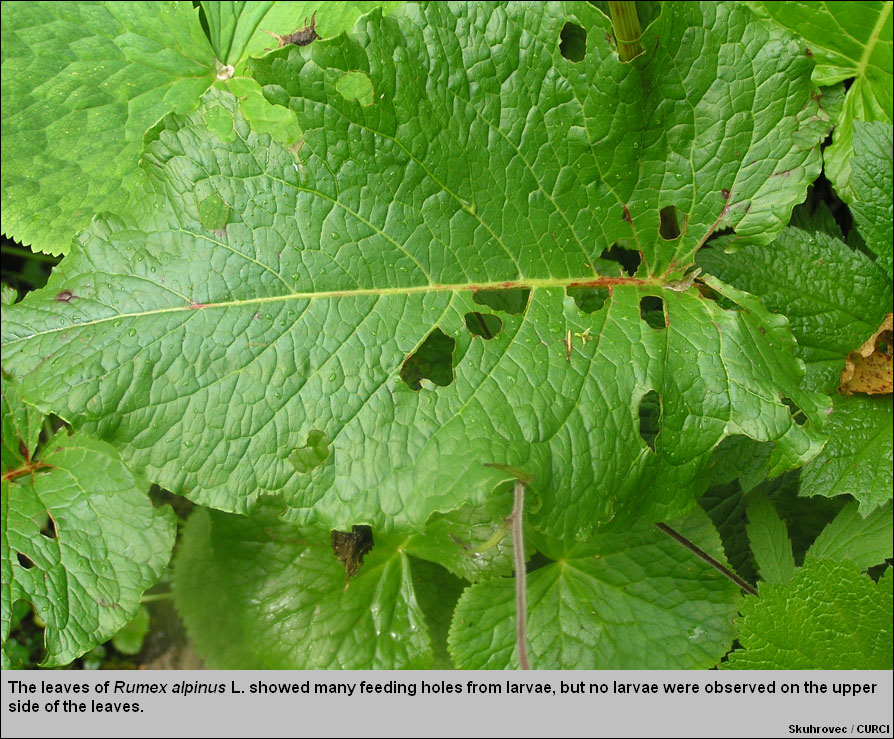
host plant. The leaves of Rumex alpinus
showed many feeding holes from larvae, but no larvae were observed on the upper
side of the leaves [Fig.
W44.10] [Fig.
W44.11] [Fig.
W44.12]. Then I considered the larval strategy
of different Donus species (Donus comatus (Boheman, 1842), D.
oxalis (Herbst, 1795), D.
palumbarius (Germar, 1821) and
others). All these species have relatively large
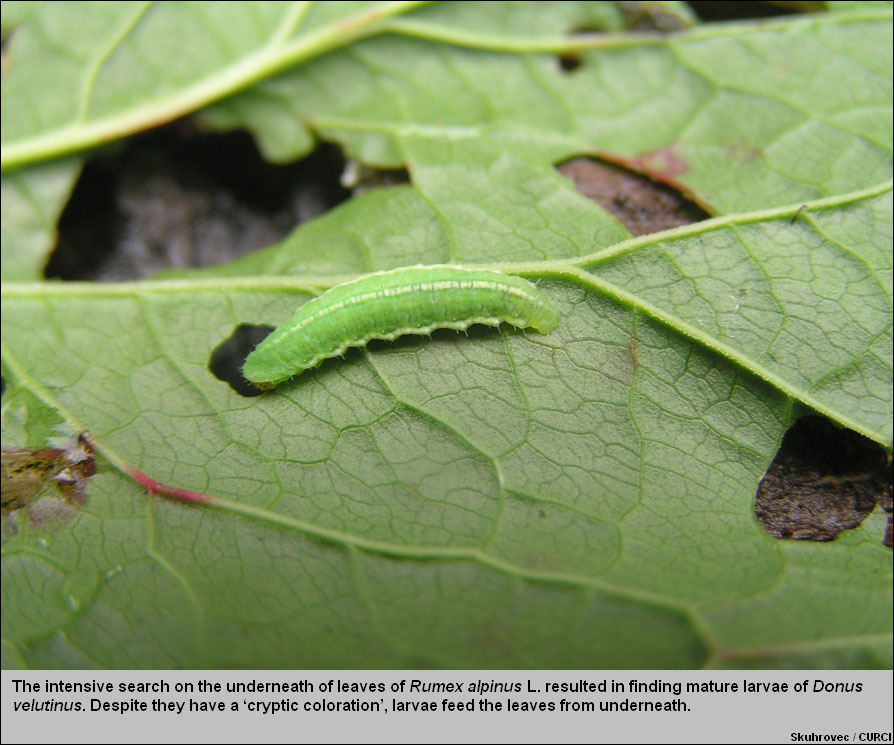
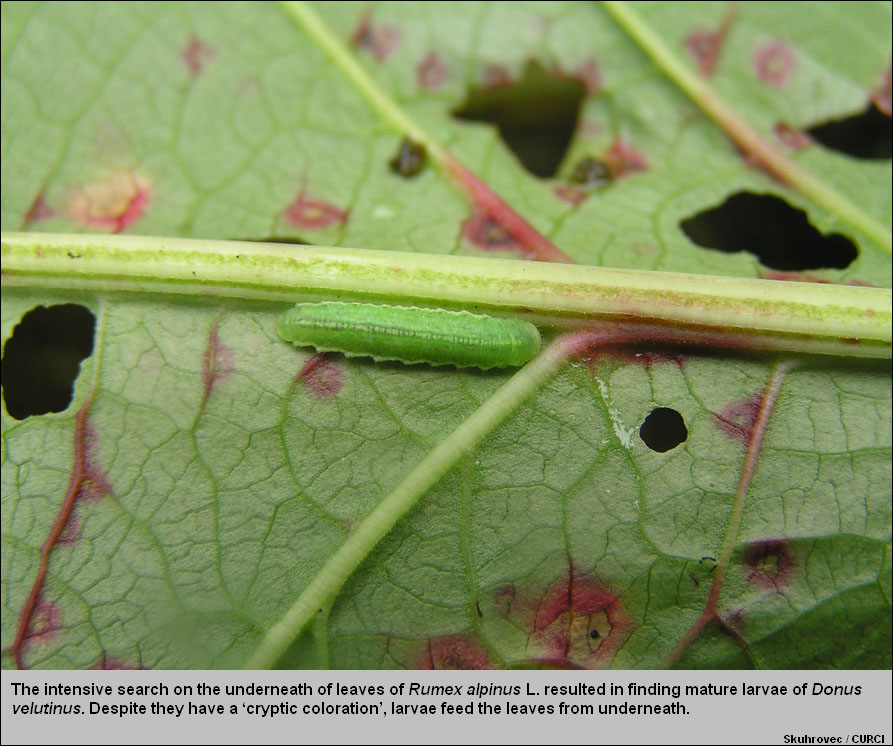
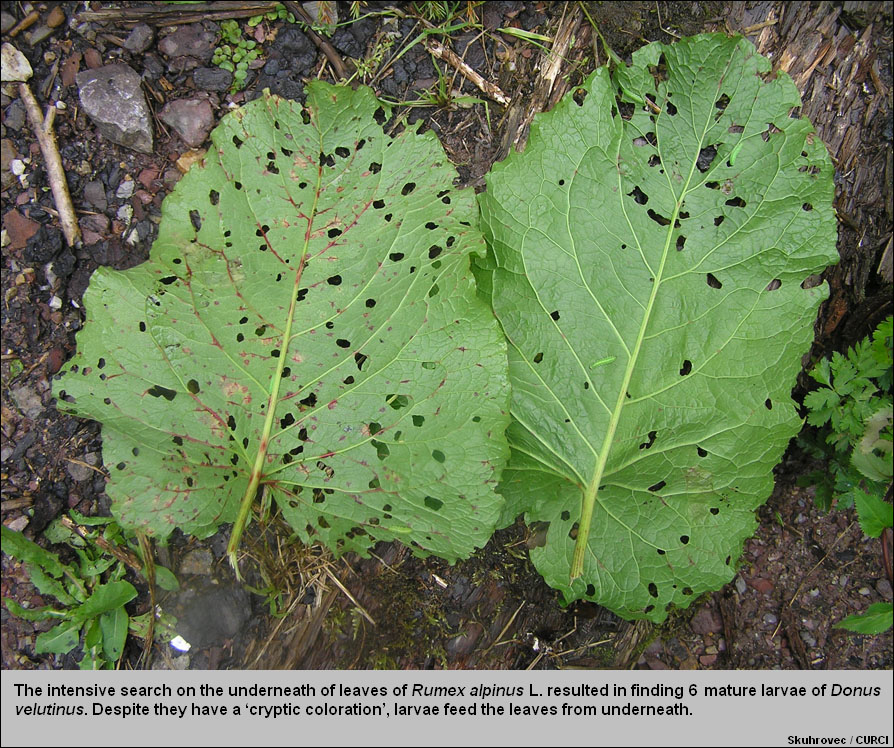
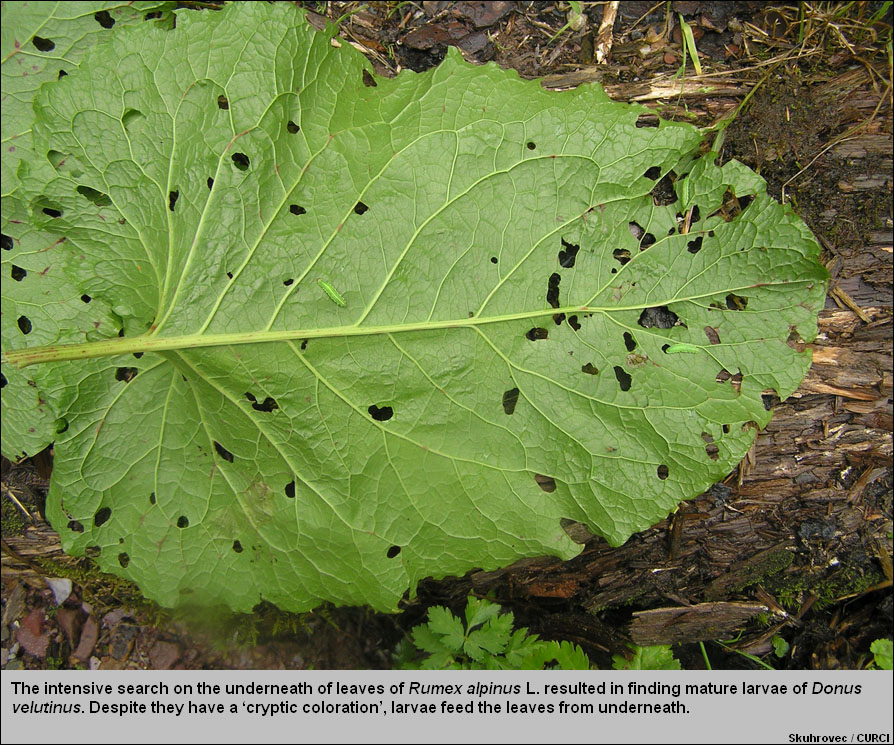
larvae compared to other Hyperinae. Despite they have a ‘cryptic coloration’ [Fig. W44.13] [Fig. W44.14], larvae feed the leaves from underneath [Fig. W44.15] [Fig. W44.16] and they behave this
way to decrease the possibility of attacks of parasitic wasps of the genus Bathyplectes Förster, 1869 (Hymenoptera: Ichneumonidae) or some predators. Larvae
of Donus velutinus have the same
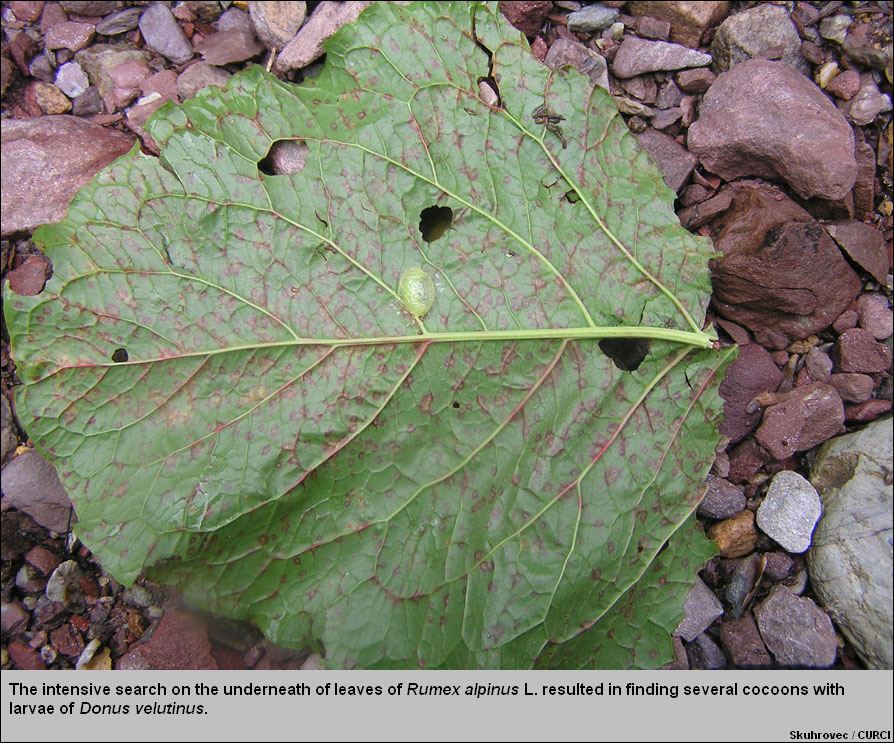
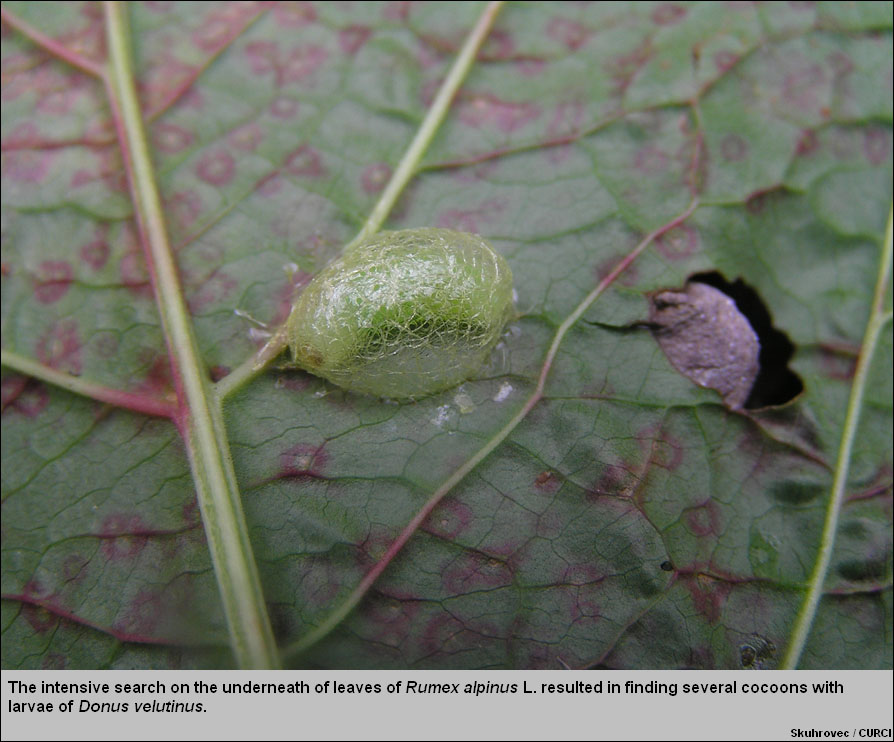
strategy. The intensive search on the underneath of
leaves resulted in finding of 7 cocoons
with larvae [Fig.
W44.17] [Fig.
W44.18] and later on also 5 mature larvae [Fig. W44.13] [Fig. W44.14] [Fig. W44.15] [Fig. W44.16]. The larvae
were put in breeding boxes. A few of them (8) were fixed in Pampel liquid (4 parts glacial acetic acid, 6 parts 4%
formaldehyde, 15 parts 95% ethyl alcohol and 30 parts distilled water) [Skuhrovec 2007a] for future detailed morphological description.
Along the bank of
the creek, several interesting plants with many feeding holes were observed,
but no Hyperinae larvae were detected. Unfortunately, the presence of feeding
traces does not give evidence about the development on a definite plant, because
the feedings can be caused by the adults, too. A host plant is only a plant
that is consumed by immature stages. However, Robert Stejskal (CZ) found two
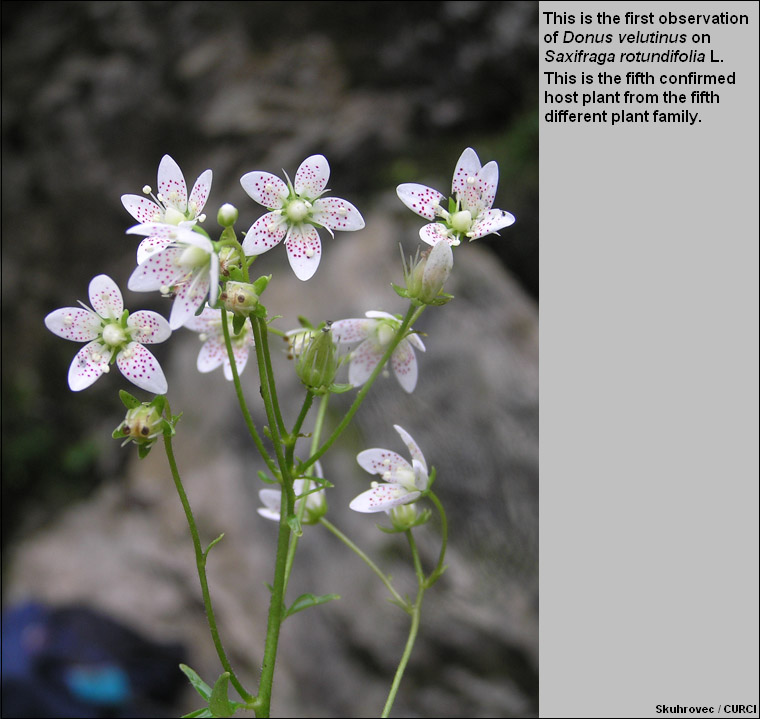
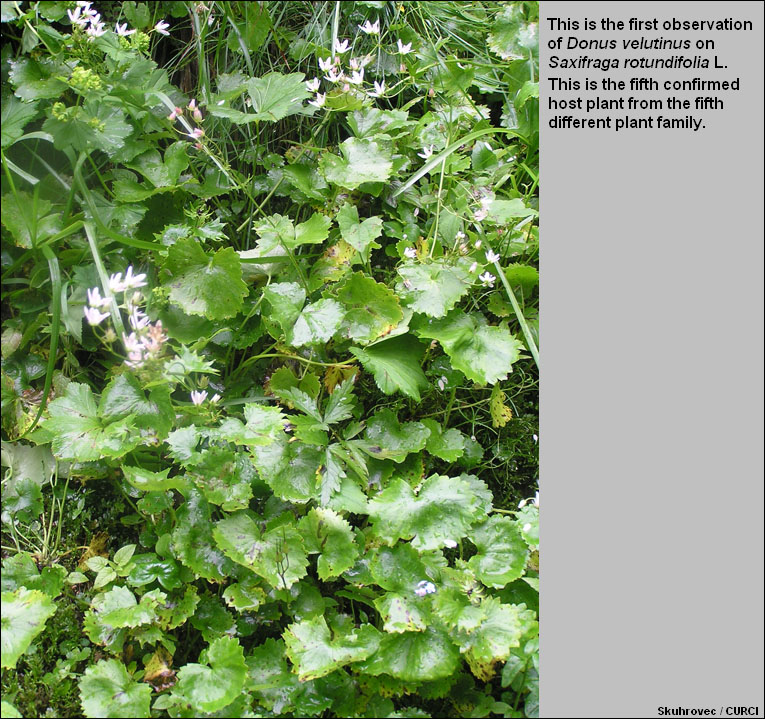
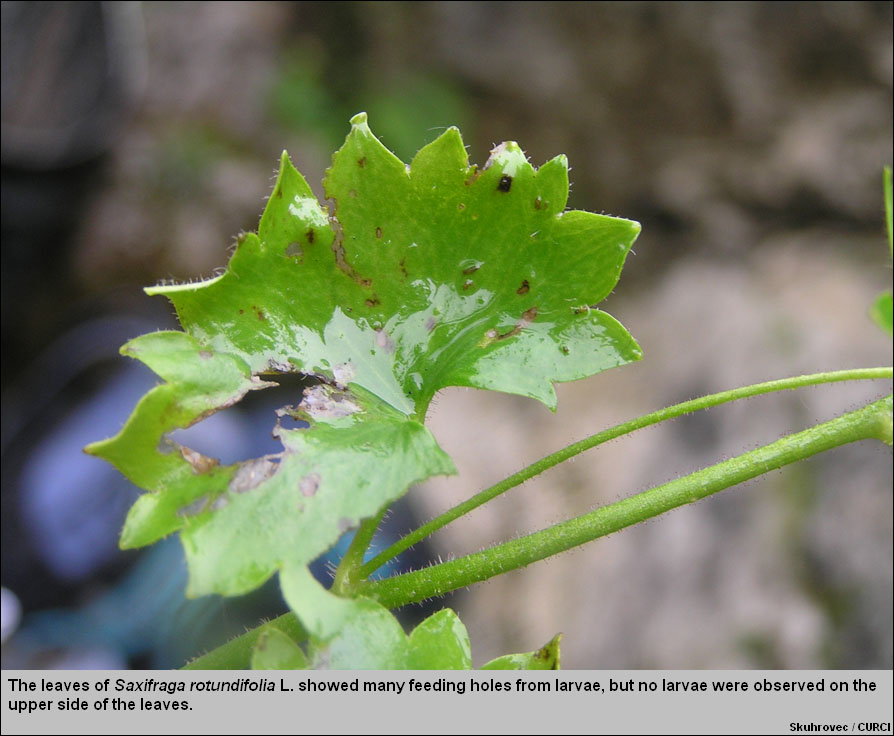
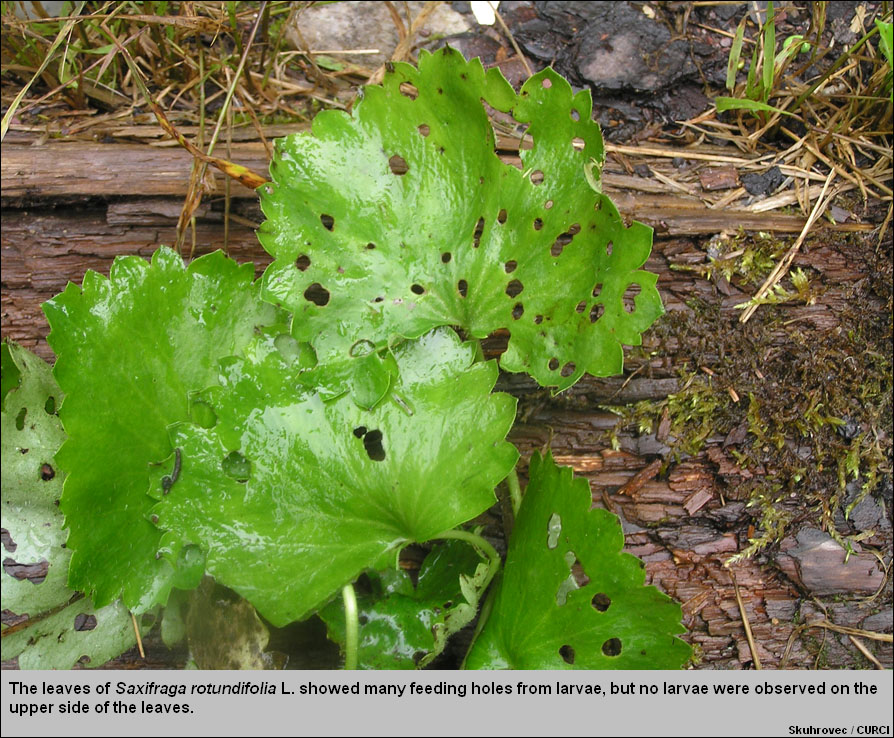
larvae also on Saxifraga rotundifolia L. (Saxifragaceae) [Fig. W44.19] [Fig. W44.20] [Fig. W44.21]. This was the first observation of Donus velutinus on Saxifraga rotundifolia.
This is the fifth confirmed host plant from the fifth different plant family.
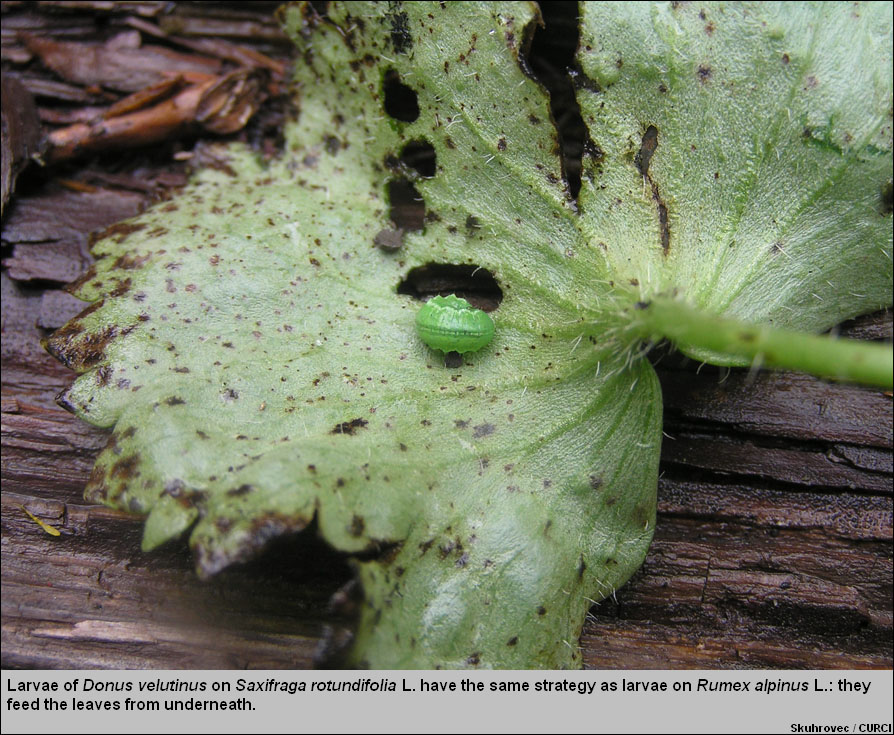
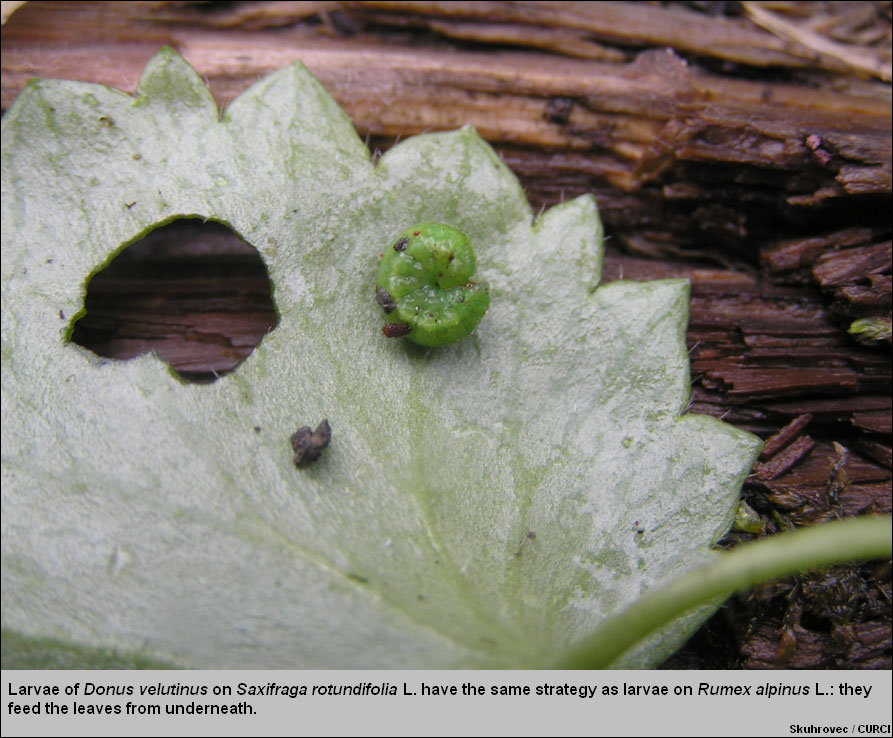
Larvae on Saxifraga rotundifolia [Fig. W44.22] [Fig. W44.23] have the same strategy as larvae on Rumex alpinus: they feed the leaves from
underneath [Fig. W44.24] [Fig. W44.25]. By exact observation of
the new host plant, several
mature larvae (3)
were found. One of them was also fixed in Pampel liquid for a comparison with the
larvae that have been developing on Rumex
alpinus.
Near the locality of Donus velutinus, Donus rubi (Krauss, 1900) was
also collected which is known to be a mountain specialist on Rubus idaeus L. and R.
hirtus W. K. (Rosaceae) [Smreczyński 1968] [Koch 1992].
Adults were collected by sweeping Rubus
sp. and/or by beating Sorbus
sp. (Rosaceae). These findings of
adults on Sorbus sp. do not confirm
this plant as a host plant, but only as adults’
food plant. End of July is too late to search for larvae of this species at
this Romanian locality.
Larval and pupal development
The larvae are typical ectophagous Hyperinae larvae: they have a greenish
coloration with white longitudinal stripes on the dorsum [Fig. W44.13] [Fig. W44.14] [Fig. W44.15] [Fig. W44.16] [Fig. W44.22] [Fig. W44.23]. A detailed description of larvae was not published
yet, but it is in preparation. All collected larvae had already developed into
the last stage - fourth instar (L4,
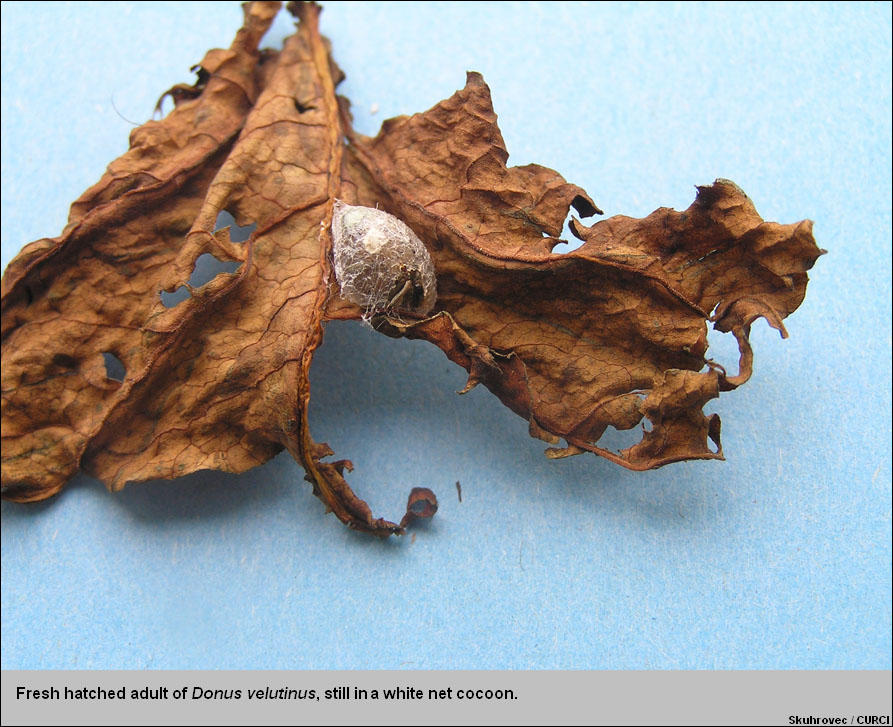
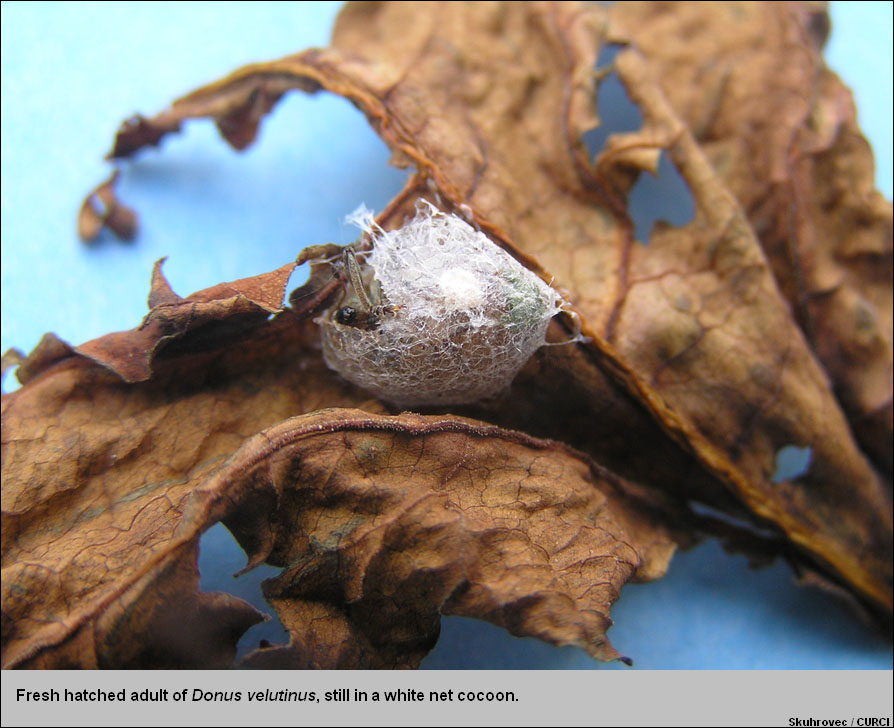
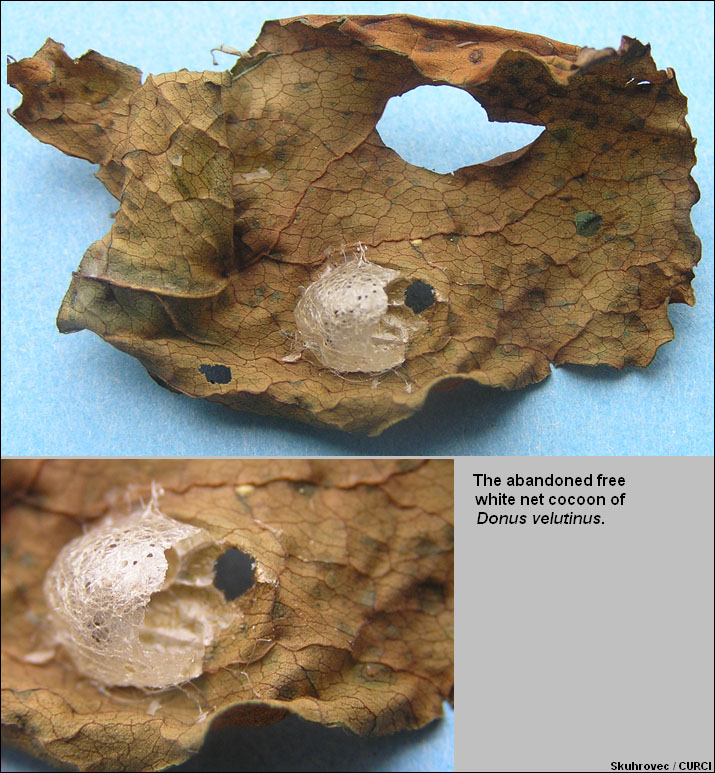
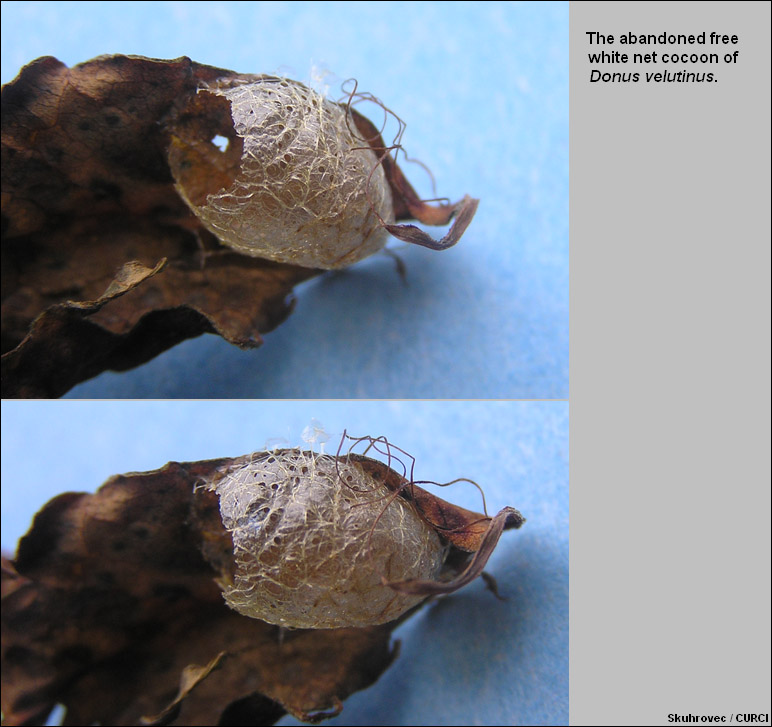
mature larva). The larvae created the net cocoons in a short time [Fig. W44.17] [Fig. W44.18] and finished their larval development
successfully [Fig.
W44.26] [Fig.
W44.27] [Fig.
W44.28] [Fig.
W44.29].
The pupal development lasts two weeks under the assumption of an
average temperature of 20 °C and a photoperiod of 16L: 8D. The pupal
development of Donus species lasts
about two weeks. For comparison, in Hypera
species it takes only one week [Skuhrovec 2007b].
Of course, the pupal development will be longer under natural conditions,
because of the lower average temperatures in nature.
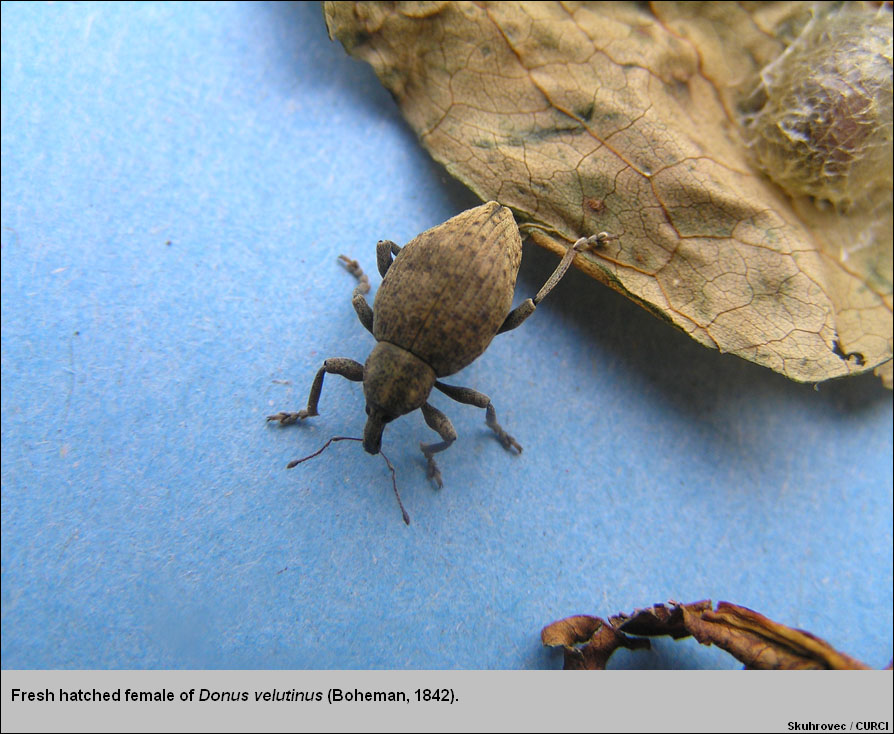
All pupated specimens hatched without any problems [Fig. W44.26] [Fig. W44.27] [Fig. W44.28] [Fig. W44.29] [Fig. W44.30] [Fig. W44.31] [Fig. W44.32] [Fig. W44.33] [Fig. W44.34] [Fig. W44.01] [Fig. W44.02]. None was
parasitised by Bathyplectes species or by another
ichneumon wasp. All adults ate leaves of Rumex
obtusifolius L. The feeding
of adults is not regarded as a proof for the utilisation of R. obtusifolius as a host plant of D.
velutinus. It was not
possible to use the leaves of confirmed host plants because none of them
occurred in the close environs of the author.
Acknowledgements
I want to thank all members of the CURCULIO-Institute
for one perfect week in Romania. Special thanks to Robert Stejskal (CZ) and
Christoph Germann (CH) for nice cooperation during the search for larvae. The
study was supported by a grant from the Ministry of Agriculture (Mze ČR)
CZ0002700604.
4. References
Alonso-Zarazaga M.
A. & Lyal C. H. C. (1999):
A World Catalogue of Families
and Genera of Curculionoidea (Insecta: Coleoptera) (Excepting Scolytidae and
Platypodidae). - S. C. P.
Edition, Entomopraxis, Barcelona, 315 pp.
Csiki E. (1934):
Coleopterorum Catalogus auspiciis et auxilio W. Junk editus a S.
Schenkling. Pars 137: Curculionidae: Subfam. Hyperinae. - W. Junk,
Berlin, 66 pp.
Dieckmann L. (1989):
Die
Zucht mitteleuropäischer Hyperini-Arten (Coleoptera, Curculionidae). - Entomologische Nachrichten und Berichte 33: 97-102.
Koch K. (1992):
Die Käfer Mitteleuropas. Ökologie. - Goecke & Evers, Krefeld, 371 pp.
Legalov
A. A. (1997):
Neue Taxone der Familien
Apionidae und Curculionidae der Rüsselkafer (Coleoptera) aus Sibirien. - Entomologica Basiliensia 20: 467-476.
Podlussány A. (1996):
Magyarország
ormányosalkatú bogarainak fajlistája (Coleoptera: Curculionoidea) (A Check-list
of the superfamily Curculionoidea (Coleoptera) of Hungary). - Folia
Entomologica Hungarica 57: 197-225 (in Hungarian, Title and
Summary English).
Roubal J. (1941):
Katalog Coleopter (Brouků) Slovenska a východních
Karpat na základě bionomickém a zoogeografickém a spolu systematický doplněk
Ganglbauerových Die Käfer von Mitteleuropa a Reitterovy Fauna Germanica. Díl
III. (Katalog der Coleopteren der Slowakei und der Ost-Karpathen auf bionomischer
und zoogeographischer Grundlage und zugleich Ergänzungen zu Ganglbauer’s „Die Käfer von Mitteleuropa“ und zu Reitter’s „Fauna Germanica”. III. Teil.). - Orbis,
Praha, 363 pp. (in Czech, German and French titles).
Skuhrovec
J. & Borovec R. (2007):
Revision of Donus caucasicus group (Coleoptera: Curculionidae: Hyperini). - Snudebiller 8, Studies on taxonomy, biology and
ecology of Curculionoidea:
154-175.
Skuhrovec J. (2007a):
Descriptions of larvae of the tribe Hyperini
(Coleoptera: Curculionidae): III. Mature larvae of the genus Donus. - Zootaxa 1606: 1-28.
Skuhrovec
J. (2007b):
Taxonomy and bionomy of the weevils of the tribe
Hyperini (Coleoptera: Curculionidae). - Unpubl.
Ph.D. thesis. Department of Zoology, Charles University, xlii + 221 pp.
Skuhrovec
J. (2008):
Taxonomic changes within the tribe Hyperini
(Coleoptera: Curculionidae). - Acta
Entomologica Musei Nationalis Pragae 48(2): 677-690.
Smreczyński S.
(1968):
Podrodziny
Tanymecinae, Cleoninae, Tanyrhynchinae, Hylobiinae. Klucze do oznaczania owadów
Polski; Cz. XIX: Coleoptera. Zeszyt 98c: Curculionidae. - PWN. Warszawa,
106 pp.
Strejček J. (1993):
Curculionoidea,
pp. 135-152. In: Jelínek J. (ed.): Check-list of Czechoslovak
Insects IV (Coleoptera). Seznam československých brouků. - Folia Heyrovskyana, Suppl. 1: 3-172 (in Czech).
Teodor L. A. & Antonie Vlad I. (2007):
Lista Faunistică a Romăniei (specii terestre şi de apă dulce):
Suprafamilia Curculionoidea. - In: Moldovan, O. T., Cîmpean, M., Borda, D.,
Lepure, S. & Ilie, V. (eds): Institutul de Speologie "Emil
Racoviţă". Casa Cărţii de Ştiinţă, Cluj-Napoca, 148-168.
Wanat M. & Mokrzycki T. (2005):
A new checklist of
the weevils of
Author:
Dr. Jiří Skuhrovec
Department of Herbology
Crop Research Institute
Drnovska 507
CZ – 161 06, Praha 6 – Ruzyne
e-mail: jirislav@email.cz