Weevil News
|
No. 27 |
5 pp. |
25th February 2005 |
ISSN 1615-3472
|
|
|
Komeza, N. & C. Germann (2005): New conclusions on the distribution of Onyxacalles
portusveneris (Mayet, 1903) in France
(Coleoptera: Curculionidae, Cryptorhynchinae). - Weevil News: http://www.curci.de/Inhalt.html,
No. 27: 5 pp., CURCULIO-Institute:
Mönchengladbach. (ISSN 1615-3472). |
|||||
New conclusions on the distribution of Onyxacalles portusveneris (Mayet, 1903) in France (Coleoptera:
Curculionidae: Cryptorhynchinae)
by
Nicolas Komeza (F-Albine) &
Christoph Germann (CH-Bern)
with
3
figures, 1 map and 2 tables
Keywords
Coleoptera,
Curculionidae, Cryptorhynchinae, Onyxacalles
portusveneris, France, Hérault, Gard, distribution, faunistical research,
bio-indicator, primeval forest, new records.
Zusammenfassung
Onyxacalles portusveneris (Mayet, 1903), aus
Frankreich seit langem aus den östlichen Pyrenäen bekannt, wurde nun erstmals
in den Departements Hérault und Gard entdeckt. Diese Funde erweitern das
bekannte Verbreitungsgebiet dieses Käfers erheblich. Die neue Verbreitung wird
dargestellt und diskutiert. Alle Exemplare wurden in immergrünen Steineichen- (Quercus
ilex L.) Wäldern nachgewiesen. Eine Hypothese über das natürliche Habitat
und eine Einschätzung über die ökologischen Bedingungen im Lebensraum werden
gegeben. Schließlich wird dargelegt, dass O. portusveneris in
Südfrankreich ein verlässlicher Bioindikator für lange Zeit bestehende, alte
immergrüne Eichenwälder ist.
Résumé
Depuis longtemps Onyxacalles portusveneris (Mayet, 1903) n’était
connue de France que des Pyrénées orientales. Dans cette étude, nous présentons
sa découverte dans les départements de l’Hérault et du Gard. Ces nouvelles
localisations élargissent considérablement la répartition connue de ce
charançon en Europe. Cette nouvelle distribution est présentée et discutée.
Comme l’ensemble des spécimens a été observé dans des forêts de Chêne vert (Quercus
ilex L.), une hypothèse concernant l’habitat naturel et les conditions
écologiques est émise. Les connaissances actuelles nous permettent de conclure
qu’ O. portusveneris est un indicateur biologique fiable attestant des
forêts de Chêne vert originelles du bassin méditerranéen.
Introduction
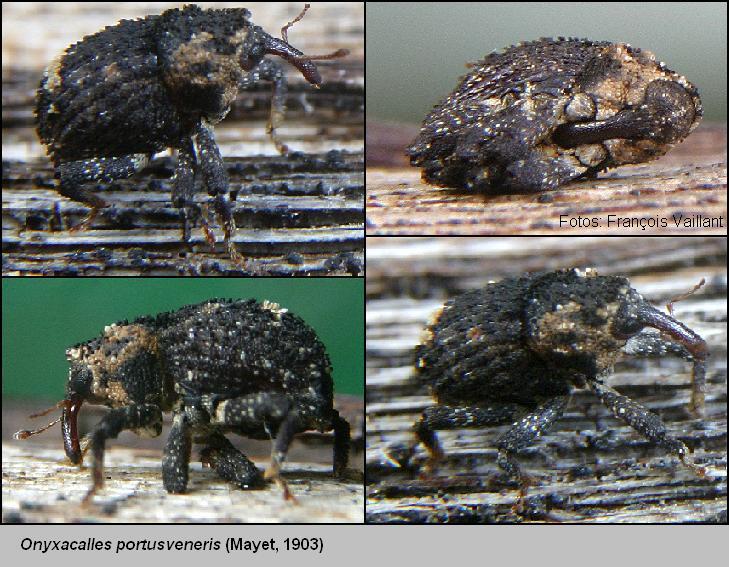
Onyxacalles
portusveneris [Fig. W27.1] was originally described by Mayet in 1903
as a variety of Onyxacalles henoni (Bedel, 1888). It was named after the
small seaport Port-Vendres 5 km away from the Locus typicus Collioure in
the eastern Pyrenean Mountains [Mayet 1903]. Stüben [Stüben 1999] raised this
variety to a well established proper species.
During the Moroccan excursions of members of the CURCULIO-Institute,
Mönchengladbach (Peter Stüben, Christoph Bayer and Christoph Germann) into the
Rif Mountains and the Middle Atlas Mountains in Winter 2001/2002, the
distribution of O. portusveneris
could be expanded strongly. Another excursion of Peter Stüben and Christoph
Germann into the High Atlas Mountains in Winter 2002/2003 [Germann 2003] showed that the distribution of O. portusveneris has its southern
borders in the most southern Quercus ilex-forests
of Morocco.
So far the distribution of Onyxacalles
portusveneris in Europe was restricted to the French-Spanish border region
around the Locus typicus [Mayet 1904] [Hoffmann 1958] [Stüben et al.
1999]. Stüben et al. concluded that this would be a relict distribution of O.
portusveneris; before man induced
historical ruination of the once dense forests in the eastern Pyrenean
Mountains, the whole area could have been a suitable habitat of O.
portusveneris.
The discovery of two Onyxacalles
portusveneris individuals near the river Hérault in the south of France
pushed one of the authors (N. Komeza) to pursue the investigations. Intensive
research for O. portusveneris was done in the French departments of
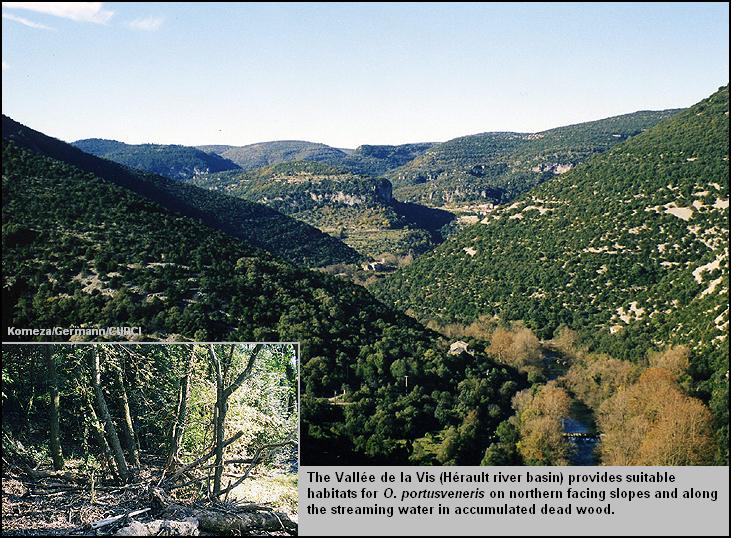
Hérault [Fig. W27.2] and Gard. Today, nine
locations of this species are revealed. In literature no records of O. portusveneris from the examined
area are available [Thérond 1976, 1980, 1986] [Schaefer 1987] Thereby the
distribution of this weevil in France could be strongly enlarged. Below the
circumstances of the new records and the records
themselves are presented and discussed.
Geography and Methods
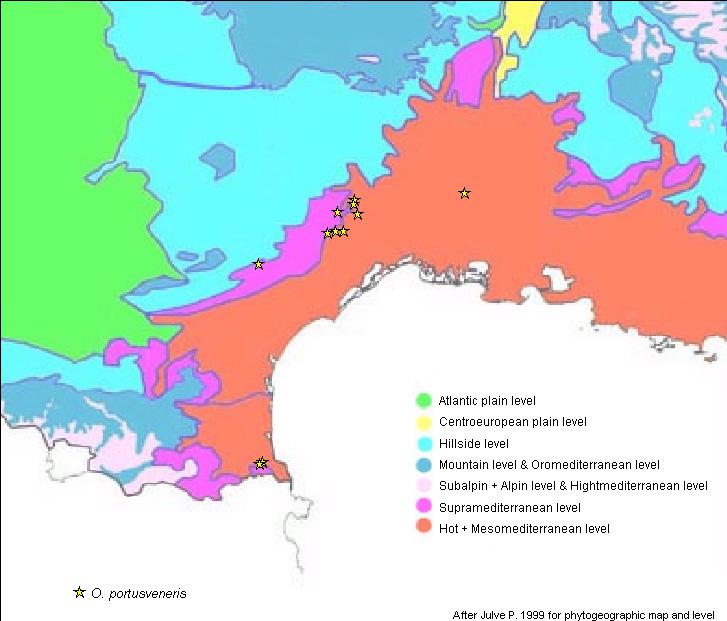
In the map
[Fig. W27.4] the
whole area of research is presented. The departments Hérault and Gard represent the
connection between the Mediterranean area (where the Locus typicus is situated) and the more southern mountains of the Massif
Central. The landscape is heterogeneous. Slopes of mountains are distorted with
rocky outcroppings. Climatic conditions correspond to wet Mediterranean
bioclimatic level. This area of slopes of mountains is covered by extended
woodland. The main tree species are Evergreen Oak (Quercus ilex L.) and
Pubescent Oak (Quercus pubescens Willd.).
Beyond climatic conditions and
Mediterranean vegetation, this area and all landscape along the coast to Spain,
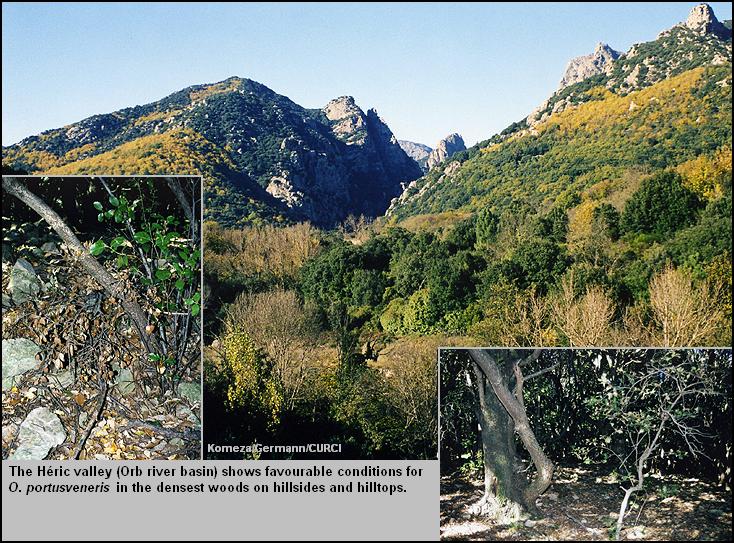
is characterized by small river basins. Principal river basins are Hérault [Fig.
W27.2], Orb [Fig. W27.3] and Vidourle. In an eastward direction,
the major Rhône basin borders the area.
The
discovery of the first Onyxacalles portusveneris exemplars in the wood
of an Evergreen Oak guided the search of more specimens. All further specimens
were found in or on the wood of Evergreen Oak.
To
collect the weevils, two established methods were used. With the beating sheet
wood and vegetation was examined. The beetle sifter was used to examine the
ground litter. All stations in the Hérault basin were sampled with the beating
sheet. Because of the extraordinary hot summer 2003, research was done not
before September, after first rainfalls when life restarted. Only dead branches
from the ground (diameter 2-12 cm) were beaten above the sheet.
In
the case of the Orb and Rhône stations, cold winter temperatures obliged to
collect with the sifter. Samples of ground litter were also taken near the
bases of trees, to pick up the hibernating specimens. The extracting method
follows Stüben [Stüben et al.
2000].
Results
In total
14 stations were prospected for O. portusveneris: 8 in the Hérault basin
[Fig. W27.2], 5 in the Orb basin [Fig. W27.3] and 1 in the Rhône basin. The stations are
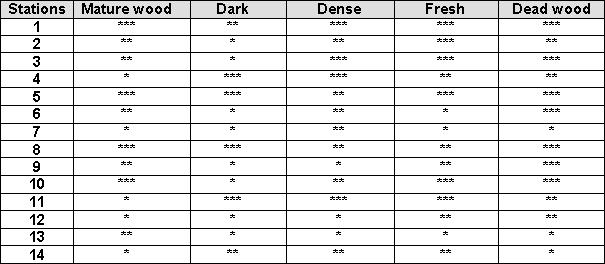
further ecologically characterised; see [Tab. W27.2].
1. France, Hérault: Puéchabon, Forêt de Puéchabon, 110 m – 10 IX 2003 – Quercus
ilex
2. France, Hérault: Causse-de-la-Selle, Bourgette, “La Buèges” valley, 105 m –
10 IX 2003 – Quercus ilex
3. France, Hérault: Gorniès, Longue Battue, 180 m – 10 IX
2003 – Quercus ilex
4. France, Hérault: Gorniès, La Séranne, 340 m – 10 IX 2003
– Quercus ilex
5. France, Gard: Blandas, les Poujols (Ruines), “La Vis” valley, 350 m – 11 IX
2003 – Quercus ilex
6. France, Hérault: Saint-Maurice-de-Navacelles, Ruisseau des Fontenilles, 360
m – 11 IX 2003 – Quercus ilex
7. France, Hérault: Arboras, Le Cabanou, 610 m – 11 IX 2003 – Quercus ilex
8. France, Hérault:
Saint-Guilhem-le-Désert, Lous Caubels, 470 m – 11 IX 2003 – Quercus ilex
9. France, Hérault: Mons, Gorges
d'Héric, Bertouyre, 550 m – 30 I 2004 – Quercus ilex
10. France, Hérault: Mons, Gorges
d’Héric, passerelle des soupirs, 180 m – 30 I 2004 – Quercus ilex
11. France, Gard: Cabrières, “Le
Gardons” valley, about 150 m – 6 II 2004 – Quercus ilex
12. France, Hérault: Olargues, Col du
Bouis, 350 m – 25 II 2004 – Quercus ilex
13. France, Hérault: Vieussan,
Ruisseau de Terrasse, 180 m – 25 II 2004 – Quercus ilex
14. France, Hérault: Vieussan,
Col du Bac, 240 m – 25 II 2004 – Quercus ilex
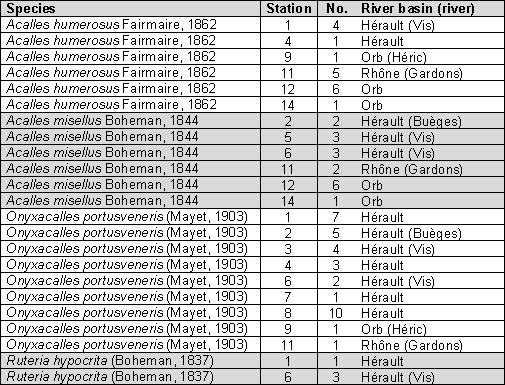
All species of Cryptorhynchinae at the 14 stations are presented in the species list [Tab_W27.1]. The records were
made
without exception nearby Quercus
ilex trees.
Altogether 4 species of Cryptorhynchinae
and 72 individuals were obtained. The species of principal interest, O.
portusveneris, was found in 34 individuals in 9 of 14 prospected stations.
Table 2: Descriptions of the ecological conditions at the
stations
(Legend: * little; ** fairly; *** very)
With these results, the habitat of O.
portusveneris can be characterised as dense, dark and little exploited evergreen
oak forest with great quantities of dead branches on the ground. An exception
is station No. 7. Only one exemplar of O. portusveneris was found there.
Discussion
The first question that comes
into ones mind: "Why was Onyxacalles portusveneris not discovered in this region before, very popular to
entomologists?" Several reasons may explain this:
- The discretion of this species
and its homochromy with the substratum, induced by its cryptic appearance.
- The absence of knowledge on ecology and habitat. It seems that this
species is relatively difficult to find during the favourable
season for most entomologists (from June to August).
- A certain refusal for collecting Cryptorhynchinae, considered to be
too difficult to identify.
- The confusion with other species like O. luigionii (A. & F.
Solari, 1907) or Ruteria hypocrita (Boheman, 1837). So it could be very
interesting to consult local entomologists and to verify their
Cryptorhynchinae!
The discovery of Onyxacalles
portusveneris in this well explored region could bring up the question, if
the species was possibly
introduced. This theory is not very unlikely, so the main distribution area is
inside of Morocco, and close commercial relationships exist since long time
between Spain, France and northern Africa. But as the results of this study
show, it seems that O. portusveneris appreciates old woods of Evergreen
Oak. This means forests with trees of bigger
size with stem diameters superior to 25 cm. Bushes consecutive to regeneration
by cutting or burning down by fire do not seem to favour the weevil.
Furthermore the woods colonized by O.
portusveneris principally have to keep a certain ground coolness and
humidity during the hot summer season. The ecological demands of the weevil,
estimated and shown in table 2 [Tab. W27.2]
are pushing strongly for a dark dense and humid primeval forest (excepting the
ecological circumstances of the unique exemplar of O. portusveneris at station n° 7).
The finding circumstances do not fit well in with the
introduction-theory, and we can even conclude that Onyxacalles portusveneris, as other members of the genera [Stüben
& Wolf 2001] [Germann & Stüben 2004], is a typical element and a good
indicator of the long time constant, ancient enormous primeval forests of
Evergreen Oak in the Mediterranean region. As the history showed, exaggerated
exploitation of Southern French forests
contributed to the rarefaction of the habitats for Onyxacalles portusveneris
[Stüben 1999]. It is likely that O. portusveneris was wider distributed in
the Mediterranean basin, but today its original distribution is split up to the
Evergreen Oak Forests in Morocco and the shown locations, mainly in France.
In
literature O. portusveneris was also found living nearby other tree
species like Quercus suber L. [Mayet 1904], Q. pubescens Willd.
[Dajoz 1965], Fagus sylvatica L. [Stüben et al. 2000] and Celtis
australis L. (personal observations N. Komeza). So this weevil seems to be
quite polyphagous. But all these probable host plants demand a certain atmospheric
humidity and fresh substratum in a mayor part of the year, comparable with the
Evergreen Oak forests of a wet Mediterranean climatic level.
Considering
all these facts, a comparison of the distribution of Onyxacalles
portusveneris and the phytogeographic classification of the Mediterranean
Region after Julve [Julve 1999] of France was done [Fig.
W27.4]. The result is that the stations of successful findings of O. portusveneris are especially situated
at the border of the Supramediterranean level (level of wet evergreen forests,
wetter than the Mesomediterranean level at the costal regions). The cases of
both stations in the Mesomediterranean level (station 9 and 11) can be
explained by the fact that they are near a river that guarantees regular humidity.
These findings push strongly to the hypothesis that the habitat of Onyxacalles
portusveneris in Europe definitely is the Evergreen Oak forest of the
Mesomediterranean level, dense and rich in old wood with a certain amount of
constant humidity during the year.
The
efficient examination of wood of Quercus ilex with the presented methods
is a precondition for the finding of O. portusveneris. It will be
interesting to look for the weevil in other primeval-like forests at the border
of the Supramediterranean level and along rivers of the Mediterranean area. Finally as a further result of this study, Onyxacalles portusveneris can also be used pragmatically in future
ecological studies as a bio-indicator for long time constant, old Evergreen Oak
forests in the south of France.
Acknowledgments
Special thanks go to Peter Stüben for verification of Onyxacalles
portusveneris specimens and Peter Sprick for the reviewing of this
paper. We also express many thanks to François Vaillant for the beautiful
life-pictures from Onyxacalles portusveneris.
References
Dajoz, R. (1965): Catalogue des
coléoptères de la forêt de la Massane. Vie et Milieu 15 (4). Supplément. 210 pp.
Germann, Ch. (2003):
Ein Reisebericht über die Exkursion des
CURCULIO-Instituts im Winter 2002/03 nach Marokko. Weevil News: http://www.curci.de/Inhalt.html, No.
11: 5 pp., CURCULIO-Institut: Mönchengladbach. (ISSN 1615-3472).
Germann, Ch. & P.E. Stüben
(2004): Beschreibung neuer Onyxacalles-Arten
aus dem mediterranen Raum und Anmerkungen zur Synonymie einiger Arten der
Gattung Onyxacalles Stüben 1999 (Coleoptera: Curculionidae: Cryptorhynchinae). - SNUDEBILLER 5, Studies on
taxonomy, biology and ecology of Curculionoidea,
Mönchengladbach: CURCULIO-Institute. 116-131.
Hoffmann,
A. (1958): Coléoptères Curculionides
(troisième partie). Faune de France 62. Fédération française des
Sociétés de Sciences naturelles, Paris. 1359-1403.
Julve,
P. (1999): Carte phytogéographique de la France. Cahiers de Géogr. Phys., 13:
30-43.
Julve
P. (1999): Carte phytogéographique de la France. http://perso.wanadoo.fr/philippe.julve/carte.htm
Mayet,
V. (1903): Coléoptères des Albères.
Collection des contributions à la faune entomologique des Pyrénées-Orientales. Extrait des Miscellanea
Entomologica vol. VIII, IX, X, XI, XII. Narbonne.
132 pp.
Schaefer,
L. (1987): Notes complémentaires pour le catalogue des coléoptères de la Camargue et
du Gard. Ann. Soc. Hort. Hist. nat.
Hérault 127 (3): 26-28.
Stüben, P.E.
(1999): Die paläarktischen
Arten der Gattung Onyxacalles n. gen. (Coleoptera, Curculionidae, Cryptorhynchinae). Entomologische
Blätter 95 (2-3): 175-203.
Stüben P.E. & Wolf, I.
(2001): Beschreibung neuer westpaläarktischer Onyxacalles-Arten. Mit einem
neuen Katalog und Schlüssel der Arten des Genus Onyxacalles. (Col.:
Curculionidae: Cryptorhynchinae) - SNUDEBILLER 2, Studies on taxonomy, biology and ecology
of Curculionoidea,
Mönchengladbach: CURCULIO-Institute, 143-154.
Stüben P.E., Bahr, F. & C. Bayer (2000):
Cryptorhynchinae-Exkursion
in die Ost-und Zentralpyrenäen (Coleoptera:
Cryptorhynchinae). Weevil News: http://www.curci.de,
No. 1: 10 pp., CURCULIO-Institut: Mönchengladbach.
Thérond
J. (1976): Catalogue des coléoptères de la Camargue et du Gard (2ème
partie). Société d’Etude des Sciences Naturelles de Nîmes 10: 230 pp.
Thérond
J. (1980): Supplément au catalogue des coléoptères de la Camargue et du Gard. Addenda
et corrigenda II. Bull. Soc. Et. Sci. nat. Nîmes 56:
1-18.
Thérond J. (1986): Supplément au catalogue des coléoptères de
la Camargue et du Gard. Addenda et corrigenda III. Bull. Soc. Et. Sci. nat. Nîmes 57:
37-43.
Authors
Nicolas
Komeza
7 place
de l’Eglise
F-81240
Albine
France
nicolas.komeza@free.fr
Christoph Germann
Weidweg 25
CH-3032 Hinterkappelen
Switzerland
chrisgerm@web.de